
Introduction
Imagine asking an AI:
A traditional AI chatbot like ChatGPT can help answer questions, explain concepts, or generate text based on your prompt.
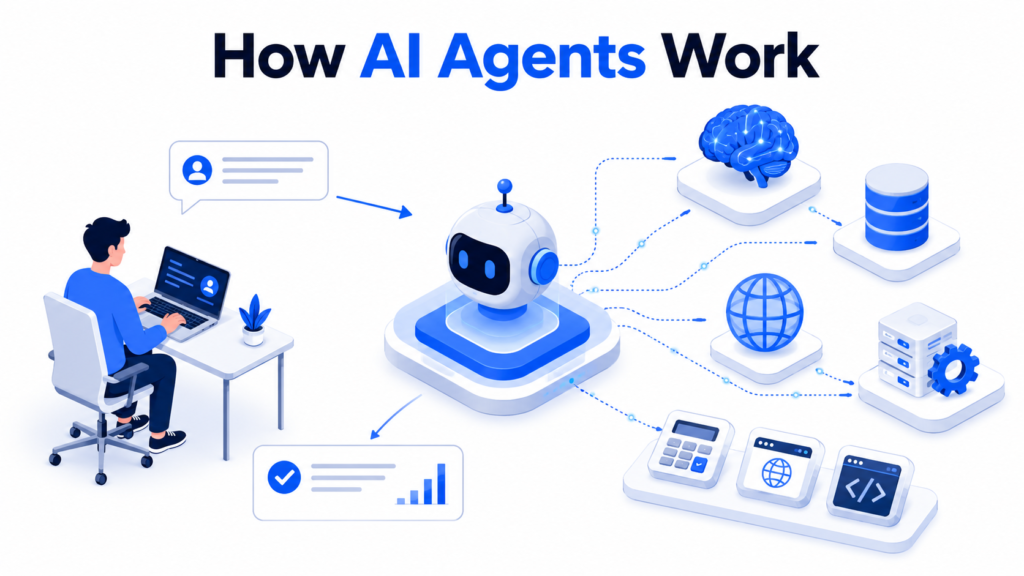
An AI agent, however, goes a step further. Instead of simply generating a response, it can break a complex task into smaller steps, search the web, compare information, use external tools, remember previous results, make decisions, and work toward completing the entire objective with minimal human guidance.
This ability to plan, reason, and take actions is what makes AI agents one of the most exciting advancements in artificial intelligence. From software development and customer support to research and business automation, AI agents are transforming how people interact with technology.
But what exactly is an AI agent? How does it think? How does it decide what to do next? And what happens behind the scenes when you give it a task?
In this guide, we’ll explore how AI agents work, their core components, their workflow, real-world examples, their limitations, and why they’re expected to shape the future of AI.
What is an AI Agent?
An AI agent is an intelligent software system that can understand a goal, make decisions, plan the steps required to achieve that goal, use external tools when needed, and continuously evaluate its progress until the task is completed.
Unlike a traditional AI chatbot that mainly generates responses to prompts, an AI agent is designed to take actions. It doesn’t stop after producing a single answer. Instead, it can reason through a problem, gather additional information, interact with other software or APIs, and adapt its approach based on new information.
Think of it like hiring a personal assistant.
If you ask a chatbot, “What’s the weather in Dubai?”, it gives you an answer.
If you ask an AI agent, “Plan my weekend trip to Dubai,” it can:
-
- Search for flights.
-
- Compare hotel prices.
-
- Check the weather forecast.
-
- Recommend places to visit.
-
- Create a day-by-day itinerary.
-
- Organize everything into a single plan.
Instead of just answering questions, the AI agent works toward achieving your objective.
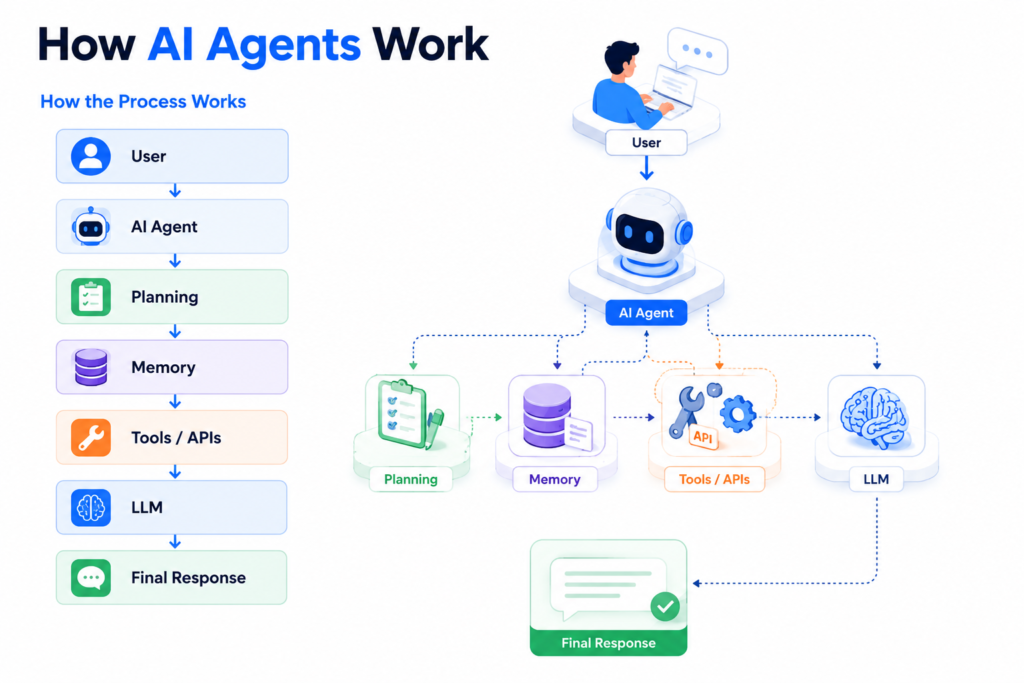
At its core, every AI agent follows a simple cycle:
-
- Understand the goal.
-
- Create a plan.
-
- Gather the required information.
-
- Use tools when necessary.
-
- Evaluate the results.
-
- Repeat the process until the task is complete.
This ability to reason, plan, use tools, and act is what separates AI agents from traditional AI systems and makes them capable of handling complex, multi-step tasks.
AI Assistant vs AI Agent
The terms AI assistant and AI agent are often used interchangeably, but they are not exactly the same.
An AI assistant is primarily designed to interact with users by answering questions, generating text, writing code, summarizing information, or helping with everyday tasks. It typically responds to one request at a time and waits for the next instruction.
An AI agent, on the other hand, is built to achieve a specific goal. Instead of stopping after generating a response, it can create a plan, decide what to do next, use external tools, gather information from multiple sources, and continue working until the objective is completed.
For example, if you ask both systems to “Build a portfolio website”:
AI Assistant
The assistant might:
-
- Explain how to build a portfolio website.
-
- Generate HTML, CSS, and JavaScript code.
-
- Suggest a design.
-
- Answer your follow-up questions.
You still need to perform most of the work yourself.
AI Agent
The agent can:
-
- Break the project into smaller tasks.
-
- Generate the website structure.
-
- Write the code.
-
- Test the application.
-
- Fix errors if they occur.
-
- Deploy the website to a hosting platform.
-
- Report back once everything is complete.
Rather than simply providing information, the agent focuses on completing the task.
Key Differences
| AI Assistant | AI Agent |
|---|---|
| Responds to prompts | Works toward achieving a goal |
| Usually handles one request at a time | Handles multiple steps automatically |
| Generates answers | Makes decisions and takes actions |
| Limited planning | Creates and updates plans |
| May use tools when instructed | Decides when and how to use tools |
| Waits for the next prompt | Continues working until the task is finished |
It’s worth noting that the line between AI assistants and AI agents is becoming increasingly blurred. Modern AI assistants, including ChatGPT, can use tools, browse the web, and automate certain workflows. However, they become AI agents when they are given the ability to plan, reason, use external tools autonomously, and execute multi-step tasks with minimal human intervention.
The 6 Core Components of an AI Agent
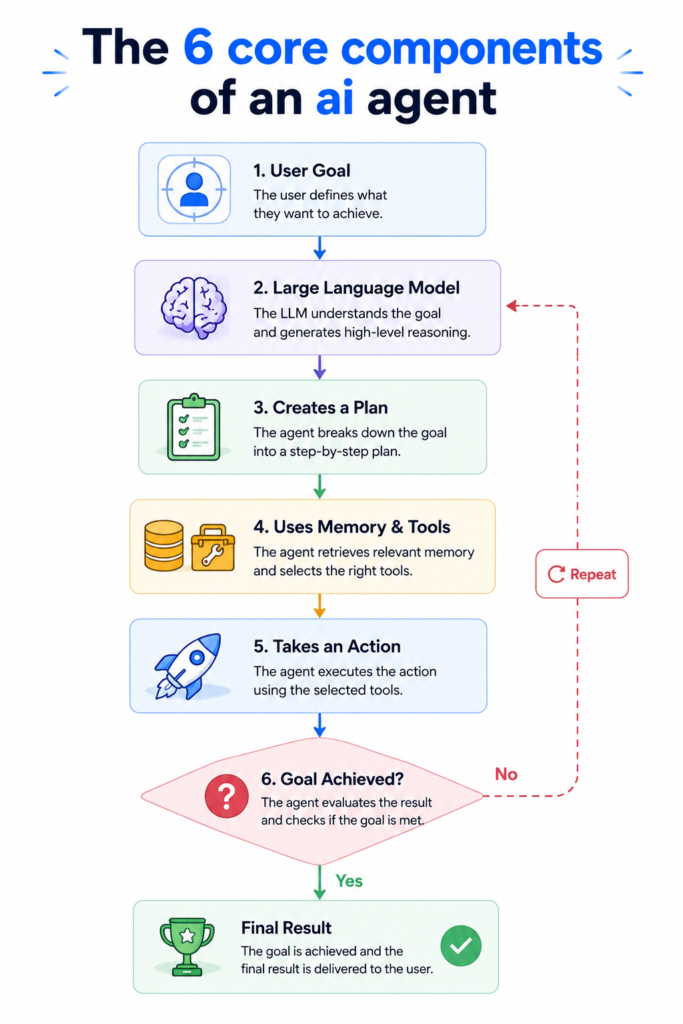
Every AI agent, whether it’s helping you write code, automate business tasks, or book a trip, is built around a few core components. These components work together to transform a simple user request into a completed task.
Let’s explore each one.
1. Goal (The Objective)
Everything starts with a goal. Instead of asking the AI to generate a single response, you give it an objective to accomplish.
For example:
“Create a professional portfolio website for a software developer.”
The AI agent’s responsibility is no longer to simply answer your question. Its job is to achieve the goal as efficiently as possible.
2. Brain (Large Language Model)
The Large Language Model (LLM) acts as the brain of the AI agent.
It understands your request, reasons about the problem, generates ideas, and decides what should happen next. Popular LLMs include OpenAI’s GPT models, Claude, Gemini, and Llama.
However, the LLM alone cannot browse the internet, access your files, or send emails. It needs other components to interact with the real world.
3. Planning
Before taking action, the AI agent creates a plan.
Instead of trying to solve everything at once, it breaks a complex task into smaller, manageable steps.
For example, if the goal is:
“Build a blog website.”
The plan might look like this:
-
- Create the homepage.
-
- Design the navigation bar.
-
- Add blog categories.
-
- Configure SEO settings.
-
- Deploy the website.
Planning helps the agent stay organized and complete tasks more reliably.
4. Memory
Memory allows an AI agent to remember important information while working.
There are generally two types of memory:
-
- Short-term memory stores information related to the current task or conversation.
-
- Long-term memory stores information that may be useful in future tasks, such as user preferences or previous interactions.
Without memory, the agent would have to start from scratch every time it receives a new instruction.
5. Tools
One of the biggest advantages of AI agents is their ability to use external tools.
These tools extend what the language model can do.
Examples include:
-
- Web browsers for searching the internet
-
- Calculators for mathematical computations
-
- Python for data analysis
-
- APIs for weather, maps, or payments
-
- Databases for retrieving information
-
- Email services for sending messages
-
- Code editors for writing and modifying software
Instead of relying only on its internal knowledge, the AI agent can gather real-time information and interact with other systems.
6. Action
Once the agent has gathered enough information, it performs the required actions.
Depending on the task, these actions could include:
-
- Sending an email.
-
- Creating a document.
-
- Booking a meeting.
-
- Writing code.
-
- Deploying an application.
-
- Updating a database.
-
- Generating a report.
After each action, the agent checks whether the goal has been achieved. If not, it continues planning, reasoning, and using tools until the task is complete.
These six components are Goal, Brain, Planning, Memory, Tools, and Action work together to make AI agents capable of solving complex, multi-step problems with minimal human guidance.
Why Are AI Agents So Powerful?
AI agents are changing the way we interact with software because they can do much more than generate text. By combining reasoning, planning, memory, and external tools, they can automate tasks that previously required constant human involvement.
Here are some of the key reasons why AI agents are so powerful.
1. They Can Handle Complex Tasks
Many real-world problems cannot be solved with a single prompt. AI agents can break large objectives into smaller tasks, solve each one step by step, and combine the results into a complete solution.
For example, instead of simply explaining how to build a website, an AI agent can generate the code, test it, fix errors, and deploy it.
2. They Can Use External Tools
Unlike traditional AI models that rely mainly on their training data, AI agents can interact with external tools and services.
They can:
-
- Search the web for the latest information.
-
- Access databases.
-
- Execute code.
-
- Analyze documents.
-
- Send emails.
-
- Call APIs.
-
- Interact with other software.
This allows them to work with real-time information and perform actions beyond text generation.
3. They Can Learn From Context
AI agents can use memory to keep track of previous steps, user preferences, and ongoing tasks.
For example, if you’re building an e-commerce website, the agent can remember your brand colors, preferred technology stack, and project requirements throughout the session instead of asking for the same information repeatedly.
4. They Reduce Manual Work
Many repetitive tasks can be automated.
Businesses already use AI agents to:
-
- Respond to customer support requests.
-
- Generate reports.
-
- Monitor systems.
-
- Schedule meetings.
-
- Process invoices.
-
- Analyze large datasets.
-
- Assist developers with coding tasks.
This saves time and allows people to focus on more creative or strategic work.
5. They Can Improve Their Results
AI agents don’t always stop after their first attempt.
They can evaluate the outcome of each step, identify mistakes, revise their plan, and try again until they reach a satisfactory result.
This iterative approach often produces more reliable outcomes than generating a single response.
Real-World Applications
Today, AI agents are being used across many industries, including:
-
- Software development
-
- Healthcare
-
- Finance
-
- Education
-
- Customer support
-
- Scientific research
-
- Cybersecurity
-
- Marketing and content creation
As AI technology continues to evolve, these systems are expected to become even more capable and handle increasingly complex workflows.
The real strength of an AI agent isn’t just its intelligence, it’s its ability to turn intelligence into action. Instead of simply answering questions, it works toward completing meaningful tasks, making it a valuable tool for both individuals and organizations.
Limitations of AI Agents
Despite their impressive capabilities, AI agents are far from perfect. While they can automate complex tasks and assist with decision-making, they still have several limitations that developers and users should understand.
1. They Can Make Mistakes
AI agents rely on large language models to reason and generate responses. Although these models are highly capable, they can still produce incorrect information, misunderstand instructions, or make poor decisions.
This is why human oversight is still important, especially for tasks involving finance, healthcare, legal advice, or critical business operations.
2. They Depend on the Quality of Their Tools
An AI agent is only as effective as the tools it can access.
For example, if a weather API returns outdated information or a search tool fails to find relevant results, the agent’s final answer may also be inaccurate.
Reliable tools and high-quality data are essential for building dependable AI agents.
3. They Don’t Truly Understand the World
AI agents can recognize patterns and generate intelligent-looking responses, but they do not possess human-like understanding, emotions, or consciousness.
They predict the most appropriate next action based on patterns in data rather than genuine comprehension or reasoning in the human sense.
4. Privacy and Security Risks
Many AI agents interact with emails, documents, databases, and online services.
If these systems are not designed with proper security measures, they could expose sensitive information or perform unintended actions.
For this reason, authentication, permissions, encryption, and human approval are often built into production AI systems.
5. Cost and Performance
Running advanced AI agents can be expensive.
Complex tasks may require multiple language model calls, API requests, database queries, and external tools. This increases computational costs and may also introduce delays before the final result is generated.
Developers must balance accuracy, speed, and cost when designing AI agent systems.
6. They Still Need Human Guidance
Although AI agents can automate many tasks, they are not completely autonomous.
They often require:
-
- Clear objectives.
-
- Well-designed workflows.
-
- Reliable tools.
-
- Human supervision for important decisions.
Rather than replacing humans entirely, AI agents are best viewed as intelligent assistants that help people work more efficiently.
The Bottom Line
AI agents are a significant step forward in artificial intelligence, but they are not magic. They can reason, plan, and perform actions, yet they can also make mistakes, depend on external systems, and require careful oversight.
Understanding these limitations helps us use AI agents more responsibly and build systems that are both powerful and trustworthy.
The Future of AI Agents
AI agents are still in their early stages, but their capabilities are improving at an incredible pace. As large language models become more powerful and tools become better integrated, AI agents are expected to handle increasingly complex tasks with greater accuracy and less human intervention.
One of the biggest trends is the rise of multi-agent systems. Instead of relying on a single AI agent, multiple specialized agents can work together, each focusing on a specific responsibility.
For example, imagine building a mobile application:
-
- One AI agent designs the user interface.
-
- Another writes the backend code.
-
- A third tests the application.
-
- A fourth reviews the code for security issues.
-
- A fifth deploys the application to the cloud.
Working together, these specialized agents can complete projects more efficiently than a single general-purpose agent.
Another important development is the integration of AI agents into everyday software. Instead of opening a separate chatbot, you’ll increasingly interact with AI agents directly inside the tools you already use—your IDE, browser, email client, project management software, and even your operating system.
For developers, AI agents are becoming valuable collaborators rather than simple code generators. They can review pull requests, write documentation, identify bugs, generate test cases, monitor applications, and automate repetitive development tasks. This allows engineers to spend more time solving complex problems and less time on routine work.
Beyond software development, AI agents are expected to play a growing role in healthcare, education, finance, scientific research, robotics, cybersecurity, and customer service. As organizations continue adopting AI-driven workflows, agents will likely become an essential part of how businesses operate.
However, greater capability also brings greater responsibility. The future of AI agents will depend not only on advances in artificial intelligence but also on strong security practices, responsible governance, transparency, and human oversight. Building trustworthy AI systems will be just as important as building intelligent ones.
Rather than replacing humans, the most likely future is one where people and AI agents work together. Humans will continue to provide creativity, critical thinking, ethics, and strategic decision-making, while AI agents handle repetitive tasks, analyze large amounts of data, and assist in executing complex workflows.
The era of AI agents has only just begun. As the technology continues to evolve, understanding how these systems work will become an increasingly valuable skill for developers, businesses, and anyone interested in the future of technology.
Conclusion
AI agents represent a major step forward in the evolution of artificial intelligence. Unlike traditional AI systems that simply respond to prompts, AI agents can understand goals, create plans, use external tools, remember context, make decisions, and perform actions to complete complex tasks.
Throughout this guide, we’ve explored how AI agents work, the core components that power them, their step-by-step workflow, real-world applications, their strengths, and their current limitations. While they are not perfect and still require human oversight, their ability to automate multi-step processes is already transforming industries ranging from software development and healthcare to education and finance.
As AI technology continues to evolve, AI agents are likely to become an integral part of our daily lives. Whether you’re a developer building intelligent applications, a student learning about modern AI, or simply someone curious about the future of technology, understanding AI agents is becoming an essential skill.
The journey doesn’t stop here. Concepts like Large Language Models (LLMs), Retrieval-Augmented Generation (RAG), Model Context Protocol (MCP), vector databases, and tool calling all play an important role in modern AI agents. We’ll explore each of these topics in dedicated articles here on S4Stack.
If you found this guide helpful, consider exploring more AI and software engineering articles on S4Stack as we continue breaking down complex technology into simple, practical, and easy-to-understand explanations.
Frequently Asked Questions (FAQ)
1. What is an AI agent?
An AI agent is a software system that can understand a goal, create a plan, make decisions, use external tools, and perform actions to complete a task with minimal human intervention. Unlike traditional AI chatbots, AI agents focus on achieving an objective rather than simply generating a response.
2. What is the difference between an AI agent and a chatbot?
A chatbot primarily answers questions and generates text based on user prompts. An AI agent goes further by planning tasks, using tools, accessing external information, and taking actions to achieve a specific goal.
3. Is ChatGPT an AI agent?
ChatGPT is primarily an AI assistant powered by a large language model. However, when it is equipped with capabilities such as tool usage, memory, planning, and autonomous task execution, it can function as an AI agent. The distinction depends on how the system is configured and used.
4. What are the main components of an AI agent?
Most AI agents consist of six core components:
-
- Goal
-
- Large Language Model (LLM)
-
- Planning
-
- Memory
-
- Tools
-
- Action
These components work together to solve complex tasks step by step.
5. Can AI agents access the internet?
Yes, if they are given the appropriate tools and permissions. AI agents can use web browsers, search engines, APIs, and databases to retrieve real-time information instead of relying only on their training data.
6. What are AI agents used for?
AI agents are used in many fields, including:
-
- Software development
-
- Customer support
-
- Data analysis
-
- Content creation
-
- Research
-
- Healthcare
-
- Finance
-
- Cybersecurity
-
- Business automation
They help automate repetitive and multi-step workflows.
7. Do AI agents learn by themselves?
Most AI agents do not automatically learn from every interaction in the way humans do. They can use memory during a task and may store information if designed to do so, but improving the underlying AI model generally requires additional training by its developers.
8. Can AI agents replace software developers?
AI agents can automate coding tasks, generate documentation, find bugs, and assist with testing, but they cannot fully replace experienced software developers. Human creativity, system design, business understanding, and critical decision-making remain essential.
9. What is Agentic AI?
Agentic AI refers to AI systems that can independently plan, reason, and take actions to achieve goals. AI agents are practical implementations of Agentic AI principles.
10. What is the future of AI agents?
AI agents are expected to become more capable, collaborative, and deeply integrated into everyday software. As models improve and tools become more powerful, AI agents will likely play a larger role in software development, business automation, education, healthcare, and many other industries while continuing to require appropriate human oversight.