Designing a machine learning system is more than choosing an algorithm and training a model. A production ML system needs reliable data, a suitable model, an inference layer, monitoring and a process for updating the model as new data arrives.
This is why machine learning system design focuses on the complete system rather than the model alone.
What Is Machine Learning System Design?
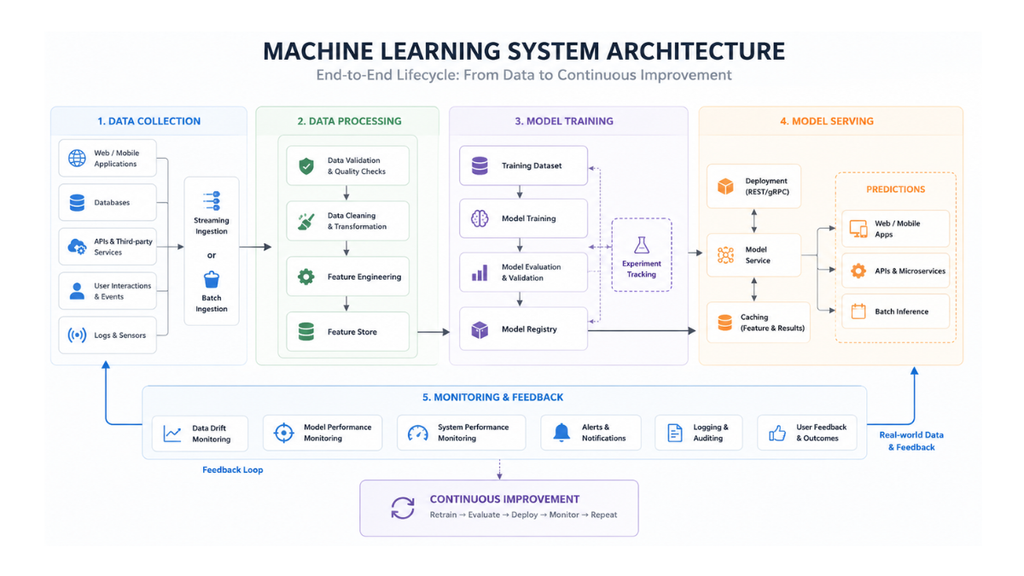
Machine learning system design is the process of planning how data, models, infrastructure and application components work together to solve a real world problem.
A typical ML system contains several connected parts:
- Data collection
- Data processing
- Feature engineering
- Model training
- Model evaluation
- Model serving
- Monitoring
- Retraining
The goal is not simply to build a model with high accuracy. The system must also be reliable, maintainable, scalable and capable of handling new data.
Google’s Rules of Machine Learning also emphasizes building a solid end to end pipeline and starting with a simple model before introducing unnecessary complexity.
1. Define the Problem and Success Metrics
Start by clearly defining what the system needs to predict or classify.
Before selecting a model, define measurable objectives such as click through rate, conversion rate or recommendation relevance.
This prevents the team from optimizing a model without knowing whether it actually improves the product.
2. Collect and Prepare Data
The quality of an ML system depends heavily on its data.
For a recommendation system, useful data could include:
- Previous purchases
- Product views
- Search queries
- Ratings
- Clicks
- Time spent on products
The raw data needs to be cleaned, transformed and converted into useful features before training.
You should also consider missing values, duplicate records, incorrect labels and changes in data distribution.
3. Choose the Model Architecture
Now you can select a model appropriate for the problem.
The right machine learning model architecture depends on factors such as:
- Type of prediction
- Amount of training data
- Latency requirements
- Accuracy requirements
- Available computing resources
- Model interpretability
Do not automatically choose the most complicated model.
A simpler model that is fast, reliable and easy to maintain can be a better production choice than a complex model that provides only a small improvement.
What Does a Machine Learning System Architecture Look Like?
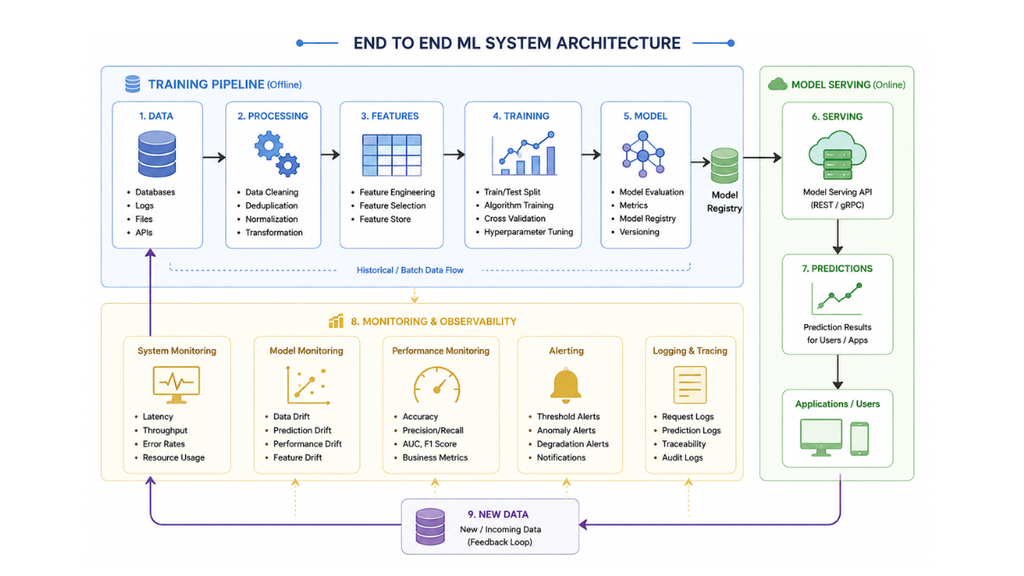
A basic ML architecture can follow this flow:
Data → Processing → Features → Training → Model → Serving → Predictions → Monitoring → New Data
4. Design the Training Pipeline
The training pipeline should make the process repeatable.
A typical pipeline includes:
- Collect new data
- Validate the data
- Transform the data
- Generate features
- Train the model
- Evaluate the model
- Compare it with the current model
- Register the approved model
This becomes particularly important when the model needs regular updates.
Google’s MLOps guidance describes automated validation, continuous training and model delivery as important parts of operating ML systems in production.
5. Design Model Serving
Once the model has been trained, users need a way to receive predictions.
There are two common approaches.
Online prediction generates a result when a user makes a request. This is useful when predictions need to reflect current information.
Batch prediction generates predictions periodically and stores the results for later use. This can be more efficient when real time predictions are unnecessary.
The decision depends on latency, cost, data freshness and application requirements.
6. Add Monitoring and Retraining
A machine learning system does not end after deployment.
Real world data changes over time. User behavior can change, products can change and the relationship between features and outcomes can shift.
Monitor metrics such as:
- Prediction quality
- Latency
- Error rate
- Data quality
- Feature distribution
- Model performance
When performance drops, the system can trigger investigation or retraining.
This is one of the major differences between traditional software and ML systems. The model depends on data, so the system needs a process for detecting when that data or model behavior changes.
How Is ML System Design Different From Traditional System Design?
Traditional system design mainly focuses on components such as databases, APIs, caching, queues and servers.
ML systems design includes these engineering concerns but adds another layer of complexity.
The system must also manage:
- Training data
- Features
- Model versions
- Model evaluation
- Training pipelines
- Prediction serving
- Model monitoring
- Retraining
Therefore, designing an ML system requires both software engineering and machine learning knowledge.
For a deeper look at AI systems, you can also read our guide on How AI Agents Work.
A Practical Example: Product Recommendation System
Consider an online store with thousands of products.
The system collects user interactions and creates features representing user preferences. A recommendation model processes these features and generates a list of products.
The architecture could look like this:
User Activity → Data Pipeline → Feature Generation → Model Training → Recommendation Model → API → User
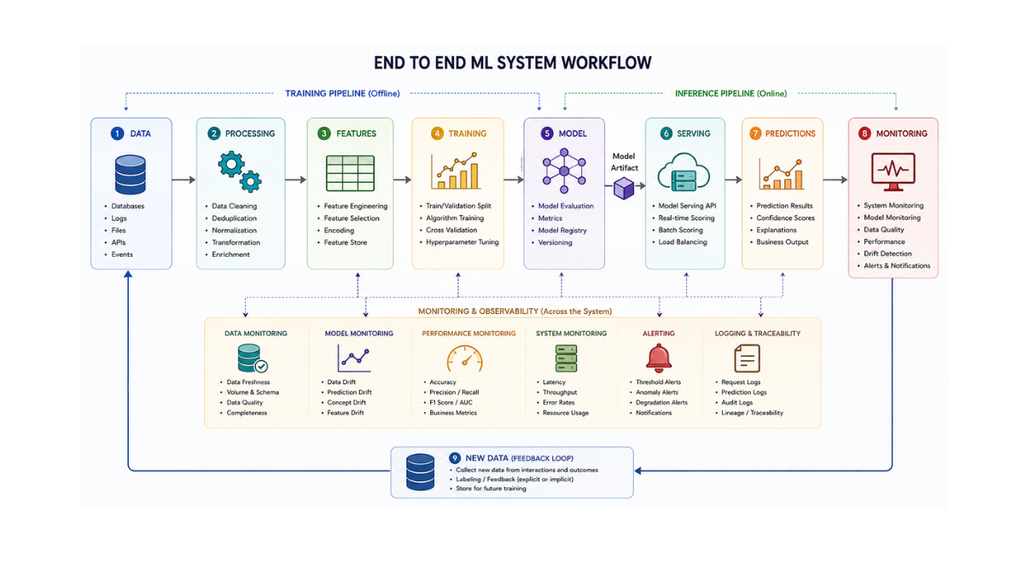
The system then records new interactions and sends them back into the data pipeline.
This creates a continuous cycle where new data can improve future recommendations.
What Makes a Good Machine Learning System Design?
A good machine learning system design balances several factors rather than focusing only on model accuracy.
The system should be:
- Accurate enough for the business objective
- Fast enough for its users
- Reliable under expected traffic
- Easy to monitor
- Easy to update
- Cost effective
- Scalable as data grows
A simple architecture with reliable data, clear metrics and a dependable deployment process can provide more value than a complex model sitting inside a poorly designed system.
Final Thoughts
Learning machine learning system design requires thinking beyond model training.
Start with the problem and measurable objectives. Build a reliable data pipeline, choose an appropriate model, design the serving layer and continuously monitor the system after deployment.
Once these fundamentals are working, you can introduce more advanced models and optimization techniques where they provide measurable value.
That approach makes ML system design practical, scalable and much closer to how machine learning systems operate in real production environments.