
Best Free Resources to Learn AI for Beginners in 2026: A Practical Learning Roadmap
Learning AI in 2026 is easier to start than ever, but choosing what to learn is becoming harder. There are thousands of courses, tutorials, YouTube videos, documentation pages, and AI tools available, yet following random resources can leave you knowing a little about everything without being able to build anything.
The better approach is to follow a structured path.
This guide brings together the best free resources to learn AI for beginners 2026 and organizes them into a practical learning roadmap. Instead of giving you a huge list of courses, we’ll look at what to learn first, which learning resources fit each stage, what to practice, and what you can safely skip.
What You Need to Know Before You Start Learning AI
You do not need to learn every part of artificial intelligence before building your first project. You also do not need advanced mathematics, deep learning, or model training on day one.
Your learning path should depend on what you want to do with AI.
If your goal is AI literacy, start with AI fundamentals, common AI tools, and generative AI. If you want to build AI applications, add Python, APIs, LLMs, retrieval, evaluation, and deployment. If you want to work closer to machine learning models, you will need stronger foundations in mathematics, statistics, data, and machine learning algorithms.
The important distinction is between learning about AI and learning to build with AI. The first gives you concepts; the second requires programming, experimentation, debugging, and real projects.
You should therefore treat AI learning as a progression rather than a collection of courses.
Stage 1: Learn AI Fundamentals
Start by understanding what artificial intelligence actually includes.
At this stage, you should understand the relationship between artificial intelligence, machine learning, deep learning, and generative AI. You should also understand basic ideas such as models, training data, inference, neural networks, supervised learning, and unsupervised learning.
You do not need to memorize mathematical formulas yet. Your goal is to build a mental model of how modern AI systems work.
For a broad introduction, Google AI’s learning resources provide beginner-oriented AI learning resources, including AI literacy training for students and educators. Google currently provides foundational material alongside more applied learning experiences.
Another useful starting point is Generative AI for Everyone by DeepLearning.AI, which introduces generative AI, its applications, and practical concepts without making advanced programming a prerequisite.
At the end of this stage, you should be able to explain what a machine learning model does, why training data matters, how neural networks fit into modern AI, and how generative AI differs from traditional machine learning.
Do not move forward simply because you finished a course. Move forward when you can explain the concepts without constantly looking them up.
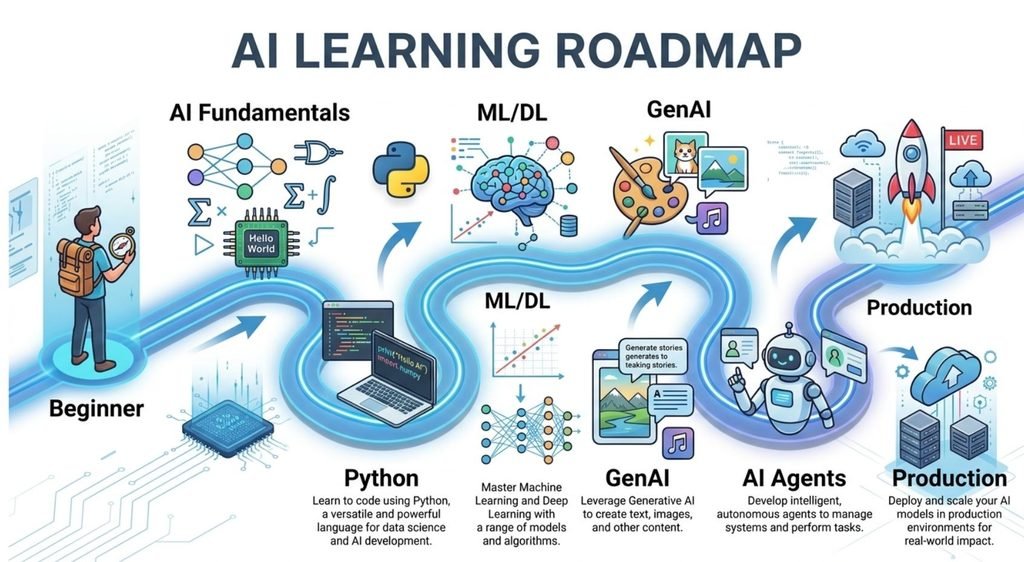
Stage 2: Build Your Technical Foundation
Once you understand the basics, learn the technical skills that allow you to actually work with AI.
For most beginners, Python for AI is the most useful programming foundation. Learn variables, functions, conditions, loops, lists, dictionaries, files, modules, and basic object-oriented programming. Then move into NumPy, pandas, data visualization, and basic data wrangling.
You do not need to become an expert Python developer before starting machine learning. You need enough Python programming knowledge to read code, modify it, debug it, and write small programs independently.
Kaggle Learn is particularly useful here because its courses are short and hands-on. Its current Python course covers syntax, functions, conditionals, lists, loops, dictionaries, and external libraries, while its broader catalog includes machine learning, deep learning, NLP, model evaluation, and AI ethics. Kaggle currently lists these Learn courses as having no cost.
After Python, learn the mathematical foundations that actually appear in AI: basic algebra, probability, statistics, and linear algebra. Calculus becomes more useful when you go deeper into neural networks and optimization, but you do not need to spend months mastering advanced calculus before writing your first model.
If you want a more practical route, learn mathematics alongside machine learning instead of trying to finish an entire mathematics curriculum first.
For beginners specifically searching for the best free resources to learn Python for AI beginners 2026, a hands-on course such as Kaggle’s Python curriculum can be more useful initially than a long theoretical programming course.
Stage 3: Learn Machine Learning and Deep Learning
Now move from programming to machine learning.
Start with supervised and unsupervised learning, training and validation data, regression, classification, overfitting, model evaluation, feature engineering, and basic machine learning algorithms.
Kaggle’s Intro to Machine Learning is a practical starting point. Its current course covers model fundamentals, data exploration, building a first model, validation, overfitting, random forests, and machine learning competitions. Kaggle currently lists the course at an estimated three hours and no cost.
Google’s Machine Learning Crash Course is another useful option when you want more technical depth. Its curriculum covers core machine learning concepts and extends into neural networks, embeddings, large language models, production ML systems, and fairness.
After traditional machine learning, learn deep learning and neural networks. First understand neurons, layers, activation functions, loss, gradient descent, backpropagation, and how a neural network learns patterns from data.
This is also where you can start exploring specialized areas such as NLP and computer vision if they match your interests.
The key is to build something after each major concept. A small classification or regression project will teach you more than watching another ten hours of lectures without writing code.
Stage 4: Learn Generative AI and LLM Applications
Once you understand the fundamentals, start building with generative AI.
This stage is particularly important for developers because you can create useful applications without training a foundation model yourself.
Learn how LLMs work at a practical level, then move into prompt engineering, structured outputs, embeddings, retrieval, RAG, APIs, tool calling, and basic evaluation.
For prompt engineering, focus on writing clear instructions, providing useful context, defining output requirements, and testing different prompts rather than collecting prompt tricks.
You can also begin using AI-assisted Python programming at this stage. Tools such as AI coding assistants can explain code, generate alternatives, and help with debugging, but they should accelerate your learning rather than replace it.
At this stage, you can build projects such as document Q&A systems, summarization applications, chatbots, semantic search, or simple multimodal applications.
If you want to understand retrieval more deeply, S4Stack’s RAG architecture guide can complement your learning once you reach embeddings and retrieval.
For learners searching for the best free resources to learn AI prompt engineering 2026, prioritize resources that explain prompting as part of a larger LLM application workflow rather than treating prompt engineering as a collection of magic phrases.
Stage 5: Build AI Systems and Agents
After learning how individual AI components work, start connecting them into complete systems.
This is where AI agents, agentic AI, tool calling, memory, retrieval, orchestration, evaluation, and workflow building become important.
An AI agent is more than a chatbot that generates text. An agent can use an LLM to interpret a task, select tools, take actions, observe results, and continue working toward an objective.
The Hugging Face AI Agents Course is currently available as a free course and covers agent fundamentals, tools, actions, frameworks, real-world use cases, hands-on assignments, and evaluation. Its prerequisites include basic Python and basic LLM knowledge.
The course also covers frameworks including smolagents, LlamaIndex, and LangGraph, while later material includes agent observability and evaluation.
You also do not need an agent framework for every application. Simple workflows can often be implemented with ordinary code, while frameworks become more useful as the system requires more complex orchestration.
Once you reach this stage, you should also learn how to evaluate and monitor AI systems rather than focusing only on whether a demo works.
S4Stack’s AI agent testing guide and AI agent monitoring guide can help you move from prototypes toward more reliable AI systems.
AI Project Ideas for Beginners
Courses give you knowledge. Projects turn that knowledge into skills.
Your first projects should be small enough to finish but complex enough to force you to use what you learned.
After Python and machine learning, try a prediction or classification project using a real dataset. After learning deep learning, build a small neural-network application. After learning generative AI, build a document Q&A application, summarizer, chatbot, or structured data extraction tool.
Once you understand APIs and tool calling, build a simple AI agent that can perform a limited task using one or two tools.
The progression matters more than the complexity.
For AI project ideas for beginners, choose projects that force you to work with data, write code, debug errors, evaluate results, and explain your design decisions. If you are specifically looking for artificial intelligence project ideas for beginners, avoid projects that are nothing more than copying a tutorial and changing the UI.
A good project should leave you with something you can explain from beginning to end.
Best Free Resources to Learn AI in 2026
There is no single resource that teaches all of AI well. A better approach is to combine a few resources based on your current stage.
Kaggle Learn is particularly useful for Python, data science, machine learning, deep learning, and hands-on exercises. Its current catalog includes Python, introductory machine learning, intermediate machine learning, deep learning, NLP, model evaluation, AI ethics, and other practical topics.
Google’s Machine Learning Crash Course is useful when you want a structured technical introduction to machine learning with interactive exercises and a curriculum that extends into neural networks, embeddings, LLMs, production ML systems, and fairness.
DeepLearning.AI is valuable when you want focused courses on modern AI topics. Its course catalog covers areas including generative AI, agents, RAG, evaluation, multimodal systems, and other AI engineering topics.
Hugging Face Learn becomes especially useful once you move toward LLMs and AI agents. Its Agents Course combines theory, hands-on work, frameworks, use cases, assignments, and evaluation.
Google AI is useful for beginners who want AI literacy and introductory material before moving into deeper technical learning. Its current learning hub includes resources for students, educators, and families, along with foundational and applied AI learning experiences.
You can also use high-quality YouTube channels for difficult concepts, but treat videos as supplementary material rather than your entire curriculum. When searching for the best YouTube channels to learn AI, prioritize channels that explain concepts, demonstrate implementation, and encourage hands-on work instead of channels focused entirely on AI news or tool announcements.
What You Should Skip When Learning AI
The biggest mistake is confusing consuming content with learning.
You do not need five Python courses. You do not need to watch every new AI tutorial. You do not need to learn every machine learning algorithm before building a project, and you do not need to train a large language model from scratch to become useful at AI engineering.
Avoid constantly switching between frameworks because a new AI tool is trending.
Do not spend months collecting certificates while avoiding code.
And do not use AI coding tools so heavily that you cannot explain the code they produce.
You should also avoid starting with advanced topics simply because they are popular. Agentic AI, fine-tuning, multimodal systems, and complex RAG architectures are much easier to understand when you already know the underlying concepts.
The goal is not to learn the largest possible number of AI topics. The goal is to develop enough understanding to build, evaluate, debug, and improve real systems.
How to Turn AI Learning Into Real Skills
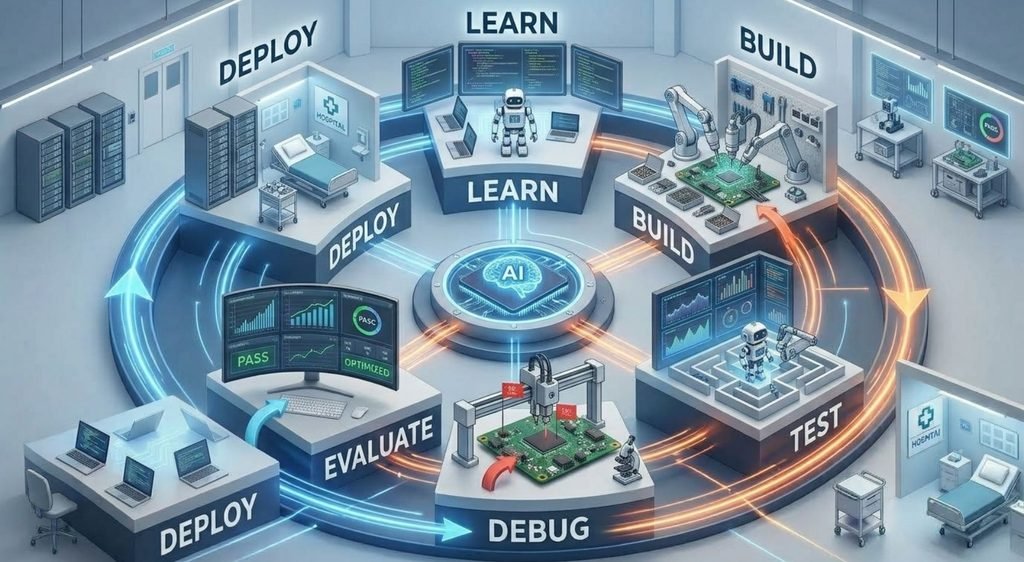
The most effective AI learning loop is simple:
Learn → build → break → debug → evaluate → improve.
Learn a concept, implement something small, deliberately experiment with it, investigate why it fails, and then improve the system.
For example, after learning machine learning, do not immediately start another course. Take a dataset and build a model. Measure its performance. Investigate errors. Change the features. Try another algorithm.
Do the same with generative AI. Build an LLM application, test different prompts, inspect incorrect outputs, improve the context, and measure whether the changes actually helped.
Eventually, your projects should become more complete end-to-end systems that include data, models, APIs, interfaces, evaluation, security, and deployment.
This is also where concepts such as AI ethics, bias, fairness, privacy, transparency, explainability, and responsible AI become practical rather than theoretical. A useful AI system is not simply one that produces impressive outputs; it should also behave reliably within the environment where people use it.
If your long-term goal is an AI engineer career, this progression is particularly valuable because modern AI engineering combines software development with model integration, LLM applications, evaluation, deployment, and system design.
You do not need to finish every stage before starting the next one. Learn enough, build something, discover what you don’t understand, and return to the relevant foundation.
That is a much more sustainable way to learn AI in 2026 than trying to memorize the entire field before writing your first real project.
FAQs
Which is the best AI course for beginners free?
Google’s Machine Learning Crash Course and free beginner courses from platforms like Coursera and edX are good starting points.
How to start learning AI in 2026?
Start with Python, mathematics, machine learning basics, and hands-on projects, then gradually move into deep learning and generative AI.
How can I learn AI by myself?
Follow a structured AI learning roadmap, use free courses and documentation, and build small projects to apply what you learn.
Which AI tool is best to learn in 2026?
Learn widely used AI tools such as ChatGPT, Gemini, Claude, and GitHub Copilot while focusing on the underlying AI concepts.
What AI is 100% free?
Several AI tools offer free plans, but their features and usage limits vary, so check each tool’s current free-tier terms.