
Introduction
AI agents are already part of everyday life even if you don’t realize it. When ChatGPT plans a trip, GitHub Copilot writes code, or an AI assistant schedules meetings automatically, you’re interacting with AI agents.
These systems don’t just answer questions. They can plan, reason, use tools, and complete tasks from start to finish.
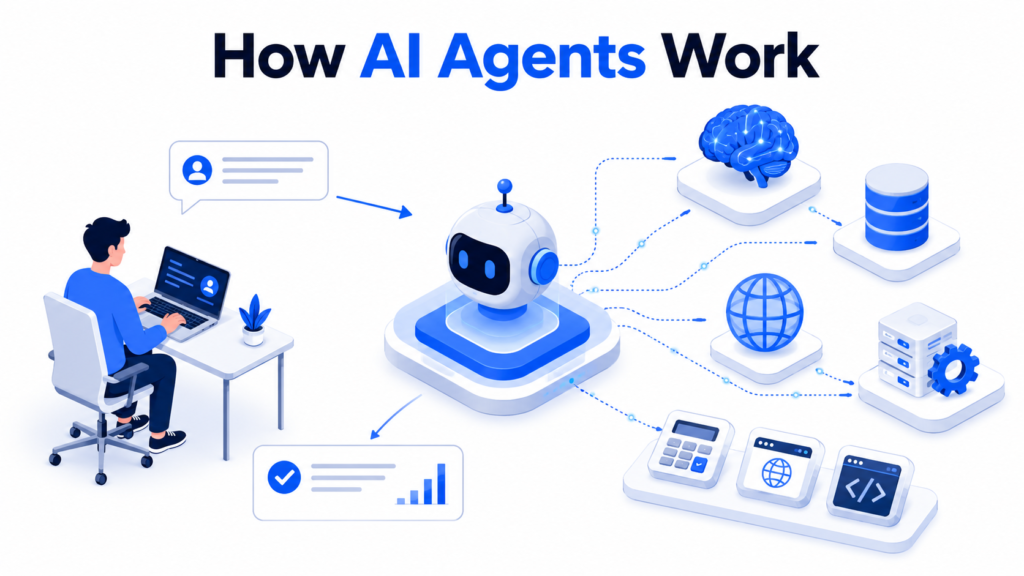
In this guide, you’ll discover 21 real AI agents examples, learn how AI agents work, understand their core components, explore their strengths and limitations, and see why they’re becoming one of the most important technologies in artificial intelligence.
What is an AI Agent?
An AI agent is an intelligent software system that can understand a goal, make decisions, plan the steps required to achieve that goal, use external tools when needed, and continuously evaluate its progress until the task is completed.
Unlike a traditional AI chatbot that mainly generates responses to prompts, an AI agent is designed to take actions. It doesn’t stop after producing a single answer. Instead, it can reason through a problem, gather additional information, interact with other software or APIs, and adapt its approach based on new information.
Think of it like hiring a personal assistant.
If you ask a chatbot, “What’s the weather in Dubai?”, it gives you an answer.
If you ask an AI agent, “Plan my weekend trip to Dubai,” it can:
-
- Search for flights.
-
- Compare hotel prices.
-
- Check the weather forecast.
-
- Recommend places to visit.
-
- Create a day-by-day itinerary.
-
- Organize everything into a single plan.
Instead of just answering questions, the AI agent works toward achieving your objective.
At its core, every AI agent follows a simple cycle:
-
- Understand the goal.
-
- Create a plan.
-
- Gather the required information.
-
- Use tools when necessary.
-
- Evaluate the results.
-
- Repeat the process until the task is complete.
This ability to reason, plan, use tools, and act is what separates AI agents from traditional AI systems and makes them capable of handling complex, multi-step tasks.
Before exploring real AI agents examples, it’s important to understand what makes a system an AI agent. Every example in this article follows the same basic principles: understanding a goal, creating a plan, using tools when needed, and taking actions until the objective is completed.
AI Assistant vs AI Agent
The terms AI assistant and AI agent are often used interchangeably, but they are not exactly the same.
An AI assistant is primarily designed to interact with users by answering questions, generating text, writing code, summarizing information, or helping with everyday tasks. It typically responds to one request at a time and waits for the next instruction.
An AI agent, on the other hand, is built to achieve a specific goal. Instead of stopping after generating a response, it can create a plan, decide what to do next, use external tools, gather information from multiple sources, and continue working until the objective is completed.
For example, if you ask both systems to “Build a portfolio website”:
AI Assistant
The assistant might:
-
- Explain how to build a portfolio website.
-
- Generate HTML, CSS, and JavaScript code.
-
- Suggest a design.
-
- Answer your follow-up questions.
You still need to perform most of the work yourself.
AI Agent
The agent can:
-
- Break the project into smaller tasks.
-
- Generate the website structure.
-
- Write the code.
-
- Test the application.
-
- Fix errors if they occur.
-
- Deploy the website to a hosting platform.
-
- Report back once everything is complete.
Rather than simply providing information, the agent focuses on completing the task.
Key Differences
| AI Assistant | AI Agent |
|---|---|
| Responds to prompts | Works toward achieving a goal |
| Usually handles one request at a time | Handles multiple steps automatically |
| Generates answers | Makes decisions and takes actions |
| Limited planning | Creates and updates plans |
| May use tools when instructed | Decides when and how to use tools |
| Waits for the next prompt | Continues working until the task is finished |
It’s worth noting that the line between AI assistants and AI agents is becoming increasingly blurred. Modern AI assistants, including ChatGPT, can use tools, browse the web, and automate certain workflows. However, they become AI agents when they are given the ability to plan, reason, use external tools autonomously, and execute multi-step tasks with minimal human intervention.
Understanding this distinction will make the upcoming AI agents examples much easier to understand because you’ll see exactly why each system qualifies as an AI agent rather than a traditional chatbot.
How AI Agents Work (Step by Step)
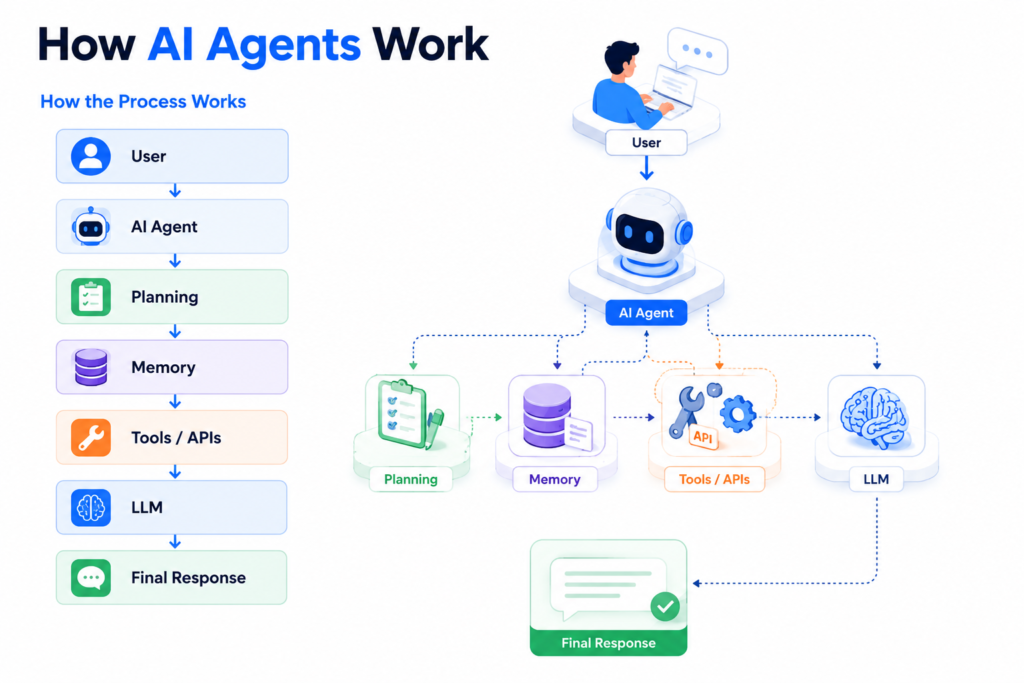
At first glance, an AI agent may seem like an advanced chatbot. In reality, it follows a structured workflow that allows it to solve complex problems instead of simply responding to a prompt. Rather than generating a single answer, an AI agent continuously plans, acts, evaluates, and improves its progress until it achieves the user’s goal.
Whether it’s booking a vacation, analyzing business data, or writing software, modern AI agents follow the same fundamental process. Let’s explore each step in detail.
Step 1: The User Provides a Goal
Every AI agent begins with a goal. Unlike traditional software that requires precise commands, AI agents are designed to understand objectives expressed in natural language.
For example, instead of asking:
“Find a hotel.”
A user might say:
“Plan a 5-day trip to Dubai next month, including flights, a hotel near Burj Khalifa, and a day-by-day itinerary.”
This isn’t a simple question—it is a complex objective containing multiple tasks. The AI agent’s responsibility is to determine everything required to accomplish that goal.
Step 2: The Large Language Model Understands the Request
Once the goal is received, the Large Language Model (LLM) acts as the brain of the AI agent. It analyzes the user’s request, identifies the intent, extracts important details, and determines what information is missing.
Instead of treating the prompt as a single instruction, the LLM recognizes that the task involves several independent activities, such as searching for flights, comparing hotels, checking the weather, and organizing an itinerary.
At this stage, the AI agent doesn’t perform any actions yet—it focuses on understanding the problem before deciding how to solve it.
Step 3: The Agent Creates a Plan
After understanding the objective, the AI agent creates a step-by-step execution plan. Breaking a large task into smaller, manageable steps makes the process more reliable and easier to monitor.
For the Dubai trip example, the plan could look like this:
- Search for available flights.
- Compare hotel prices and ratings.
- Check the weather forecast.
- Find popular tourist attractions.
- Organize activities into a five-day schedule.
- Present everything in a single travel plan.
Planning allows the AI agent to stay organized and adjust its strategy if new information becomes available during execution.
Step 4: Memory Provides Context
Before moving forward, the AI agent consults its memory.
Short-term memory stores information related to the current task, such as the destination, travel dates, preferred budget, or selected hotel.
Long-term memory, when available, may contain user preferences from previous interactions—for example, preferred airlines, favorite programming languages, or frequently visited locations.
Memory prevents the AI agent from repeating work and enables it to make more personalized decisions throughout the workflow.
Step 5: The Agent Selects the Right Tools
Large Language Models cannot directly browse the internet, access databases, send emails, or execute code on their own. To interact with the real world, AI agents use external tools.
Depending on the task, an AI agent may choose tools such as:
- Web search engines for real-time information
- Weather APIs for forecasts
- Maps for navigation
- Python for calculations or data analysis
- Databases for retrieving records
- Email services for communication
- Code editors and deployment tools for software development
One of the defining characteristics of AI agents is that they can determine which tools to use and when to use them, instead of waiting for explicit instructions from the user.
Step 6: The Agent Executes Actions
With a plan in place and the necessary tools selected, the AI agent begins executing each task.
It may search the web, call APIs, analyze files, generate code, create reports, or interact with other software systems. Every completed action produces new information that helps the agent move closer to its objective.
Unlike traditional chatbots that stop after generating text, AI agents continue working until meaningful progress has been made.
Step 7: The Agent Observes the Results
Execution is only part of the process. After every action, the AI agent evaluates the outcome.
For example:
- Did the flight search return enough options?
- Was the selected hotel within the user’s budget?
- Did the generated code compile successfully?
- Did the API request return valid data?
This observation step allows the AI agent to detect problems before moving forward.
Step 8: The Agent Decides What to Do Next
Based on the results, the AI agent reasons about its next action.
If everything is working as expected, it proceeds to the next step in the plan.
If something goes wrong—such as a failed API request, missing information, or an unexpected error—it modifies its strategy, chooses a different tool, or retries the task using a new approach.
This ability to adapt makes AI agents far more flexible than traditional rule-based automation systems.
Step 9: The Process Repeats Until the Goal Is Complete
Complex objectives rarely finish after a single action.
Instead, AI agents continuously repeat the cycle of planning, tool usage, execution, observation, and decision-making until every requirement has been satisfied.
This iterative workflow enables AI agents to handle sophisticated, multi-step tasks with minimal human intervention.
Step 10: The Final Result Is Delivered
Once all planned tasks have been completed successfully, the AI agent combines the results into a final response.
Instead of returning isolated pieces of information, it delivers a complete solution. In the travel example, this could include flight recommendations, hotel comparisons, weather forecasts, tourist attractions, and a detailed five-day itinerary presented as a single organized plan.
This goal-oriented workflow is what separates AI agents from traditional AI assistants. Rather than simply answering questions, AI agents reason, plan, use tools, evaluate progress, and continue working until the objective is achieved.
The 6 Core Components of an AI Agent
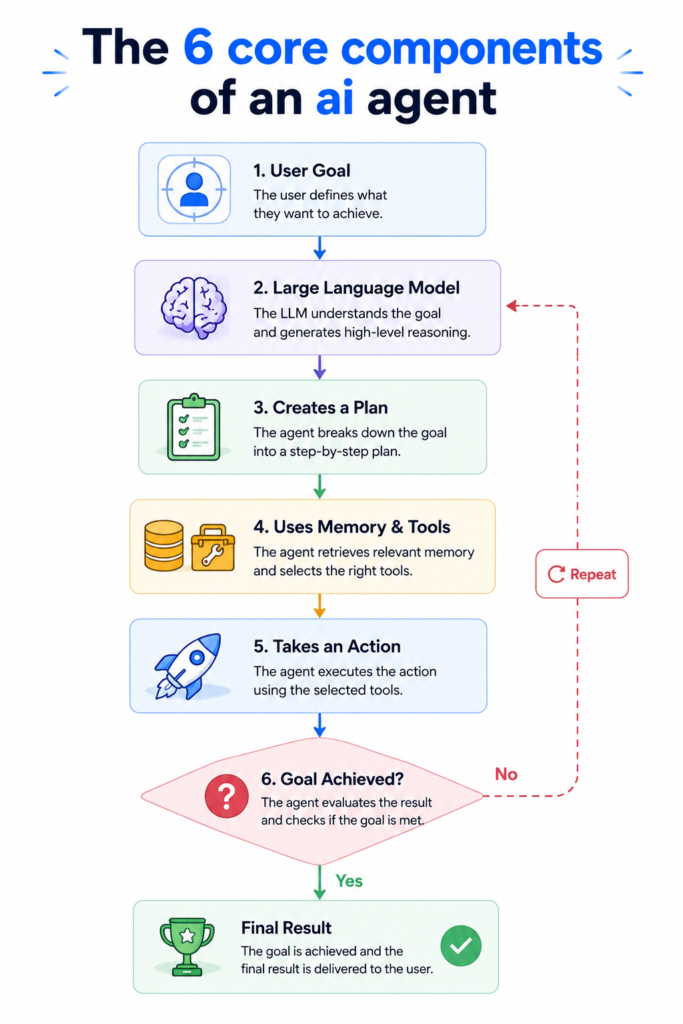
Every AI agents example you’ll see later in this guide is built on these six components. Whether it’s a coding assistant or a travel planner, the same architecture powers modern AI agents.
Let’s explore each one.
1. Goal (The Objective)
Everything starts with a goal. Instead of asking the AI to generate a single response, you give it an objective to accomplish.
For example:
“Create a professional portfolio website for a software developer.”
The AI agent’s responsibility is no longer to simply answer your question. Its job is to achieve the goal as efficiently as possible.
2. Brain (Large Language Model)
The Large Language Model (LLM) acts as the brain of the AI agent.
It understands your request, reasons about the problem, generates ideas, and decides what should happen next. Popular LLMs include OpenAI’s GPT models, Claude, Gemini, and Llama.
However, the LLM alone cannot browse the internet, access your files, or send emails. It needs other components to interact with the real world.
3. Planning
Before taking action, the AI agent creates a plan.
Instead of trying to solve everything at once, it breaks a complex task into smaller, manageable steps.
For example, if the goal is:
“Build a blog website.”
The plan might look like this:
-
- Create the homepage.
-
- Design the navigation bar.
-
- Add blog categories.
-
- Configure SEO settings.
-
- Deploy the website.
Planning helps the agent stay organized and complete tasks more reliably.
4. Memory
Memory allows an AI agent to remember important information while working.
There are generally two types of memory:
-
- Short-term memory stores information related to the current task or conversation.
-
- Long-term memory stores information that may be useful in future tasks, such as user preferences or previous interactions.
Without memory, the agent would have to start from scratch every time it receives a new instruction.
5. Tools
One of the biggest advantages of AI agents is their ability to use external tools.
These tools extend what the language model can do.
Examples include:
-
- Web browsers for searching the internet
-
- Calculators for mathematical computations
-
- Python for data analysis
-
- APIs for weather, maps, or payments
-
- Databases for retrieving information
-
- Email services for sending messages
-
- Code editors for writing and modifying software
Instead of relying only on its internal knowledge, the AI agent can gather real-time information and interact with other systems.
6. Action
Once the agent has gathered enough information, it performs the required actions.
Depending on the task, these actions could include:
-
- Sending an email.
-
- Creating a document.
-
- Booking a meeting.
-
- Writing code.
-
- Deploying an application.
-
- Updating a database.
-
- Generating a report.
After each action, the agent checks whether the goal has been achieved. If not, it continues planning, reasoning, and using tools until the task is complete.
These six components are Goal, Brain, Planning, Memory, Tools, and Action work together to make AI agents capable of solving complex, multi-step problems with minimal human guidance.
AI Agents Examples: 21 Real-World Applications You Should Know
Now that you understand how AI agents work, let’s explore some of the best AI agents examples used today. These examples show that AI agents are no longer experimental—they’re already transforming software development, business operations, healthcare, research, and everyday life.
Although each AI agent serves a different purpose, they all follow the same core workflow: understand a goal, create a plan, use memory, select tools, take actions, evaluate results, and repeat until the objective is achieved.
AI Agents Examples in Software Development
Software development is one of the fastest-growing areas for AI agents. These systems help developers write code, find bugs, automate testing, and even deploy applications.
1. ChatGPT with Tools
What it does
When equipped with tools like web browsing, Python, file analysis, and external APIs, ChatGPT can perform much more than answering questions. It can analyze documents, generate reports, debug code, automate workflows, and complete multi-step tasks.
Why it’s an AI agent
Instead of responding with a single answer, it plans the required steps, decides when to use tools, evaluates results, and continues working until the task is complete.
Core components used
-
Goal
-
LLM
-
Planning
-
Memory
-
Tools
-
Action
2. GitHub Copilot
What it does
GitHub Copilot assists developers by suggesting code, generating functions, explaining existing code, and helping fix programming errors.
Why it’s an AI agent
Modern versions understand project context, reason about programming tasks, and assist throughout the software development process instead of simply predicting the next line of code.
Core components used
-
Goal
-
LLM
-
Memory
-
Planning
-
Action
3. Cursor AI
What it does
Cursor AI understands an entire codebase, edits multiple files, explains architecture, refactors code, and assists developers inside their editor.
Why it’s an AI agent
It analyzes the project’s context, plans changes across files, executes edits, and continuously improves the solution based on developer feedback.
Core components used
-
Goal
-
Planning
-
Memory
-
Tools
-
Action
4. Devin AI
What it does
Devin is designed to function as an autonomous software engineering agent. It can plan software projects, write code, debug applications, execute tests, and deploy completed projects.
Why it’s an AI agent
Rather than assisting with individual coding tasks, Devin works toward completing an entire software development objective with minimal supervision.
Core components used
-
Goal
-
Planning
-
Memory
-
Tools
-
Action
-
Observation
AI Agents Examples for Productivity
Productivity-focused AI agents help users complete everyday work faster by automating repetitive tasks and organizing information.
5. Microsoft Copilot
What it does
Microsoft Copilot works across Word, Excel, Outlook, Teams, and PowerPoint. It summarizes documents, drafts emails, analyzes spreadsheets, and creates presentations.
Why it’s an AI agent
It understands user intent, accesses organizational data, performs actions across multiple applications, and automates business workflows.
Core components used
-
Goal
-
Memory
-
Tools
-
Action
-
Planning
6. Google Gemini
What it does
Google Gemini assists users across Gmail, Docs, Drive, Calendar, and other Google services by organizing information and completing tasks.
Why it’s an AI agent
Instead of simply generating responses, it connects multiple Google services to accomplish larger objectives.
Core components used
-
Goal
-
Planning
-
Memory
-
Tools
-
Action
7. Claude
What it does
Claude specializes in understanding long documents, analyzing reports, summarizing research papers, and assisting with reasoning-intensive tasks.
Why it’s an AI agent
It processes large amounts of information, reasons through complex problems, and produces structured outputs aligned with the user’s objective.
Core components used
-
Goal
-
LLM
-
Memory
-
Planning
AI Agents Examples in Business
Businesses increasingly use AI agents to automate routine operations and improve productivity.
8. Customer Support Agent
What it does
AI customer support agents answer questions, resolve common issues, create support tickets, and escalate complex cases to human representatives.
Why it’s an AI agent
It understands customer requests, retrieves relevant information, decides the best response, and continues assisting until the issue is resolved.
Core components used
-
Goal
-
Memory
-
Tools
-
Action
9. Email Automation Agent
What it does
These agents organize inboxes, prioritize important messages, draft replies, schedule meetings, and send follow-up emails automatically.
Why it’s an AI agent
Instead of filtering emails using fixed rules, it reasons about priorities and performs actions based on user preferences.
Core components used
-
Goal
-
Planning
-
Memory
-
Tools
-
Action
10. HR Agent
What it does
HR agents screen resumes, schedule interviews, answer employee questions, and assist with onboarding new hires.
Why it’s an AI agent
It automates multiple recruitment tasks while adapting its workflow according to company requirements.
Core components used
-
Goal
-
Planning
-
Memory
-
Tools
-
Action
11. Finance Agent
What it does
Finance agents analyze expenses, generate financial reports, detect unusual transactions, and assist with budgeting.
Why it’s an AI agent
They combine data analysis with reasoning to help organizations make better financial decisions.
Core components used
-
Goal
-
Memory
-
Planning
-
Tools
-
Action
12. Marketing Agent
What it does
Marketing agents generate content ideas, analyze campaign performance, optimize advertisements, and recommend marketing strategies.
Why it’s an AI agent
They continuously evaluate campaign results and adjust recommendations to improve business outcomes.
Core components used
-
Goal
-
Planning
-
Memory
-
Tools
-
Observation
AI Agents Examples in Research
Research often requires gathering information from multiple sources, making it an ideal application for AI agents.
13. Perplexity AI
What it does
Perplexity AI searches the web, gathers reliable sources, summarizes information, and provides references.
Why it’s an AI agent
It plans search strategies, retrieves information, evaluates sources, and combines findings into a single answer.
Core components used
-
Goal
-
Planning
-
Tools
-
Observation
14. Research Agents
What they do
Research agents collect information from academic papers, websites, reports, and databases before creating comprehensive summaries.
Why they’re AI agents
They repeatedly search, analyze, compare, and refine results until enough evidence has been collected.
Core components used
-
Goal
-
Planning
-
Memory
-
Tools
-
Action
15. Document Analysis Agents
What they do
These agents extract information from contracts, PDFs, invoices, medical records, and legal documents.
Why they’re AI agents
They understand document structure, retrieve important information, answer questions, and automate document processing.
Core components used
-
Goal
-
LLM
-
Memory
-
Tools
-
Action
AI Agents Examples in Healthcare
Healthcare organizations increasingly rely on AI agents to improve efficiency while supporting medical professionals.
16. Medical Diagnosis Assistants
What they do
These systems analyze symptoms, medical history, and diagnostic reports to assist healthcare professionals with clinical decision-making.
Why they’re AI agents
They combine reasoning, medical knowledge, and patient data to generate evidence-based recommendations.
Core components used
-
Goal
-
Planning
-
Memory
-
Tools
-
Observation
17. Hospital Scheduling Agents
What they do
Scheduling agents coordinate appointments, assign hospital resources, manage staff availability, and reduce scheduling conflicts.
Why they’re AI agents
They continuously adapt schedules as new appointments, emergencies, and cancellations occur.
Core components used
-
Goal
-
Planning
-
Memory
-
Tools
-
Action
AI Agents Examples in Everyday Life
AI agents are becoming part of everyday experiences, helping people save time and automate routine tasks.
18. Travel Planning Agent
What it does
A travel planning agent searches for flights, compares hotels, checks weather forecasts, recommends attractions, and creates complete travel itineraries.
Why it’s an AI agent
It coordinates multiple services and continues working until the travel plan is complete.
Core components used
-
Goal
-
Planning
-
Memory
-
Tools
-
Action
19. Smart Home Agent
What it does
Smart home agents control lighting, security systems, heating, entertainment devices, and energy usage based on user preferences.
Why it’s an AI agent
It observes environmental conditions, makes decisions, and automates actions without requiring constant user input.
Core components used
-
Goal
-
Memory
-
Tools
-
Observation
-
Action
20. Shopping Agent
What it does
Shopping agents compare prices, recommend products, monitor discounts, and help users make purchasing decisions.
Why it’s an AI agent
Instead of simply displaying products, it evaluates options based on budget, preferences, reviews, and availability.
Core components used
-
Goal
-
Planning
-
Memory
-
Tools
-
Action
21. Autonomous Vehicles
What they do
Self-driving vehicles continuously monitor their surroundings, recognize traffic signals, detect obstacles, plan safe routes, and control the vehicle in real time.
Why they’re AI agents
They constantly observe the environment, make decisions, execute actions, and adapt to changing road conditions without direct human control.
Core components used
-
Goal
-
Planning
-
Memory
-
Tools (Sensors & Cameras)
-
Observation
-
Action
What These AI Agents Examples Have in Common
Although these AI agents examples serve different industries, they all follow the same intelligent workflow:
-
They understand a goal.
-
They create a plan.
-
They remember relevant context.
-
They use external tools when necessary.
-
They perform actions instead of only generating text.
-
They evaluate results and adapt their strategy.
-
They continue working until the objective is achieved.
From software development and business automation to healthcare and autonomous vehicles, these real-world AI agents examples demonstrate how AI is evolving from simple chatbots into intelligent systems capable of solving complex, multi-step problems. This shift is transforming the way people work, learn, and interact with technology.
Why Are AI Agents So Powerful?
AI agents are changing the way we interact with software because they can do much more than generate text. By combining reasoning, planning, memory, and external tools, they can automate tasks that previously required constant human involvement.
Here are some of the key reasons why AI agents are so powerful.
1. They Can Handle Complex Tasks
Many real-world problems cannot be solved with a single prompt. AI agents can break large objectives into smaller tasks, solve each one step by step, and combine the results into a complete solution.
For example, instead of simply explaining how to build a website, an AI agent can generate the code, test it, fix errors, and deploy it.
2. They Can Use External Tools
Unlike traditional AI models that rely mainly on their training data, AI agents can interact with external tools and services.
They can:
-
- Search the web for the latest information.
-
- Access databases.
-
- Execute code.
-
- Analyze documents.
-
- Send emails.
-
- Call APIs.
-
- Interact with other software.
This allows them to work with real-time information and perform actions beyond text generation.
3. They Can Learn From Context
AI agents can use memory to keep track of previous steps, user preferences, and ongoing tasks.
For example, if you’re building an e-commerce website, the agent can remember your brand colors, preferred technology stack, and project requirements throughout the session instead of asking for the same information repeatedly.
4. They Reduce Manual Work
Many repetitive tasks can be automated.
Businesses already use AI agents to:
-
- Respond to customer support requests.
-
- Generate reports.
-
- Monitor systems.
-
- Schedule meetings.
-
- Process invoices.
-
- Analyze large datasets.
-
- Assist developers with coding tasks.
This saves time and allows people to focus on more creative or strategic work.
5. They Can Improve Their Results
AI agents don’t always stop after their first attempt.
They can evaluate the outcome of each step, identify mistakes, revise their plan, and try again until they reach a satisfactory result.
This iterative approach often produces more reliable outcomes than generating a single response.
Real-World Applications
Today, AI agents are being used across many industries, including:
-
- Software development
-
- Healthcare
-
- Finance
-
- Education
-
- Customer support
-
- Scientific research
-
- Cybersecurity
-
- Marketing and content creation
As AI technology continues to evolve, these systems are expected to become even more capable and handle increasingly complex workflows.
The real strength of an AI agent isn’t just its intelligence, it’s its ability to turn intelligence into action. Instead of simply answering questions, it works toward completing meaningful tasks, making it a valuable tool for both individuals and organizations.
The growing number of AI agents examples across industries shows that these systems are no longer experimental. They are already improving productivity in software development, healthcare, education, finance, and business operations.
Limitations of AI Agents
Despite their impressive capabilities, AI agents are far from perfect. While they can automate complex tasks and assist with decision-making, they still have several limitations that developers and users should understand.
1. They Can Make Mistakes
AI agents rely on large language models to reason and generate responses. Although these models are highly capable, they can still produce incorrect information, misunderstand instructions, or make poor decisions.
This is why human oversight is still important, especially for tasks involving finance, healthcare, legal advice, or critical business operations.
2. They Can Be Expensive
Mention API costs.
Mention multiple LLM calls.
Mention tool costs.
Mention vector databases.
2. They Depend on the Quality of Their Tools
An AI agent is only as effective as the tools it can access.
For example, if a weather API returns outdated information or a search tool fails to find relevant results, the agent’s final answer may also be inaccurate.
Reliable tools and high-quality data are essential for building dependable AI agents.
3. They Don’t Truly Understand the World
AI agents can recognize patterns and generate intelligent-looking responses, but they do not possess human-like understanding, emotions, or consciousness.
They predict the most appropriate next action based on patterns in data rather than genuine comprehension or reasoning in the human sense.
4. Privacy and Security Risks
Many AI agents interact with emails, documents, databases, and online services.
If these systems are not designed with proper security measures, they could expose sensitive information or perform unintended actions.
For this reason, authentication, permissions, encryption, and human approval are often built into production AI systems.
5. Cost and Performance
Running advanced AI agents can be expensive.
Complex tasks may require multiple language model calls, API requests, database queries, and external tools. This increases computational costs and may also introduce delays before the final result is generated.
Developers must balance accuracy, speed, and cost when designing AI agent systems.
6. They Still Need Human Guidance
Although AI agents can automate many tasks, they are not completely autonomous.
They often require:
-
- Clear objectives.
-
- Well-designed workflows.
-
- Reliable tools.
-
- Human supervision for important decisions.
Rather than replacing humans entirely, AI agents are best viewed as intelligent assistants that help people work more efficiently.
The Future of AI Agents
AI agents are still in their early stages, but their capabilities are improving at an incredible pace. As large language models become more powerful and tools become better integrated, AI agents are expected to handle increasingly complex tasks with greater accuracy and less human intervention.
One of the biggest trends is the rise of multi-agent systems. Instead of relying on a single AI agent, multiple specialized agents can work together, each focusing on a specific responsibility.
For example, imagine building a mobile application:
-
- One AI agent designs the user interface.
-
- Another writes the backend code.
-
- A third tests the application.
-
- A fourth reviews the code for security issues.
-
- A fifth deploys the application to the cloud.
Working together, these specialized agents can complete projects more efficiently than a single general-purpose agent.
Another important development is the integration of AI agents into everyday software. Instead of opening a separate chatbot, you’ll increasingly interact with AI agents directly inside the tools you already use—your IDE, browser, email client, project management software, and even your operating system.
For developers, AI agents are becoming valuable collaborators rather than simple code generators. They can review pull requests, write documentation, identify bugs, generate test cases, monitor applications, and automate repetitive development tasks. This allows engineers to spend more time solving complex problems and less time on routine work.
Beyond software development, AI agents are expected to play a growing role in healthcare, education, finance, scientific research, robotics, cybersecurity, and customer service. As organizations continue adopting AI-driven workflows, agents will likely become an essential part of how businesses operate.
However, greater capability also brings greater responsibility. The future of AI agents will depend not only on advances in artificial intelligence but also on strong security practices, responsible governance, transparency, and human oversight. Building trustworthy AI systems will be just as important as building intelligent ones.
Rather than replacing humans, the most likely future is one where people and AI agents work together. Humans will continue to provide creativity, critical thinking, ethics, and strategic decision-making, while AI agents handle repetitive tasks, analyze large amounts of data, and assist in executing complex workflows.
The era of AI agents has only just begun. As the technology continues to evolve, understanding how these systems work will become an increasingly valuable skill for developers, businesses, and anyone interested in the future of technology.
Conclusion
From coding assistants and research tools to autonomous vehicles and business automation platforms, today’s AI agents examples demonstrate how quickly this technology is evolving. Unlike traditional chatbots, AI agents can plan, reason, use external tools, remember context, and complete complex tasks with minimal human intervention.
Throughout this guide, we’ve explored how AI agents work, the core components that power them, their step-by-step workflow, real-world applications, their strengths, and their current limitations. While they are not perfect and still require human oversight, their ability to automate multi-step processes is already transforming industries ranging from software development and healthcare to education and finance.
As AI technology continues to evolve, AI agents are likely to become an integral part of our daily lives. Whether you’re a developer building intelligent applications, a student learning about modern AI, or simply someone curious about the future of technology, understanding AI agents is becoming an essential skill.
The journey doesn’t stop here. Concepts like Large Language Models (LLMs), Retrieval-Augmented Generation (RAG), Model Context Protocol (MCP), vector databases, and tool calling all play an important role in modern AI agents. We’ll explore each of these topics in dedicated articles here on S4Stack.
If you found this guide helpful, consider exploring more AI and software engineering articles on S4Stack as we continue breaking down complex technology into simple, practical, and easy-to-understand explanations.
Frequently Asked Questions (FAQ)
1. What is an AI agent?
An AI agent is a software system that can understand a goal, create a plan, make decisions, use external tools, and perform actions to complete a task with minimal human intervention. Unlike traditional AI chatbots, AI agents focus on achieving an objective rather than simply generating a response.
2. What is the difference between an AI agent and a chatbot?
A chatbot primarily answers questions and generates text based on user prompts. An AI agent goes further by planning tasks, using tools, accessing external information, and taking actions to achieve a specific goal.
3. Is ChatGPT an AI agent?
ChatGPT is primarily an AI assistant powered by a large language model. However, when it is equipped with capabilities such as tool usage, memory, planning, and autonomous task execution, it can function as an AI agent. The distinction depends on how the system is configured and used.
4. What are the main components of an AI agent?
Most AI agents consist of six core components:
-
- Goal
-
- Large Language Model (LLM)
-
- Planning
-
- Memory
-
- Tools
-
- Action
These components work together to solve complex tasks step by step.
5. Can AI agents access the internet?
Yes, if they are given the appropriate tools and permissions. AI agents can use web browsers, search engines, APIs, and databases to retrieve real-time information instead of relying only on their training data.
6. What are AI agents used for?
AI agents are used in many fields, including:
-
- Software development
-
- Customer support
-
- Data analysis
-
- Content creation
-
- Research
-
- Healthcare
-
- Finance
-
- Cybersecurity
-
- Business automation
They help automate repetitive and multi-step workflows.
7. Do AI agents learn by themselves?
Most AI agents do not automatically learn from every interaction in the way humans do. They can use memory during a task and may store information if designed to do so, but improving the underlying AI model generally requires additional training by its developers.
8. Can AI agents replace software developers?
AI agents can automate coding tasks, generate documentation, find bugs, and assist with testing, but they cannot fully replace experienced software developers. Human creativity, system design, business understanding, and critical decision-making remain essential.
9. What is Agentic AI?
Agentic AI refers to AI systems that can independently plan, reason, and take actions to achieve goals. AI agents are practical implementations of Agentic AI principles.
10. What is the future of AI agents?
AI agents are expected to become more capable, collaborative, and deeply integrated into everyday software. As models improve and tools become more powerful, AI agents will likely play a larger role in software development, business automation, education, healthcare, and many other industries while continuing to require appropriate human oversight.
11. What are the best AI agents examples?
Some of the best AI agents examples include ChatGPT with tools, GitHub Copilot, Cursor AI, Devin AI, Microsoft Copilot, Google Gemini, Claude, Perplexity AI, AI customer support agents, travel planning agents, smart home assistants, shopping agents, and autonomous vehicles. Although they serve different purposes, they all share the ability to understand goals, create plans, use external tools, and take actions to complete tasks.
Litterly, It’s simply explained.
Best article on AI Agents, their components and use cases with practical examples.
It’s worth reading. Highly recommend
Litterly, It’s simply explained.
Best article on AI Agents, their components and use cases with practical examples.
It’s worth reading. Highly recommend