AI agents can plan tasks, use tools, retrieve information, make decisions, and execute multi-step workflows with limited human intervention. That autonomy makes them more useful than traditional AI assistants—but it also introduces failure modes that conventional software testing may not catch.
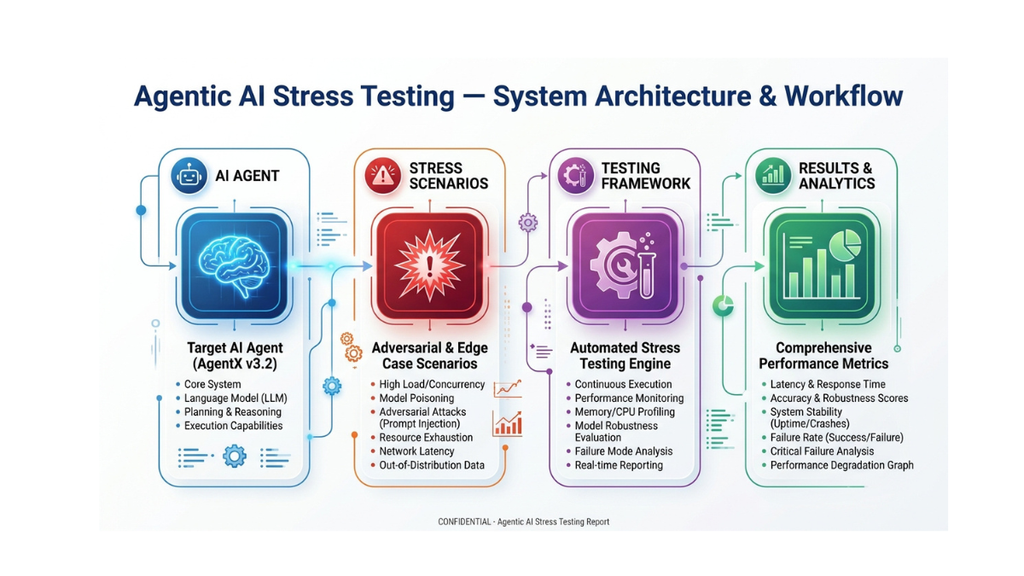
Agentic AI stress testing is the process of deliberately pushing an AI agent beyond normal operating conditions to discover failures in reasoning, tool usage, security, performance, autonomy, data retrieval, and decision-making.
Instead of asking only whether an agent produces the correct answer, stress testing asks a harder question:
What happens when the environment becomes unreliable, adversarial, overloaded, ambiguous, or completely different from what the agent expects?
This matters before enterprise deployment because an agent that works perfectly in a controlled demo can behave very differently when it encounters real users, changing data, failed APIs, conflicting instructions, long-running tasks, or malicious inputs.
What Is Agentic AI Stress Testing?
Agentic AI stress testing evaluates an AI agent under difficult or abnormal conditions to determine whether it continues operating safely, reliably, and within its intended boundaries.
Traditional AI testing often focuses on model outputs. Agentic AI testing has a much larger surface because an agent can interact with external systems through tools, APIs, databases, memory, retrieval systems, and other agents.
A stress test can deliberately introduce:
- High request or task volume
- Tool and API failures
- Incorrect or incomplete data
- Conflicting instructions
- Prompt injection
- Unauthorized tool requests
- Retrieval failures
- Long-running workflows
- Repeated retries and loops
- High token consumption
- Unexpected user behavior
- Multi-agent communication failures
The objective is not simply to make the agent fail. It is to understand how it fails, whether the failure is contained, and whether the agent can recover without creating a larger problem.
OWASP’s AI testing guidance similarly treats agentic systems as requiring testing across application, model, infrastructure, and data layers rather than limiting validation to model outputs.
Why AI Agents Need Stress Testing
An AI agent is not just a language model generating text.
It is an autonomous system that may follow an engineering loop:
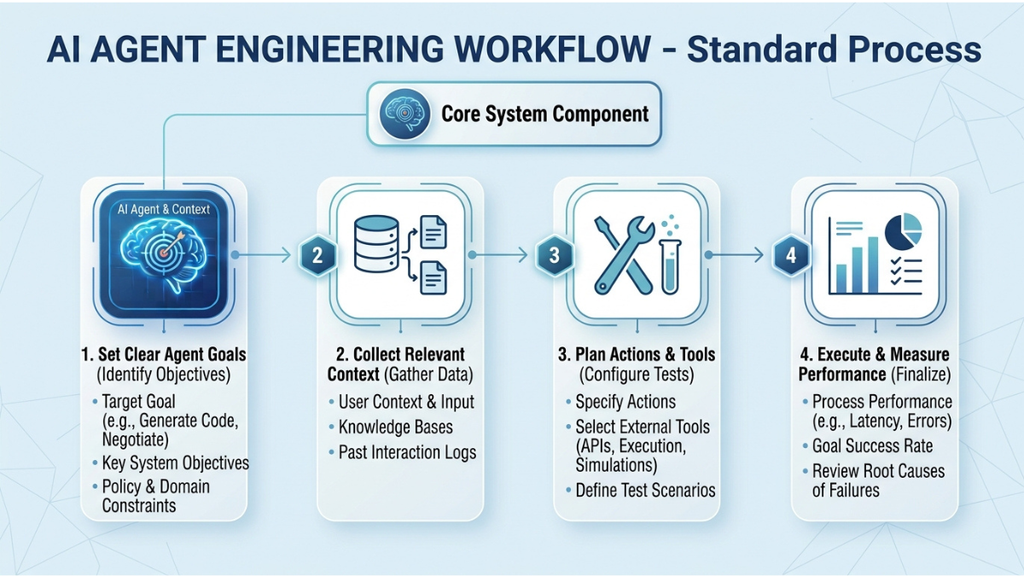
Every stage introduces another potential failure point.
For example, an agent might correctly understand a user’s request but:
- Select the wrong tool.
- Use an API with incorrect parameters.
- Trust stale retrieval results.
- Continue after a failed operation.
- Repeat the same action indefinitely.
- Expose sensitive information.
- Make an unsafe decision because of conflicting context.
This is why agentic AI stress testing should evaluate the complete system rather than only the underlying model.
Agentic AI Testing vs Traditional Software Testing
Traditional software testing usually operates around deterministic inputs and expected outputs.
Agentic systems are different because their behavior can change depending on:
- Model responses
- Context
- Retrieved information
- Tool availability
- Previous actions
- Memory
- User instructions
- External system state
This creates a much larger testing surface.
| Traditional testing | Agentic AI stress testing |
|---|---|
| Fixed inputs | Dynamic inputs and context |
| Expected outputs | Expected behavior and boundaries |
| Deterministic workflows | Adaptive workflows |
| Application failures | Model, tool, data, and reasoning failures |
| Unit/integration tests | Evaluation, simulation, adversarial and system tests |
| Mostly predefined paths | Unexpected paths and autonomous decisions |
Agentic AI software testing therefore needs to combine conventional software testing with AI evaluation, security testing, observability, and adversarial validation.
Common Agentic AI Failure Modes
A useful stress-testing strategy starts by identifying how the agent can fail.
1. Reasoning and decision failures
An agent may select an incorrect next step even when the available information is correct.
Stress testing should evaluate whether the agent can:
- Interpret ambiguous requests
- Select appropriate actions
- Recover from incorrect assumptions
- Re-evaluate failed approaches
- Stop when the goal cannot be safely completed
The focus is not on inspecting hidden reasoning. Instead, test observable decisions, actions, outputs, and evidence.
2. Tool and API failures
Agentic tools significantly expand an agent’s capabilities, but they also expand its attack surface.
Test what happens when:
- An API becomes unavailable.
- A tool returns malformed data.
- Authentication expires.
- A tool returns an error.
- A database is unreachable.
- An agent receives unexpected tool output.
The agent should fail safely rather than blindly retrying or switching to an unsafe workaround.
3. Retrieval and data failures
Agents using RAG, vector databases, enterprise search, or external knowledge sources have another important failure surface.
Test:
- Missing documents
- Stale information
- Duplicate records
- Incorrect retrieval
- Empty results
- Conflicting sources
- Unauthorized documents
- Malicious retrieved content
Retrieval should be treated as an input channel, not automatically trusted context.
4. Prompt injection and security attacks
Agentic AI security testing should include prompt injection, sensitive-data exposure, privilege escalation, tool misuse, and memory poisoning.
OWASP specifically recommends testing agents after significant changes to prompts, tools, memory, retrieval, policies, or model providers. Its testing guidance also highlights unauthorized tool invocation, recursive tool abuse, data exfiltration, and memory poisoning as important abuse cases.
5. Unbounded autonomy
An agent can sometimes continue working after it should stop.
This can appear as:
- Infinite loops
- Repeated tool calls
- Recursive planning
- Unnecessary sub-goals
- Excessive retries
- Actions outside the original scope
How to Stress Test AI Agents
A practical agentic AI stress testing process can be divided into several stages.
1. Establish a baseline
First, understand normal behavior.
Record:
- Task success rate
- Response time
- Tool-call success rate
- Token usage
- Cost per task
- Error rate
- Recovery rate
- Human intervention rate
Without a baseline, it becomes difficult to determine whether stress conditions actually degraded the system.
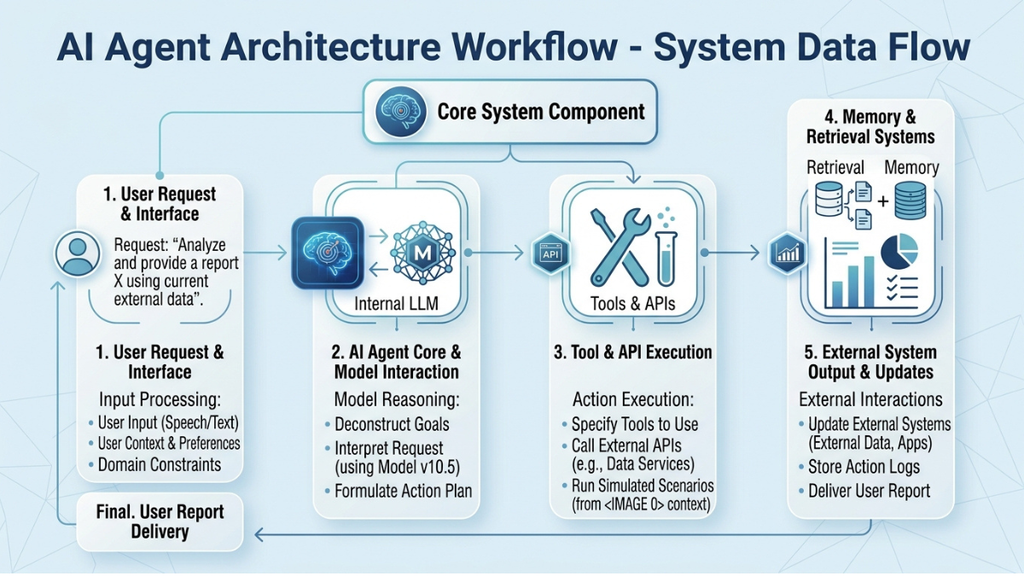
2. Map the agent architecture
Identify every component involved in the workflow:
3. Define failure scenarios
Create explicit test scenarios rather than relying on random failures.
Examples include:
- API unavailable
- Database timeout
- Invalid authentication
- Empty retrieval result
- Conflicting documents
- Malicious instructions
- High-volume requests
- Long-running task
- Repeated tool failure
- Unexpected tool output
Each scenario should have a defined expected safe behavior.
4. Apply controlled stress
Increase difficulty gradually.
Start with normal conditions, then introduce one failure at a time. After that, combine failures to simulate realistic production conditions.
For example:
High task volume + slow API + incomplete retrieval + malicious input
This reveals interactions that isolated tests may miss.
5. Measure observable behavior
Do not measure only whether the final answer is correct.
Track:
- Task completion
- Error rate
- Latency
- Tool-call accuracy
- Failed tool calls
- Retry count
- Loop count
- Token consumption
- Cost
- Security violations
- Guardrail violations
- Human escalation
- Recovery time
These metrics help reveal whether the agent is becoming unstable under pressure.
Load and Performance Testing for AI Agents
Performance testing is one part of stress testing, but agentic systems make performance more complicated.
An agent may generate several model calls and tool calls for a single user request. A simple increase in users can therefore produce a much larger increase in:
- Model requests
- API calls
- Database queries
- Token usage
- Memory operations
- Retrieval requests
Measure both system-level performance and agent-level behavior.
Important metrics include:
- P50/P95/P99 latency
- Requests per second
- Task completion time
- Token consumption
- Cost per successful task
- Tool-call latency
- Failure rate
- Concurrent task capacity
The goal is to discover the point where performance degradation begins and determine whether the agent fails gracefully.
Security and Adversarial Stress Testing
Security testing should not be treated as a final checklist.
Agentic systems require continuous adversarial validation because changes to models, tools, memory, retrieval, or prompts can change behavior.
Important tests include:
- Prompt injection
- Tool misuse
- Privilege escalation
- Sensitive data leakage
- Memory poisoning
- Unauthorized actions
- Recursive tool abuse
- Agent-to-agent attacks
- Excessive permissions
- Malicious retrieved content
Stress Testing Multi-Agent Systems
Multi-agent systems introduce another layer of complexity.
Instead of testing one agent independently, test how agents behave when they communicate and delegate tasks.
Potential failures include:
- Incorrect delegation
- Conflicting objectives
- Malicious inter-agent instructions
- Repeated delegation
- Shared-memory corruption
- Cascading failures
- Privilege propagation
A failure in one agent can therefore propagate through the entire workflow.
Multi-agent stress testing should monitor not only individual agents but also the communication and orchestration layer.
Agentic AI Stress Testing Metrics
A useful testing framework should combine technical, behavioral, security, and business metrics.
| Metric | What it measures |
|---|---|
| Task success rate | Whether the agent completes its objective |
| Failure rate | How often workflows fail |
| Recovery rate | Whether the agent recovers safely |
| Tool accuracy | Whether the correct tools are selected |
| Tool failure rate | Reliability of external actions |
| Loop rate | Unbounded or repetitive behavior |
| Guardrail violations | Safety-control failures |
| Latency | Performance under load |
| Token usage | Resource consumption |
| Cost per task | Economic efficiency |
| Human escalation | Need for human intervention |
The important principle is to connect these metrics to actual outcomes rather than optimizing one metric in isolation.
Best Practices for Agentic AI Stress Testing
Test the complete system
Testing only the model misses failures in tools, retrieval, memory, APIs, orchestration, and infrastructure.
Test after meaningful changes
Repeat critical tests after changing:
- Models
- Prompts
- Tools
- Policies
- Memory
- Retrieval
- Agent architecture
Use short, repeatable test loops
The engineering loop should be:
Test → observe → identify failure → fix → retest → document
This makes failures easier to reproduce and reduces uncertainty.
Ground tests in real system behavior
Use logs, API responses, schemas, row counts, tool results, and actual system state instead of assumptions.
This is especially important for agentic software testing because an agent can appear correct while interacting incorrectly with the underlying system.
Turn failures into reusable tests
A discovered failure should become a regression test, verification script, guardrail, monitoring rule, or documented test case.
That converts individual failures into durable engineering knowledge.
Agentic AI Stress Testing Before Enterprise Deployment
Before deploying an AI agent into production, test it under progressively harder conditions.
A practical sequence is:
Baseline testing → Functional testing → Load testing → Failure testing → Security testing → Adversarial testing → Recovery testing → Production monitoring
The objective is not to prove that an agent can never fail.
That is unrealistic.
The objective is to demonstrate that failures are predictable, detectable, contained, recoverable, and aligned with acceptable risk.
For high-impact workflows, human-in-the-loop controls should also be tested. An escalation mechanism is only useful if it actually activates when the agent reaches an unsafe or uncertain state.
Tools and Frameworks for Agentic AI Testing
Agentic AI testing can combine several categories of tools:
- AI evaluation frameworks
- Load-testing platforms
- Observability systems
- Security scanners
- Red-team frameworks
- Synthetic users
- API testing tools
- Agent simulation environments
- Custom regression suites
The exact tool matters less than having repeatable scenarios and measurable acceptance criteria.
For security-focused testing, the OWASP AI Testing Guide, AI Security Verification Standard, and Agentic Security guidance provide useful foundations for creating structured test programs.
FAQs
What is agentic AI stress testing?
Agentic AI stress testing is the process of deliberately testing autonomous AI agents under high-load, failure, adversarial, and unexpected conditions to evaluate reliability, security, performance, autonomy, and recovery.
How do you stress test AI agents before enterprise deployment?
Start with a baseline, map the agent architecture, define failure scenarios, simulate load and adversarial conditions, measure observable behavior, validate recovery, and repeat the tests after major system changes.
How can you stress test AI agents under attack load?
Combine realistic workload simulation with adversarial scenarios such as prompt injection, unauthorized tool requests, malicious retrieval content, excessive retries, and privilege-escalation attempts. The objective is to determine whether security controls continue working under pressure.
What is the difference between agentic testing and stress testing?
Agentic testing evaluates whether an AI agent behaves correctly and safely. Stress testing specifically pushes the system beyond normal conditions to discover how its behavior changes under pressure, failure, or attack.
Why is testing AI agents different from testing traditional software?
AI agents operate probabilistically and can dynamically plan, call tools, retrieve information, and adapt their workflow. This creates failure modes that traditional deterministic software tests may not cover.
Should AI agents be stress tested after deployment?
Yes. Agent behavior can change when models, prompts, tools, retrieval systems, memory, policies, or external services change. Continuous evaluation and monitoring are therefore important parts of production reliability.
Final Takeaway
Agentic AI stress testing should be treated as an engineering discipline rather than a final QA step.
The strongest approach combines functional testing, performance testing, AI evaluation, security testing, adversarial testing, observability, and recovery testing.
The key question is not:
“Can this AI agent complete the task?”
It is:
“Can this agent continue operating safely when the task, data, tools, infrastructure, users, and environment stop behaving as expected?”
That is the difference between an impressive AI demo and an agentic system that is ready for real-world deployment.