AI is no longer limited to answering prompts or generating content. Agentic AI can reason, plan, use tools, and take actions to complete complex goals with minimal human input. Behind these capabilities is an AI agent tech stack that combines models, memory, retrieval, tools, orchestration, observability, and security.
Unlike traditional AI systems, an agentic AI stack gives autonomous AI agents the infrastructure needed to handle multi-step workflows and adapt to changing conditions.
For U.S. businesses, understanding the agentic AI architecture is becoming essential for building reliable, scalable, and secure AI solutions. But what exactly powers these systems, and why does the right agentic AI tech stack matter for production?
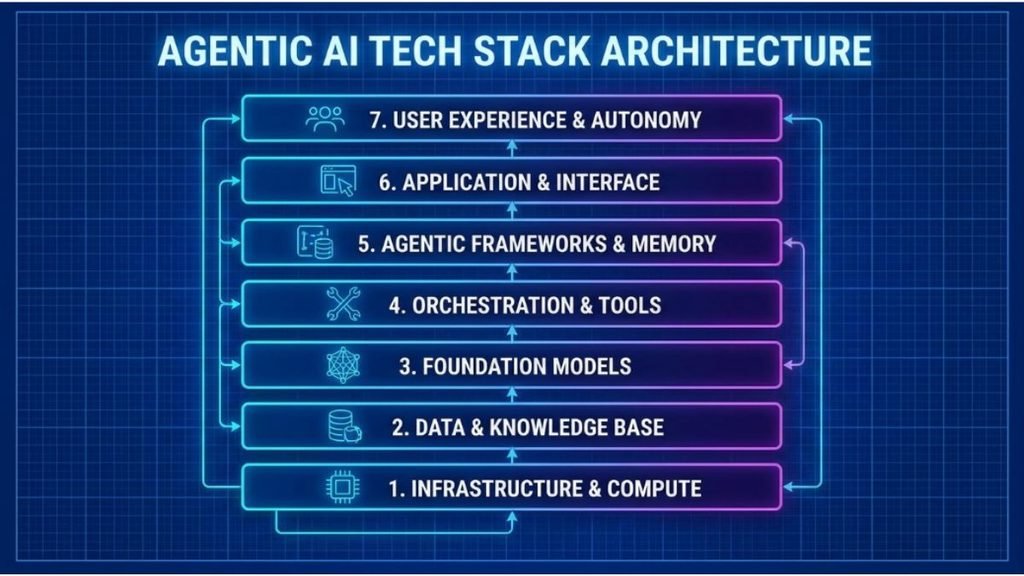
What Are the 7 Layers of the Agentic AI Tech Stack?
A practical AI agent architecture can be viewed as seven connected layers. The first layer provides intelligence. The middle layers provide memory, tools, workflows, and applications. The final layers make the system measurable, secure, and production-ready.
| Layer | Main purpose | Common technologies |
|---|
| 1. Models & infrastructure | Reasoning and generation | foundation models, LLMs, GPUs, model gateway |
| 2. Runtime & memory | State and context | AI agent runtime, memory, RAG |
| 3. Tools & protocols | Taking action | APIs, function calling, MCP |
| 4. Orchestration | Managing workflows | LangGraph, CrewAI, AutoGen |
| 5. Applications | User-facing experiences | CRM, support, analytics, coding |
| 6. Observability | Measuring behavior | tracing, evals, monitoring |
| 7. Security & governance | Controlling risk | guardrails, IAM, compliance |
This layered view also explains the AI agent infrastructure stack. Modern enterprise architectures increasingly treat observability, security, discoverability, and governance as cross-layer concerns. AWS uses a similar layered approach for production agentic AI architecture.
Layer 1 — Foundation Models and AI Infrastructure
The foundation is the model layer. Foundation models, large language models, reasoning models, and open-weight models provide language understanding, planning, coding, and reasoning. Providers such as OpenAI, Anthropic, Google, Meta, and Mistral offer different tradeoffs in capability, latency, context window, price, and deployment options.
However, models alone do not create agents. Your AI agent infrastructure also needs GPU or cloud resources, model gateways, API serving, authentication, caching, and cost controls. A model gateway can route simple tasks to cheaper models while sending difficult reasoning tasks to stronger models. That becomes important for AI agent scalability and AI agent cost optimization.
Why Model Choice Matters
An enterprise agent may use one model for classification and another for complex reasoning. This approach can reduce latency and operating costs without sacrificing quality.
Layer 2 — Agent Runtime, Memory and Retrieval
The runtime controls the agent’s execution loop, control flow, and state management. It decides when the model should think, retrieve information, call a tool, retry an action, or finish. A modern AI agent runtime can also manage sessions, approvals, sandbox environments, and persistent state.
Memory gives agents continuity. Working memory handles the current task while episodic memory stores past interactions. Semantic memory stores facts and knowledge while procedural memory can represent reusable methods. Together, these capabilities create persistent context and more useful stateful AI agents.
RAG and Knowledge Retrieval
A retrieval augmented generation or RAG pipeline connects an agent to external knowledge. Documents are ingested, processed through document chunking, converted into embeddings, and stored in a vector database or vector store. Retrieval can use vector search, semantic search, hybrid search, BM25, or HNSW.
Popular technologies include Pinecone, Weaviate, Chroma, pgvector, and PostgreSQL. The result is better knowledge retrieval without forcing the model to memorize every company document.
Example: A customer-support agent can search a product knowledge base before answering a warranty question.
Layer 3 — Tools, Protocols and Interoperability
Tools turn an AI model into an operational agent. AI tools, custom tools, API calls, web search, code execution, file I/O, and browser automation allow agents to interact with real systems.
Tool use depends on controlled function calling, tool calling, permissions, and schemas. A tool should clearly define what it accepts, what it returns, and what actions it can perform. This prevents a capable model from becoming an uncontrolled automation engine.
Why MCP Matters
The Model Context Protocol or MCP provides a standardized way for applications to expose tools and context to models. An MCP server can expose databases, files, APIs, or business services to agents. MCP integrations therefore reduce custom integration work.
Think of MCP as a common connector between agents and digital tools.
For example, an internal sales agent could use MCP to access a CRM, retrieve account information, and create a follow-up task while respecting tool permissions.
Layer 4 — Agent Orchestration and Multi-Agent Workflows
Agent orchestration determines how an agent moves from one task to another. A simple workflow may use one agent. Complex systems may use multi-agent systems where specialist agents collaborate.
Popular agentic AI frameworks include LangChain, LangGraph, CrewAI, AutoGen, Semantic Kernel, and LlamaIndex. The right framework depends on how much control you need over state, branching, retries, memory, and multi-agent coordination.
A Simple Agent Workflow
User goal → Planning → Retrieval → Tool call → Result check → Next action → Final response
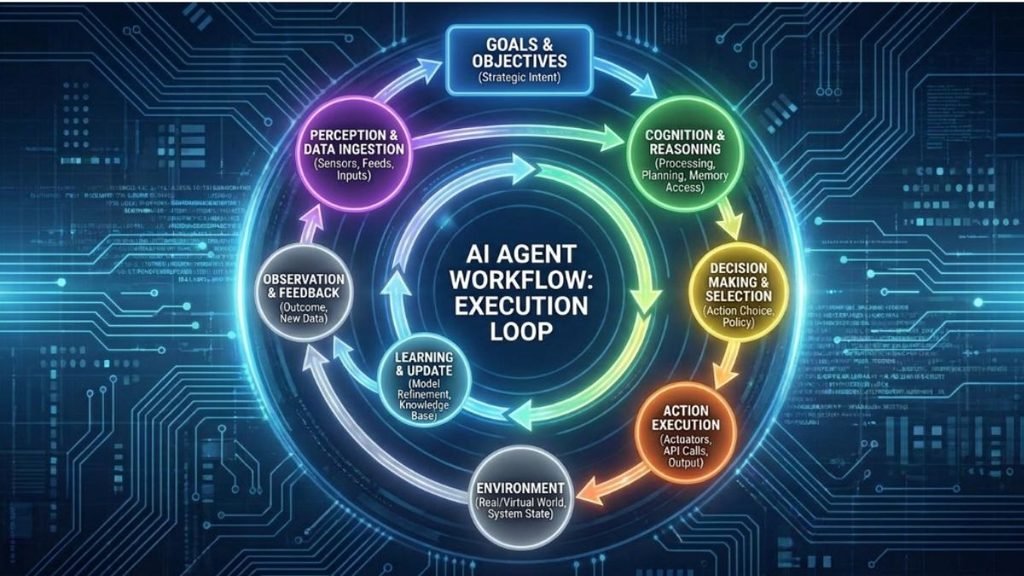
For example, an agentic AI for data management workflow might receive a reporting request, query a database, validate the results, generate a summary, and send it to an approved destination.
Layer 5 — Applications and Tooling for Agentic AI
This is where users actually experience Agentic AI. Applications include agentic AI for marketing, agentic AI CRM, agentic AI customer support, agentic AI for help desk automation, agentic AI in travel, agentic AI for supply chain, and agentic AI for data analytics.
Developers can also build internal AI agents, an AI agent for SaaS, or AI agents for data engineering. Other use cases include agentic AI in data engineering, agentic AI test automation, and agentic AI process automation.
From Demo to Production
An agentic AI developer needs more than prompts. Production AI agents require authentication, error handling, retries, sandboxing, testing, observability, and human approval for sensitive actions.
Example: A travel agent might search flights, compare hotel options, check company policy, and prepare an itinerary. A human can approve the final purchase.
Layer 6 — Observability, Evaluation and Performance
Agents behave differently from conventional software because their paths can change from one run to another. That makes LLM observability, AI agent observability, and agent tracing essential.
Teams should monitor latency, token usage, tool failures, hallucination rate, faithfulness, relevance, task completion, and other performance metrics. These measurements reveal whether an agent is actually improving business outcomes.
AI Evaluation
AI evaluation and LLM evaluation should test realistic tasks rather than only benchmark questions. Useful evaluation metrics include accuracy, task success, tool selection, response quality, cost, latency, and safety.
Tools such as LangSmith, Langfuse, Arize Phoenix, and MLflow can support evals, monitoring, and agent tracing.
Layer 7 — Security, Safety and Governance
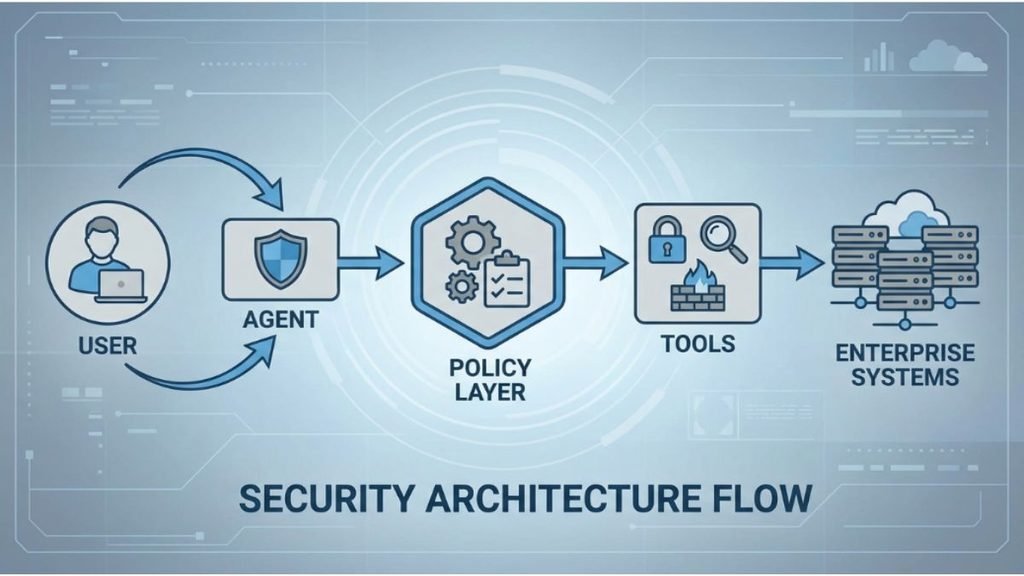
The more autonomy an agent has, the larger its security surface becomes. An agent with access to email, databases, financial systems, or production infrastructure can cause real damage if permissions are poorly designed.
That is why AI guardrails, AI safety, AI governance, identity controls, audit logs, approval flows, and least-privilege access belong inside the architecture rather than being added later. NIST’s 2026 AI Agent Standards Initiative specifically focuses on interoperability, security, identity, and trusted adoption.
Security for Agentic AI
Prompt injection, malicious tool outputs, excessive permissions, credential theft, and unintended actions are major concerns. Sensitive operations should use explicit tool permissions and human approval.
NIST describes agent security and identity as important areas for enabling trusted human-agent and multi-agent interactions.
How Do You Build and Operationalize an Agentic AI Stack in Production?
Start with the business task rather than the framework. Define the goal, required tools, data sources, approval points, and success metric. Then choose the model, AI agent framework, runtime, memory system, retrieval system, and orchestration pattern.
A typical production AI agent stack may use a model provider, RAG layer, vector database, MCP or API integrations, an orchestration framework, FastAPI for API serving, Docker for containerization, and Kubernetes for scalable deployment. Celery, AWS SQS, or Google Pub/Sub can handle asynchronous processing and async queues.
| Production concern | Example solution |
|---|
| Model access | Model gateway |
| Runtime | Agent framework |
| Knowledge | RAG + vector store |
| Tools | APIs + MCP |
| API serving | FastAPI |
| Containers | Docker |
| Scaling | Kubernetes |
| Async work | Celery / SQS / Pub/Sub |
| Monitoring | LangSmith / Langfuse / MLflow |
| Governance | IAM + guardrails |
Cloud platforms also offer managed options such as Amazon Bedrock, AWS AgentCore, Vertex AI Agent Builder, and Azure OpenAI Service. The goal is not to assemble the largest stack. It is to build a reliable production AI infrastructure layer that supports measurable business outcomes.
What Are the Biggest Challenges and Emerging Trends in Agentic AI?
The biggest challenges include unreliable reasoning, tool misuse, hallucinations, complex debugging, rising inference costs, data access, security, and AI agent sprawl. As companies deploy more agents, they also need consistent identity, data residency, compliance controls, auditability, and clear SLA expectations.
The 2026 direction is toward more interoperable agents, stronger identity systems, better evaluation, sandboxed execution, and standardized protocols. NIST is actively developing standards work around trusted and interoperable agents. OpenAI’s current Agents SDK also combines tools, handoffs, guardrails, sessions, tracing, and sandbox capabilities for more controlled agent development.
Where Agentic AI Is Heading
The emerging agentic AI trends 2026 point toward enterprise adoption rather than isolated chatbots. Companies are exploring agentic AI autonomous systems, agentic AI analytics, agentic AI for security operations, and domain-specific agents.
The next competitive advantage may not come from owning the best model. It may come from building the best AI agent stack around that model.
Agentic AI Tech Stack vs. Traditional AI Stack
A traditional AI stack often focuses on data, model training, inference, and an application. An agentic AI tech stack adds dynamic planning, memory, tools, orchestration, evaluation, permissions, and autonomous execution.
| Traditional AI | Agentic AI |
|---|
| Predicts or generates | Plans and acts |
| Mostly fixed workflow | Dynamic workflow |
| Limited tool use | Tool calling |
| Stateless or simple sessions | Stateful memory |
| Model-centric | System-centric |
| Basic monitoring | Agent observability |
| Human-driven execution | Autonomous execution with controls |
That is essentially how agentic AI is different from earlier forms of AI: the system can pursue a goal through multiple actions instead of simply producing one prediction or response.
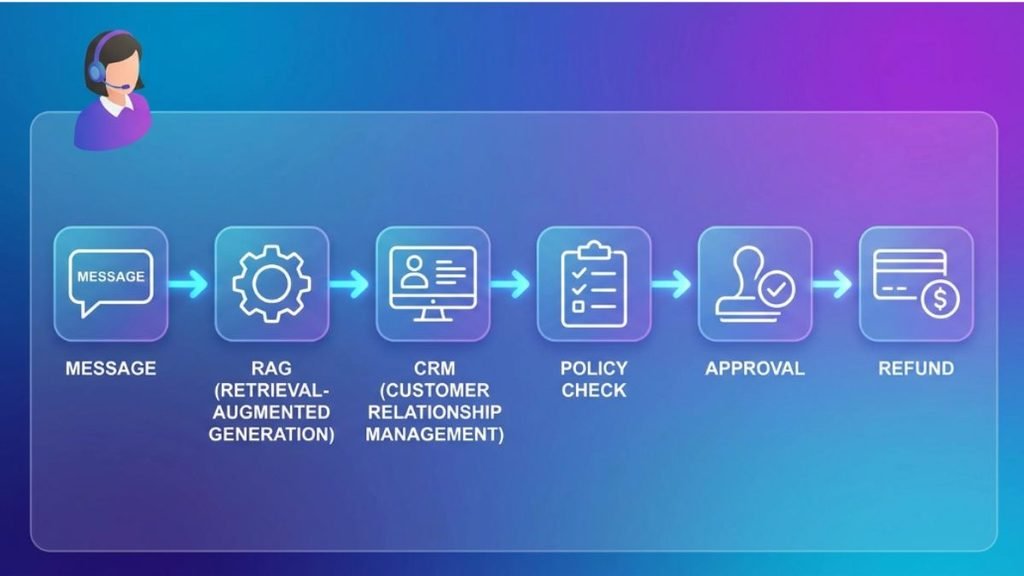
Case Study: A Customer Support Agent
Imagine a U.S. retailer receiving a refund request. The agent reads the customer’s message, retrieves the order, checks the return policy, verifies eligibility, and prepares the refund.
The AI agent workflow combines an LLM, semantic search, CRM tools, order APIs, memory, orchestration, and AI guardrails. A high-risk refund can then require human approval. This is where the stack becomes more valuable than a standalone chatbot.
Agentic AI Control Plane Architecture
As organizations scale, they need an agentic AI control plane architecture that manages agents across teams. The control plane can handle identity, model routing, policies, tool discovery, observability, evaluation, cost allocation, and deployment.
This architecture helps prevent AI agent sprawl. Instead of every team creating isolated agents, organizations can create shared AI agent infrastructure and reusable services. That improves AI agent reliability, governance, scalability, and cost control.
What Should You Look for in an AI Agent Stack?
Choose the smallest architecture that can safely handle the job. A prototype may only need one model, a few custom tools, and simple memory. A regulated enterprise system may need cloud AI infrastructure, private data controls, advanced observability, human approval, and strict governance.
The strongest AI agent technology stack is not necessarily the one with the most components. It is the one that makes agents useful, measurable, secure, and affordable in production.
Conclusion
An agentic AI tech stack is the operating system around an intelligent agent. Models provide reasoning. Memory provides continuity. RAG provides knowledge. Tools provide action. Orchestration provides control. Observability provides visibility. Security and governance provide trust.
For businesses, the real opportunity is not simply building another chatbot. It is creating production AI agents that can complete meaningful work while remaining observable, permissioned, and reliable.
The winning architecture will balance autonomy with control. That is what turns an impressive AI demo into a dependable autonomous AI agent that can operate inside a real business.
FAQs
What is the agentic AI tech stack?
The agentic AI tech stack is the combination of models, memory, tools, orchestration, observability, and security that powers autonomous AI agents.
Can you explain what agentic AI is?
Agentic AI refers to AI systems that can reason, plan, make decisions, use tools, and complete tasks with limited human intervention.
Can you provide some examples of agentic AI technology?
Examples include AI agents using LangGraph, CrewAI, AutoGen, MCP, and OpenAI’s Agents SDK to perform multi-step tasks.
What is the most popular agentic AI?
There is no single most popular agentic AI. ChatGPT, Claude, Gemini, and enterprise AI agents are widely used for agentic workflows.
Is ChatGPT an agentic AI?
ChatGPT can support agentic AI capabilities by using tools, planning, web access, and multi-step task execution, depending on the features enabled.