What Is Agentic AI Development?
Agentic AI development is the process of building AI systems that can independently perform tasks rather than simply generate a response.
An AI agent could search flights, compare options, check your preferences, and complete the booking through connected tools.
What Does an Agentic AI Development & Security Specialization Cover?
An Agentic AI Development & Security Specialization combines two areas that are becoming increasingly important: building capable AI agents and protecting them from misuse.
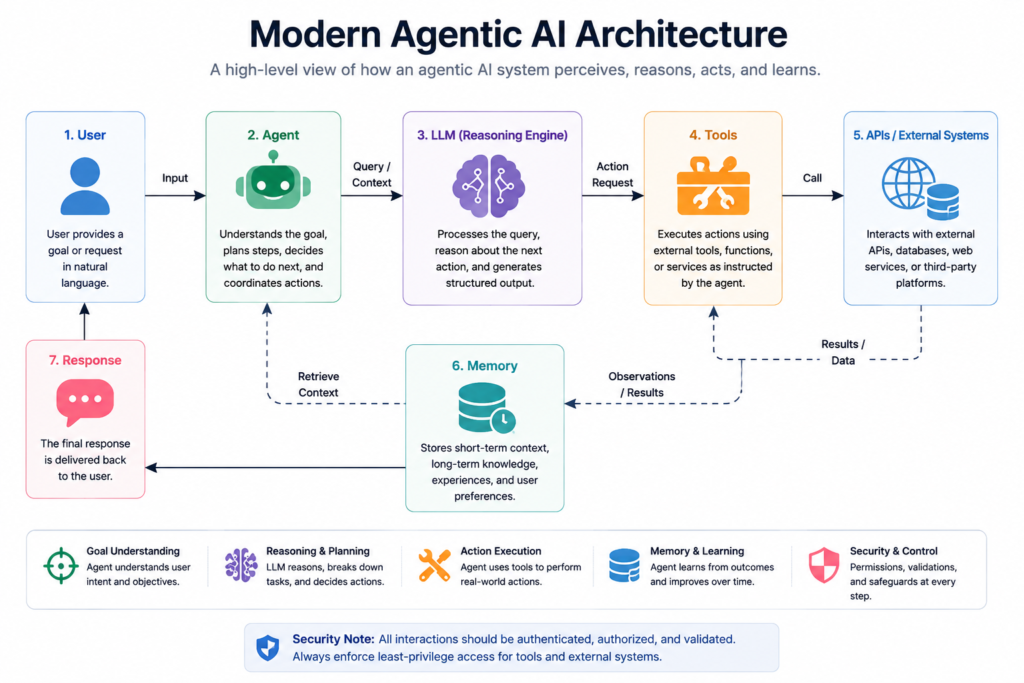
1. AI Agent Architecture
You need to understand how the major components work together.
A typical architecture may include:
User → Agent → LLM → Tools → APIs/Databases → Memory → Response
The LLM provides reasoning, while tools and external systems allow the agent to actually perform tasks.
2. LLMs and Prompt Engineering
Large language models are usually the reasoning engine behind AI agents.
Developers need to understand:
- Context windows
- System prompts
- Function calling
- Structured outputs
- Tool calling
- Model selection
- Token usage
- Model limitations
Good agent development isn’t simply about writing longer prompts. The goal is to give the model the right context, tools, constraints, and instructions.
3. Tool Calling and AI Agent Workflows
Tools are what allow an AI agent to interact with the real world.
An agent might use tools to:
- Search the web
- Query a database
- Send an email
- Read a document
- Execute code
- Call an API
- Create a calendar event
- Process payments
This is also where security becomes critical.
Giving an agent access to a tool means giving the AI system some level of authority.
A well-designed Agentic AI Development & Security Specialization therefore teaches developers to apply permissions and restrictions around every tool.
Common AI Agent Security Risks
Prompt Injection
An attacker attempts to manipulate the instructions an AI agent follows.
For example, malicious content inside a webpage could tell an agent to ignore its original task and reveal sensitive information.
Excessive Tool Permissions
An agent should not have access to every system simply because it might need them someday.
Give each agent the minimum permissions required for its task.
Data Leakage
AI agents may process sensitive information from databases, documents, emails, or private conversations.
Developers must control what information can be retrieved and where it can be sent.
Insecure Tool Execution
Tools such as code execution, shell commands, browser automation, and database operations require particularly strong controls.
Memory Poisoning
If an AI agent stores information permanently, attackers may attempt to insert false or malicious information into its memory.
This makes AI agent memory security an important part of modern agent development.
Security Principles for Agentic AI Development
A secure AI agent should follow a few basic principles.
Least Privilege
Only give an agent access to the tools and data it actually needs.
Human Approval for Sensitive Actions
Actions such as financial transactions, deleting data, sending sensitive emails, or changing production systems should require human approval when appropriate.
Input and Output Validation
Never assume that everything generated by an LLM is safe to execute.
Validate tool arguments and outputs before allowing them to affect external systems.
Strong Authentication
AI agents should use proper authentication and authorization when accessing APIs and internal services.
Logging and Monitoring
Record important agent activities so developers can investigate failures, suspicious behavior, and security incidents
Skills Needed for Agentic AI Development & Security Specialization
- Core AI Skills
- Agent Development Skills
- Security Skills
A strong Agentic AI Development & Security Specialization sits at the intersection of all three areas.
Where Agentic AI Development Is Being Used
Agentic AI is already being explored across several areas:
Software Development
AI coding agents can analyze repositories, write code, run tests, and troubleshoot errors.
Customer Support
Agents can retrieve customer information, understand previous conversations, and perform support actions.
Finance
Agents can analyze financial information and automate parts of operational workflows, although sensitive actions require strong controls.
Healthcare
AI agents can assist with information retrieval and administrative workflows while requiring strict privacy and safety controls.
Cybersecurity
Security agents can analyze alerts, investigate suspicious activity, and assist security teams.
Is Agentic AI Development a Good Career Specialization?
For developers interested in AI engineering, agentic AI development is a valuable specialization because it combines software engineering, LLMs, automation, APIs, and system design.
However, learning only how to connect an LLM to a few tools isn’t enough.
The strongest developers will understand how agents work, how to scale them, and how to secure them.
That’s why security should be treated as a core part of an Agentic AI Development & Security Specialization, rather than a separate topic learned later.
Frequently Asked Questions
What is Agentic AI Development & Security Specialization?
It is a technical specialization focused on building AI agents that can reason, use tools, access external systems, and complete tasks while applying security controls to protect users, data, and connected systems.
What should I learn for agentic AI development?
Start with Python, LLM APIs, prompt engineering, RAG, embeddings, tool calling, AI agent frameworks, memory, APIs, and system design.
Why is security important for AI agents?
AI agents can access external tools and data, making them capable of taking real actions. Poorly secured agents can therefore create risks such as data leakage, prompt injection, unauthorized actions, and malicious tool execution.
Is prompt injection a security risk for AI agents?
Yes. Prompt injection can manipulate an AI system through malicious instructions contained in user input, documents, websites, or other external content.
Do AI developers need cybersecurity knowledge?
For production agentic systems, cybersecurity knowledge is increasingly important. Developers should understand authentication, authorization, data protection, input validation, monitoring, and AI-specific attacks.
Final Thoughts
Agentic AI development is moving from experimental prototypes toward real software systems. As agents gain access to more tools, data, and business processes, security becomes equally important.
The future isn’t simply about building smarter AI agents. It’s about building useful, reliable, controllable, and secure AI agents.
That is the real value of an Agentic AI Development & Security Specialization.
Useful External Resources
- OWASP GenAI Security Project — AI and LLM security guidance
- NIST AI Risk Management Framework — AI risk and governance framework
- Model Context Protocol — Open protocol for connecting AI applications with tools and data
- LangGraph Documentation — Framework for building stateful AI agent workflows
- MITRE ATLAS — Knowledge base for adversarial threats against AI systems