A recommendation system analyzes user behavior, content, and other signals to determine which items are most relevant to a user. It is commonly used to personalize videos, products, jobs, articles, music, and search results.A recommendation system analyzes user behavior, content, and other signals to determine which items are most relevant to a user. It is commonly used to personalize videos, products, jobs, articles, music, and search results.
What Is Recommendation System Design?
Recommendation system design focuses on building the complete architecture required to collect user data, generate recommendations, rank potential items, and deliver the final results with low latency.
The system usually combines machine learning models with distributed data-processing and storage systems. Instead of evaluating every available item for every user, modern architectures reduce the search space through multiple stages.
A typical recommendation pipeline contains:
Data collection → Feature processing → Candidate generation → Ranking → Recommendation API → User feedback
Each stage has a different responsibility, and the design must account for scalability, latency, accuracy, and reliability.
How a Recommendation System Works
The first step is collecting signals about users and items. These signals can include views, clicks, searches, purchases, likes, skips, ratings, watch time, and other interactions.
The collected data is transformed into useful features. A recommendation model then uses these features to identify items that are likely to be relevant.
Rather than sending thousands or millions of items directly to a complex ranking model, the system normally uses a two-stage or multi-stage approach:
- Candidate generation selects a relatively small set of potentially relevant items.
- Ranking evaluates those candidates more carefully and produces the final ordering.
This separation is important because ranking every item would be computationally expensive and would increase response latency.
High-Level Recommendation System Architecture
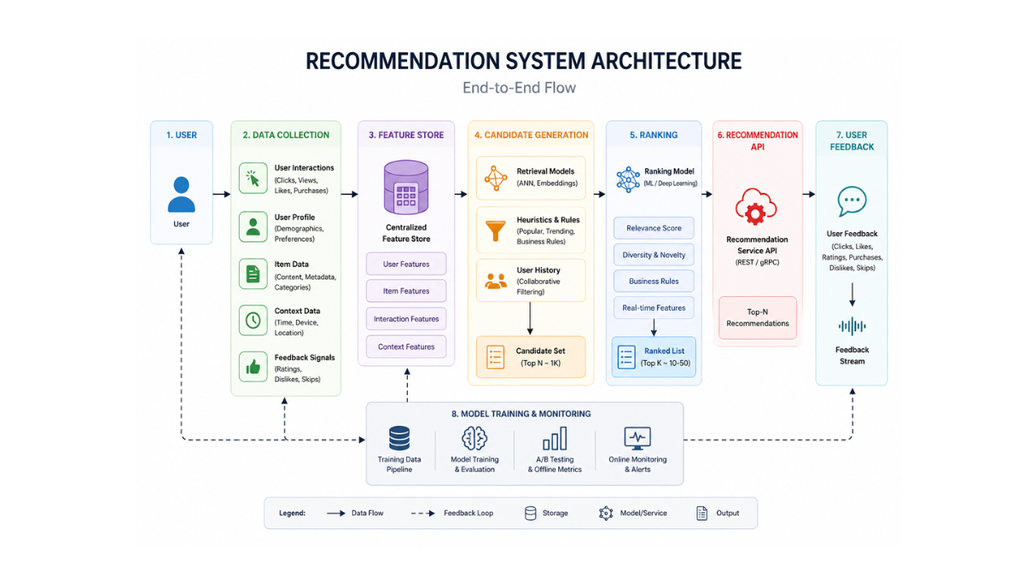
A scalable recommendation system can be divided into several major components:
User → Recommendation API → Candidate Generation → Ranking Model → Top-N Results
Behind these online components are data pipelines, feature stores, model-training infrastructure, and databases.
The data pipeline continuously collects interaction events and prepares them for model training and feature generation. Trained models are then deployed to the serving layer, where they can produce recommendations for users in real time.
The architecture therefore has two connected sides:
- Offline system: data processing, feature engineering, model training, and evaluation.
- Online system: feature retrieval, candidate generation, ranking, and recommendation serving.
Keeping these responsibilities separate makes the system easier to scale and maintain.
Data Collection and Processing
User interaction data is one of the most important inputs in recommendation system design.
Events can be generated whenever a user interacts with the application. For example, a platform may record a view, click, search, purchase, or completed session.
A high-volume system needs an event-processing pipeline capable of handling large streams of data. Events can be sent to a message or streaming system and then processed for both real-time features and offline training datasets.
The processed data can be stored in different systems depending on its purpose:
- Data lakes or warehouses for historical analysis and model training
- Key-value or NoSQL databases for fast online access
- Feature stores for serving machine-learning features
- Caches for frequently requested data
The important design principle is to avoid forcing the online recommendation service to perform expensive data-processing operations during every request.
Candidate Generation
Candidate generation is the first major machine-learning stage.
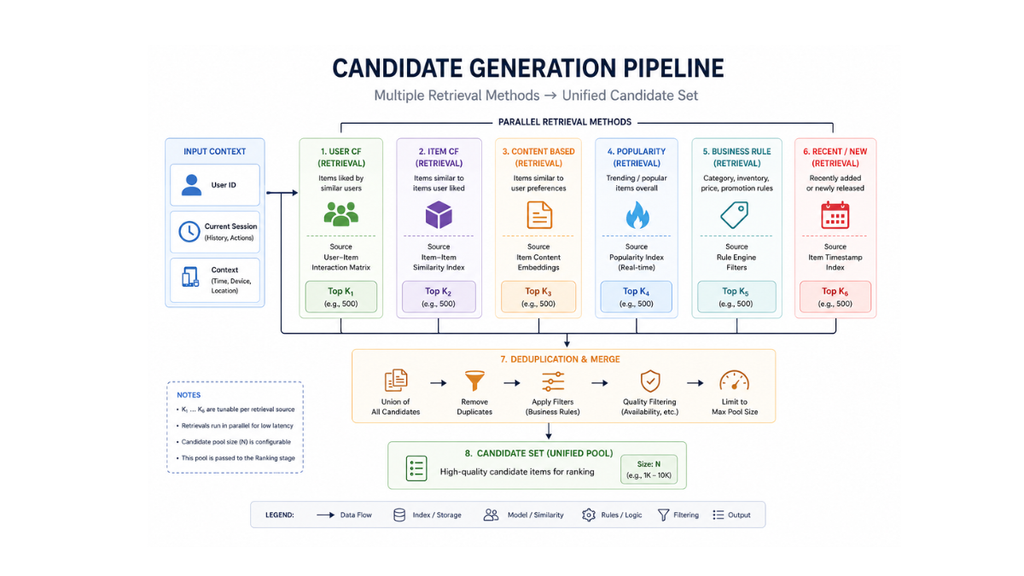
A platform may have millions of possible items, but only a small portion should be considered for a particular user. The candidate-generation layer reduces this enormous search space.
Different retrieval strategies can be combined. Collaborative filtering can identify items based on similar users or interaction patterns. Content-based methods can use item attributes and user preferences. Embedding-based retrieval can represent users and items as vectors and find items that are close in vector space.
Multiple candidate sources can produce separate lists. These lists can then be merged and filtered before reaching the ranking stage.
The objective here is high recall: the system should avoid removing potentially useful items too early.
Ranking System
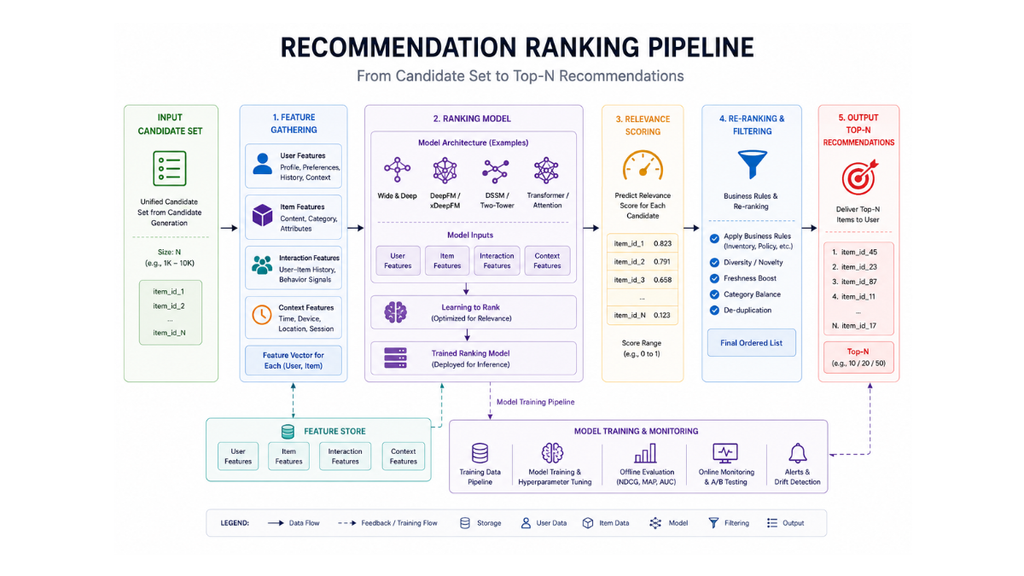
After candidate generation, the ranking model determines the order in which items should be presented.
Ranking can use a much larger set of features because the model is operating on a smaller candidate pool.
Possible features include:
- User interaction history
- Item popularity
- Recent user activity
- Item characteristics
- Context such as device or time
- Historical engagement
- User-item similarity
- Model-generated embeddings
The ranking model can predict a target such as the probability of clicking, watching, purchasing, or completing an item.
The final ranking should not necessarily optimize only one metric. A system may need to balance engagement with diversity, freshness, quality, business requirements, and user satisfaction.
Feature Engineering and Feature Store
Features connect raw data with machine-learning models.
Some features change slowly, such as an item’s category or a user’s long-term preferences. Others change rapidly, such as the user’s most recent interactions.
Recommendation systems therefore often need both offline and online feature processing.
Offline features can be calculated from historical datasets and used during model training. Online features need to be available quickly when a recommendation request arrives.
A feature store can help maintain consistency between training and serving. Without careful feature management, the model may be trained using information that is unavailable or calculated differently when the model is serving real users.
Machine Learning Models
The choice of model depends on the scale, available data, and recommendation objective.
Traditional approaches include collaborative filtering and matrix-factorization techniques. More advanced systems can use neural networks, embeddings, deep ranking models, or other machine-learning approaches.
A practical recommendation architecture may use several models instead of relying on a single model for the entire pipeline.
For example, a lightweight retrieval model can generate candidates efficiently, while a more computationally expensive ranking model evaluates the smaller candidate set.
This allows the system to improve recommendation quality without making every request unnecessarily expensive.
Cold Start Problem
One of the major challenges in recommendation system design is the cold-start problem.
A new user has little or no interaction history, making personalized recommendations difficult. Similarly, a newly added item may have no engagement data.
A system can address this by combining behavioral signals with content and contextual information.
For new users, popular or contextually relevant items can provide an initial recommendation set. For new items, metadata and content-based features can help the system understand where the item may fit before sufficient interaction data becomes available.
As more interactions are collected, the system can gradually move toward more personalized recommendations.
Scalability and Latency
Recommendation systems can serve millions of users while handling large catalogs, so scalability is a central part of the architecture.
The online recommendation service should avoid expensive computation whenever possible. Candidate generation can use precomputed representations, indexes, caches, or approximate nearest-neighbor search to reduce computation.
Ranking can then be performed only on a limited candidate set.
Caching is also useful for popular or frequently requested results, while horizontal scaling allows recommendation servers to handle increasing traffic.
Latency is particularly important because recommendations are often requested directly during user interactions. A system that produces highly accurate results but takes too long to respond can still provide a poor user experience.
Evaluating Recommendation Quality
Offline evaluation can be performed using historical datasets before deploying a model.
Common metrics include:
- Precision
- Recall
- Mean Average Precision
- Normalized Discounted Cumulative Gain
- Area Under the ROC Curve
However, offline metrics do not always reflect real user behavior. A model may perform well on historical data but behave differently when deployed.
For this reason, production systems commonly use online experiments such as A/B testing. Metrics can include click-through rate, watch time, conversion rate, retention, or other product-specific measurements.
The evaluation process should measure both recommendation quality and system performance.
Diversity, Freshness, and Feedback Loops
Optimizing only for predicted engagement can cause a recommendation system to repeatedly show similar content.
A production system may therefore introduce diversity and freshness into the final results. It can prevent excessive repetition, expose users to different categories, and give newer items an opportunity to receive interactions.
User feedback then becomes another input to the system.
Positive signals such as clicks, completed views, purchases, or likes can increase the relevance of similar items. Negative signals such as skips, short viewing time, or explicit dislikes can reduce their relevance.
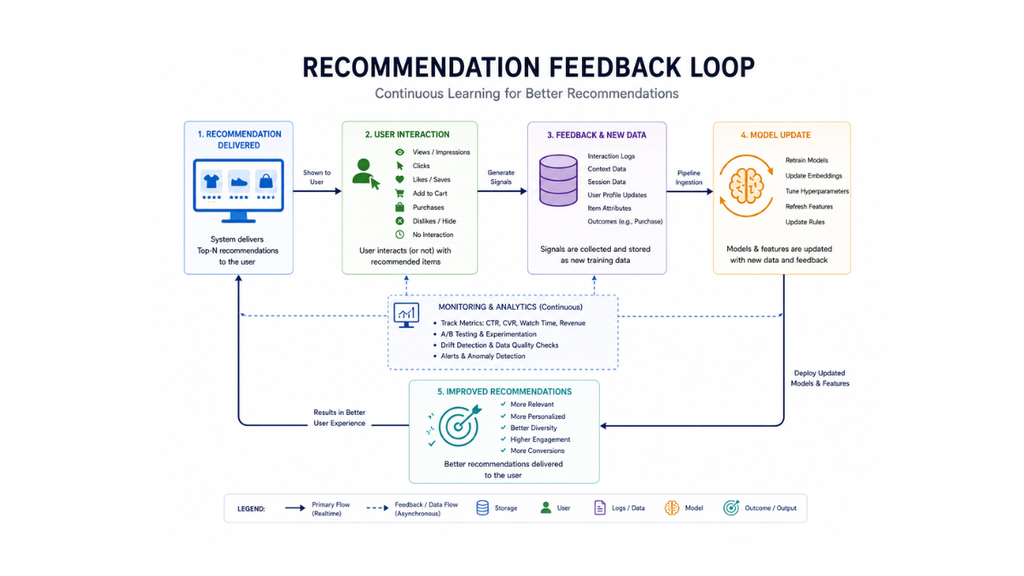
This creates a continuous loop:
Recommendation → User Interaction → New Data → Model Update → Improved Recommendation
Key Design Considerations
A strong recommendation system design needs to balance several competing requirements:
Accuracy: Recommendations should be relevant to the individual user.
Scalability: The architecture must support growing users, items, and interactions.
Latency: Recommendations should be generated quickly enough for interactive applications.
Freshness: New user behavior and new content should be reflected without unnecessary delay.
Diversity: Results should avoid becoming repetitive or overly narrow.
Reliability: The system should continue providing useful results even if a model or supporting service becomes temporarily unavailable.
Maintainability: Data pipelines, models, features, and serving components should be independently manageable.
Final Architecture
A production-grade recommendation system can be viewed as a pipeline connecting data infrastructure with an online serving layer.
User interactions are collected and processed through data pipelines. Historical data supports model training, while frequently changing information is made available through online feature infrastructure.
During a recommendation request, the system retrieves relevant user and item features, generates a manageable candidate set, applies a ranking model, performs final filtering and business rules, and returns the top results.
The architecture must continuously learn from new interactions while maintaining low latency and reliable service.
The central principle behind effective recommendation system design is therefore not simply choosing the best machine-learning model. It is designing an end-to-end system in which data collection, candidate generation, ranking, feature serving, scalability, evaluation, and feedback work together efficiently.