Retrieval-Augmented Generation (RAG) is an architecture that allows an AI application to retrieve relevant information from an external knowledge base before generating a response.
Instead of depending only on the information stored in an LLM’s training parameters, a RAG system retrieves relevant data at query time and provides it to the model as additional context.
A well-designed RAG system therefore has two major responsibilities:
- Retrieve relevant information
- Generate a grounded response using that information
The quality of a RAG application depends heavily on its data processing, retrieval strategy, embedding model, and generation process.
How to Build a RAG System
Building a RAG system involves several connected stages. Each stage has a specific purpose and affects the quality of the final response.
The core RAG pipeline is:
Data ingestion → Document processing → Chunking → Embedding generation → Vector storage → Retrieval → Context preparation → LLM generation
Each stage should be designed separately so the complete system can be evaluated and improved.
1. Collect and Prepare the Data
The first step is collecting the information that the RAG system needs to retrieve.
A RAG knowledge base can contain:
- Documents
- PDFs
- Web pages
- Technical documentation
- Product information
- Internal company content
- Database records
- Text files
Before indexing the data, remove unnecessary content and ensure that the information is accurate and up to date.
Poor-quality source data can lead to poor retrieval results regardless of which LLM or vector database is used.
Data preparation should include:
- Removing duplicate content
- Cleaning unnecessary formatting
- Extracting usable text
- Preserving important document structure
- Adding useful metadata
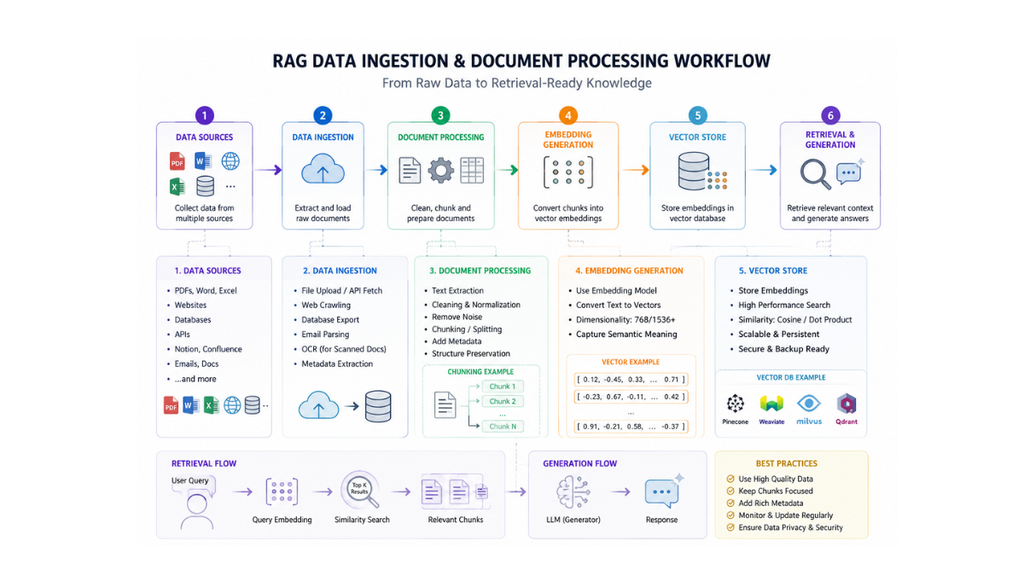
2. Split Documents Into Chunks
Large documents need to be divided into smaller sections before they can be efficiently retrieved.
These sections are called chunks.
Chunking is important because retrieval normally operates on smaller pieces of information rather than entire documents.
A chunk should contain enough information to preserve its meaning while remaining focused on a specific piece of content.
Common chunking approaches include:
- Fixed-size chunking
- Overlapping chunking
- Sentence-based chunking
- Paragraph-based chunking
- Semantic chunking
- Structure-aware chunking
There is no single chunk size that works for every RAG application.
The appropriate strategy depends on the document structure, retrieval requirements, embedding model, and type of questions the system needs to answer.
Poor chunking can cause:
- Missing context
- Irrelevant retrieval
- Fragmented information
- Lower retrieval accuracy
3. Generate Embeddings
After documents are divided into chunks, each chunk is converted into a numerical representation called an embedding.
An embedding model transforms text into a vector that represents its semantic meaning.
This allows the retrieval system to compare the meaning of a user’s query with the meaning of stored content.
The embedding process can be represented as:
Text chunk → Embedding model → Vector representation
Choosing appropriate RAG embedding models is important because different models can perform differently across languages, domains, document types, and retrieval tasks.
For specialized applications, embedding models should be evaluated against the actual data and queries used by the system.
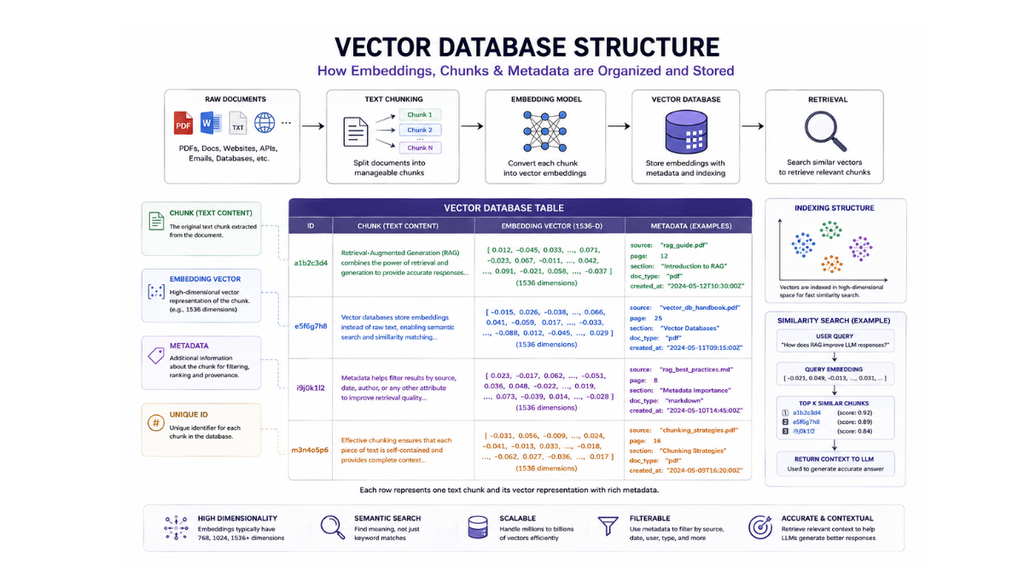
4. Store Embeddings in a Vector Database
The generated embeddings need to be stored in a system capable of performing efficient vector similarity searches.
A vector database stores vector representations together with the associated content and metadata.
The stored information commonly includes:
- Vector embedding
- Original text chunk
- Document identifier
- Metadata
- Source information
When a query arrives, the system compares the query embedding against stored vectors and identifies the most relevant content.
This is the foundation of vector-based retrieval in many RAG architectures.
5. Build the Retrieval Layer
The retrieval layer is responsible for finding the information most relevant to the user’s query.
When a user submits a question, the query is processed and converted into an embedding.
The retrieval system then searches the indexed knowledge base and returns the most relevant chunks.
The basic process is:
User query → Query embedding → Similarity search → Relevant chunks
Retrieval quality is one of the most important factors in RAG performance.
If relevant information is not retrieved, the LLM may not have the necessary context to generate an accurate answer.
6. Use Semantic Search for Retrieval
Semantic search retrieves information based on meaning rather than relying only on exact keyword matches.
This makes RAG and semantic search closely connected.
A semantic retrieval system compares the vector representation of the query with the vector representations stored in the knowledge base.
Common retrieval approaches include:
- Dense vector search
- Keyword search
- Hybrid search
- Metadata filtering
- Reranking
Hybrid search combines semantic retrieval with traditional keyword-based retrieval.
This can be useful when both conceptual similarity and exact terms are important.
7. Add a Reranking Stage
Initial retrieval may return several potentially relevant documents, but they may not all be equally useful.
A reranker evaluates the retrieved results and reorders them according to their relevance to the query.
The retrieval process can therefore become:
Query → Initial retrieval → Reranking → Top relevant chunks
Reranking can improve the quality of the context provided to the LLM by reducing irrelevant information.
It is particularly useful when the knowledge base contains many similar or closely related documents.
8. Build the Context for the LLM
After retrieving the relevant information, the system prepares the context that will be provided to the LLM.
The context should contain the most relevant retrieved information while avoiding unnecessary content.
The system typically combines:
- User query
- Retrieved chunks
- Relevant metadata
- System instructions
The resulting prompt is then sent to the LLM.
Effective context construction helps the model focus on the retrieved information instead of processing large amounts of irrelevant content.
9. Generate the Final Response
The LLM receives the user’s query together with the retrieved context.
It then generates the final response based on the available information and the instructions provided by the application.
A simplified generation stage is:
Retrieved context + User query + Instructions → LLM → Response
The generation layer should be designed to minimize unsupported claims and keep responses grounded in retrieved information.
Depending on the application, the system can also instruct the LLM to:
- Use only retrieved information
- Indicate when information is unavailable
- Include source references
- Avoid unsupported claims
- Follow a specific response format
What Are RAG Pipelines?
A RAG system generally contains two separate pipelines: an indexing pipeline and a query pipeline.
Indexing Pipeline
The indexing pipeline prepares information before it is retrieved.
Documents → Processing → Chunking → Embeddings → Vector Database
Its purpose is to transform raw information into a searchable knowledge base.
Query Pipeline
The query pipeline runs whenever a user submits a question.
Query → Query processing → Retrieval → Reranking → Context construction → LLM → Response
Separating these pipelines makes the architecture easier to maintain, test, and optimize.
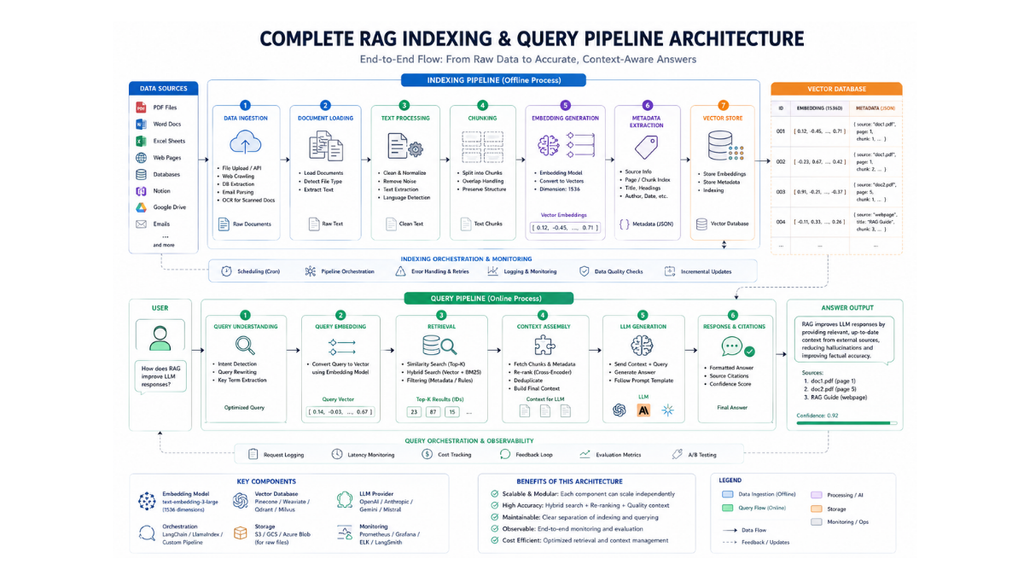
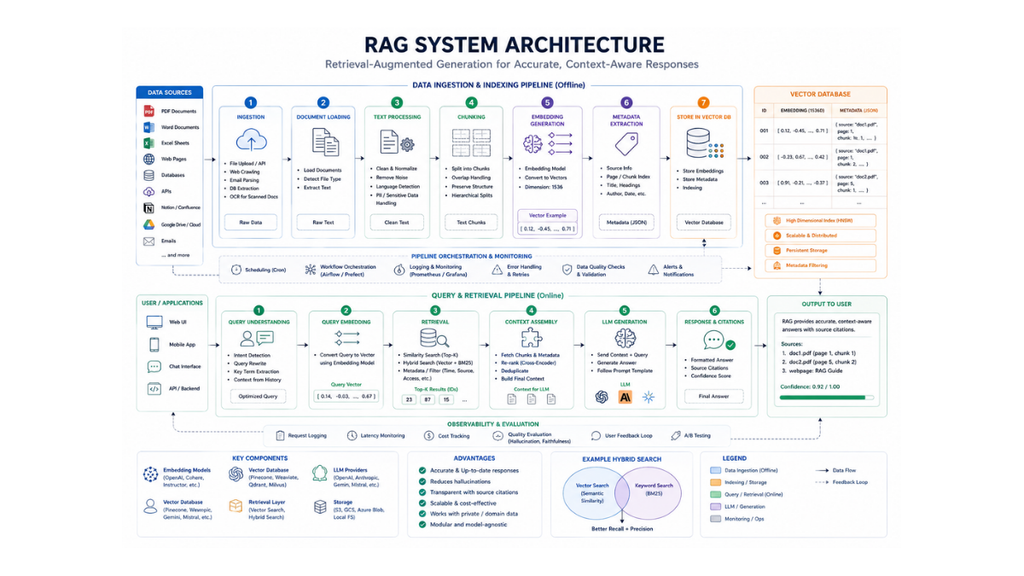
RAG System Architecture
A complete RAG system architecture can contain the following components:
- Data sources — provide the original information.
- Document processing layer — cleans and prepares the data.
- Chunking layer — divides documents into retrievable units.
- Embedding model — converts text into vectors.
- Vector database — stores and searches embeddings.
- Retriever — finds relevant information.
- Reranker — improves the ranking of retrieved results.
- Context builder — prepares information for the LLM.
- LLM — generates the final response.
- Evaluation layer — measures retrieval and generation quality.
Types of RAG Systems
RAG implementations can differ considerably depending on the retrieval strategy and application requirements.
Basic RAG
Basic RAG uses a relatively simple retrieval-and-generation workflow.
Query → Retrieval → Context → LLM
It is easier to implement and is suitable when the retrieval requirements are straightforward.
Advanced RAG
Advanced RAG adds additional techniques to improve retrieval and generation quality.
These can include:
- Query rewriting
- Hybrid search
- Metadata filtering
- Reranking
- Improved chunking
- Multiple retrieval strategies
- Retrieval evaluation
Advanced RAG is useful when a basic retrieval pipeline does not provide sufficient accuracy.
Self-RAG
Self-RAG introduces mechanisms that allow the system to evaluate the usefulness of retrieved information and improve the generation process.
It can help reduce unsupported responses and improve the grounding of generated answers.
Corrective RAG
Corrective RAG focuses on identifying inadequate retrieval results and applying corrective retrieval strategies.
Instead of treating every retrieval result as reliable, the system can evaluate retrieval quality and take additional action when the retrieved information is insufficient.
RAG for AI Chatbots
RAG is commonly used to provide AI chatbots with access to external knowledge.
A RAG-based AI chatbot generally contains:
- Chat interface
- Query processing
- Retrieval system
- Knowledge base
- Vector database
- LLM
- Response generation
The chatbot retrieves relevant information before generating its response.
This architecture is useful when the chatbot needs access to information that is not reliably available from the LLM’s pretrained knowledge.
RAG for Databases
RAG can also work with structured and semi-structured data.
RAG for databases can combine database information with unstructured knowledge sources.
A database-integrated RAG architecture may include:
- Database retrieval
- Vector retrieval
- Metadata filtering
- Query processing
- Context construction
- LLM generation
The exact architecture depends on whether the application needs structured queries, semantic retrieval, or both.
How to Improve RAG Performance
Building the initial RAG pipeline is only the first stage. The system should be continuously evaluated and improved.
Improve Data Quality
Use accurate, relevant, updated, and well-structured information.
Improve Chunking
Test different chunk sizes and chunking strategies to determine which approach preserves the required context.
Improve Embeddings
Evaluate different embedding models for RAG against real application queries.
Improve Retrieval
Consider:
- Hybrid search
- Metadata filtering
- Query rewriting
- Query expansion
- Reranking
Reduce Irrelevant Context
Retrieving more documents does not necessarily produce better results.
The system should provide the LLM with relevant context rather than large amounts of unrelated information.
Evaluate Retrieval Separately
Measure whether the correct information is being retrieved before evaluating the final LLM response.
This makes it easier to determine whether a problem comes from retrieval or generation.
RAG Evaluation
A production RAG system should be evaluated using representative queries and expected results.
Important areas to evaluate include:
- Retrieval relevance
- Retrieval accuracy
- Context relevance
- Answer correctness
- Answer faithfulness
- Response latency
- Retrieval speed
RAG evaluation frameworks can help automate and standardize parts of this process.
A useful evaluation process should test both the retrieval pipeline and the final generated responses.
RAG Performance Optimization
RAG performance depends on multiple components rather than a single model.
Important optimization areas include:
- Data quality
- Chunking strategy
- Embedding model
- Vector search
- Retrieval parameters
- Reranking
- Context size
- LLM selection
- Prompt design
- Caching
- Evaluation
Improving one component while ignoring the others may not significantly improve the overall system.
Final Thoughts
Learning how to build a RAG system requires more than connecting a vector database to an LLM.
A reliable RAG architecture needs a complete pipeline for:
Data preparation → Chunking → Embeddings → Vector storage → Retrieval → Reranking → Context construction → Generation → Evaluation
Start with a simple retrieval pipeline, measure its performance, and then introduce advanced techniques only where they solve an identifiable problem.
The most important goal is to consistently retrieve the right information and provide high-quality context to the LLM.