Jev AI: What It Is, How System One Works, and How Developers Can Use It
Jev AI is a new type of AI model designed to make structured decisions inside software rather than generate long-form text like a traditional chatbot.
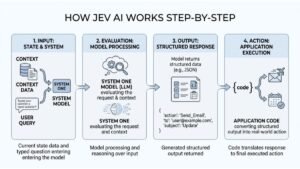
Developed by TypeSafe AI, Jev is the first implementation of what TypeSafe calls a System One model. Instead of asking the model to write an answer, developers provide application state and a specific question. Jev then returns a typed result such as a Choice, Score, or Noul answer, along with probability information where applicable.
That makes Jev AI interesting for developers building AI agents, automation systems, routing layers, moderation workflows, and other applications where the software needs a fast judgment rather than another paragraph of generated text.
In this guide, you’ll learn what Jev AI is, how the System One model works, how Jev differs from LLMs, what Choice, Score, and Noul mean, how the Jev API works, where developers can use it, and what limitations to consider before putting it into production.
What Is Jev AI?
Jev AI is a decision-focused AI model from TypeSafe AI. Its purpose is to turn unstructured application state into structured decisions that software can use directly.
A traditional large language model (LLM) usually receives a prompt and generates text. You might ask an LLM to classify a support ticket, decide whether a request is urgent, or choose which agent should handle a task. The model may return the correct answer, but your application still has to interpret the generated response.
Jev approaches the problem differently.
You provide state, define a question, and specify the expected type of answer. The model returns that structured answer so your application can use it in normal control flow.
For example, a support application could send:
“The customer has been unable to connect their payment account for three days.”
Instead of asking Jev to explain the situation, you could ask:
- Which team should handle this ticket?
- How urgent is it?
- Should a human review it?
The application can then use those results to route the ticket, prioritize the queue, or trigger human review.
Image Placeholder — Jev AI Decision Architecture: Show application state entering Jev, three structured outputs—Choice, Score, and Noul—then application code using those results for routing, prioritization, or escalation.
The official TypeSafe AI documentation describes this model as a System One approach focused on structured judgments rather than conversational generation. TypeSafe AI — Introducing System One Models & Jev
What Is a System One Model?
A System One model is designed around fast, bounded decisions instead of open-ended text generation.
The name refers to the idea of quick, intuitive judgments often associated with “System 1” thinking. However, in software, the important distinction is architectural: the model receives application state and produces a constrained, typed result.
Jev is currently the first System One model from TypeSafe.
The basic idea looks like this:
Application state → Jev → Structured decision → Application control flow
That separation is important.
Jev makes the judgment, but your application remains responsible for deciding what happens afterward.
For example:
Support ticket
      ↓
     Jev
      ↓
Choice: billing
Score: high urgency
Noul: human review = yes
      ↓
Application logic
      ↓
Route + prioritize + escalate
This makes System One useful as a decision primitive inside existing software rather than as another standalone chatbot.
The current Jev developer documentation describes the model as a component that converts text or JSON state into Choice, Score, or Noul outputs while leaving control flow to application code. Jev System One Developer Guide
How Does Jev AI Work?
The Jev AI architecture can be understood through three main inputs: State, Model, and Questions.
1. State provides the context
State contains the information Jev needs to evaluate the decision.
It can represent a message, support ticket, product record, retrieved information, or structured JSON data.
For example:
{
  "customer_message": "I was charged twice and need a refund today.",
  "customer_tier": "enterprise"
}
The important principle is to provide the smallest useful context.
If your application asks whether a support ticket is urgent, there is little reason to send an unrelated database export containing thousands of records.
2. Questions define the judgment
The question describes what your application wants Jev to determine.
Instead of:
“Analyze this customer.”
You could ask:
“Which support department should handle this request?”
Then define the possible outcomes.
This makes the expected output predictable.
3. Jev returns a structured result
The response is associated with the question ID you provide.
Depending on the question type, the result can contain a selected Choice, a Score, or a Noul probability.
Your application can then use that result in normal code.
This is one of the central ideas behind Jev AI: the model handles judgment, while the application handles execution.
Jev AI vs. Traditional LLMs
The biggest difference between Jev AI and LLMs is the type of output they are designed to produce.
| Feature | Traditional LLM | Jev AI / System One |
|---|---|---|
| Primary purpose | Generate and understand text | Make bounded decisions |
| Output | Natural language or generated JSON | Typed decision |
| Typical task | Explanation, writing, reasoning | Classification, scoring, yes/no judgment |
| Control flow | Often interpreted by application | Designed to enter application logic |
| Output shape | Can vary | Defined by question type |
| Typical examples | Chatbots, writing assistants, coding | Routing, triage, moderation, escalation |
This does not mean Jev replaces LLMs.
An LLM is useful when an application needs generated language, complex explanations, summarization, code generation, or open-ended reasoning.
Jev is aimed at narrower decisions where the application already knows what type of answer it needs.
For example, an AI customer-support system might use an LLM to understand a conversation and generate a response, while Jev AI determines whether the ticket belongs to billing, technical support, or sales.
That means Jev can sit alongside an LLM rather than compete with it directly.
Choice, Score, and Noul: The Three Jev AI Question Types
One of the most important concepts to understand when using Jev AI is its three question types: Choice, Score, and Noul.
Each type represents a different kind of decision.
| Question type | What it answers | Example |
|---|---|---|
| Choice | Which option fits? | Which team should handle this ticket? |
| Score | Where does something fall on an ordered scale? | How urgent is this request? |
| Noul | Is a specific statement true? | Does this request require human review? |
The official Jev documentation uses these three types as the core interface for structured decisions. Jev AI API Documentation
Choice: Classification and Routing
Use Choice when the answer belongs to a predefined set of options.
For example:
Which team should handle this request?

billing
technical
sales
account
Jev returns the selected choice along with probabilities and confidence information.
This makes Choice useful for:
- Ticket routing
- Intent classification
- Content categorization
- Agent selection
- Model routing
- Moderation categories
You can also define an other or none-of-the-above option when forcing every request into a known category would create bad decisions.
Score: Ordered Evaluation
Use Score when the answer belongs on an ordered scale.
For example:
Low
Medium
High
Critical
This can represent:
- Urgency
- Severity
- Risk
- Quality
- Customer frustration
- Priority
A useful property of Score is that the result can represent a probability-weighted position rather than simply returning one label.
That gives application developers more flexibility when setting thresholds.
Noul: A Yes-or-No Judgment
Noul is designed for a focused proposition.
For example:
“Does this customer explicitly request a refund?”
or:
“Should a human review this action?”
The response represents the probability that the proposition is true.
Noul is particularly useful for confirmation, escalation, safety checks, and blocking decisions.
However, Noul should not be confused with confidence. A Noul value represents the probability of “yes”; it is not a separate confidence measurement.
Image Placeholder — Jev AI Choice vs. Score vs. Noul: Show the three question types side by side, with Choice selecting one category, Score placing a request on an ordered scale, and Noul returning the probability of a yes/no proposition.
How to Use the Jev AI API
The Jev AI API is designed to let developers put these decisions directly inside application workflows.
The current documentation uses a System One API endpoint with a request containing the model, state, and questions.
A simplified request concept looks like:
POST /v1/systemone

{
  model,
  state,
  questions
}
For example, a server could send a support message and ask Jev whether it expresses urgency.
The response can then be read by application code:
if urgency is high:
    prioritize ticket

if human_review is true:
    send to review queue
The important architectural principle is that Jev should make the judgment, not execute the business action.
Your application should still control:
- Authentication
- Input validation
- Thresholds
- Retries
- Logging
- Human review
- Business rules
- Final actions
The current Jev API documentation describes the request around model, state, and questions, with typed answers returned under the corresponding question IDs. Jev API Documentation
Where Can Developers Use Jev AI?
The strongest Jev AI use cases are situations where software repeatedly needs a small, well-defined judgment.
AI Agent Routing
An AI agent may have access to multiple tools or specialized agents.
Jev can help determine:
Which agent should handle this task?
For example:
Customer request
       ↓
      Jev
       ↓
Billing Agent
Technical Agent
Sales Agent
The main agent or orchestrator can then route the task based on the structured result.
Customer Support
A support platform could use Jev to classify incoming tickets, score urgency, and determine whether human intervention is required.
This can happen before a larger LLM generates the final response.
Content Moderation
Jev can evaluate whether content belongs to predefined moderation categories.
A Choice question could classify content, while a Noul question could determine whether a specific policy violation is present.
Fraud and Risk Detection
Financial systems often need repeated classification or risk judgments.
Jev could provide a structured assessment that application code combines with transaction rules and other signals.
However, high-impact financial decisions require extensive validation, monitoring, and appropriate human oversight.
Model Routing
Modern AI applications often use multiple models.
A smaller model may handle simple requests while a more expensive model handles complex tasks.
Jev can act as a routing layer, determining which path an application should take.
AI Safety and Human Review
Jev can also help answer bounded questions such as:
“Does this action require human approval?”
The application can then use a threshold to determine whether to proceed automatically or send the request to a review queue.
Jev AI for AI Agents
One particularly interesting application is using Jev AI inside AI agents.
An agent constantly makes decisions:
- Which tool should I call?
- Should I retry?
- Which workflow should I use?
- Does this task need human approval?
- Is the result sufficient?
- Should I escalate?
Traditionally, developers may ask an LLM to make each of these judgments.
That can be expensive and can also introduce unnecessary natural-language generation into the control flow.
A System One model can instead act as a specialized decision layer.
For example:
User request
     ↓
AI Agent
     ↓
Jev decision
     ↓
Choice: search_web
     ↓
Tool execution
     ↓
Result
     ↓
Jev decision
     ↓
Noul: needs_human_review?
     ↓
Application action
This architecture separates language generation from software decision-making.
That separation can make agent workflows easier to reason about because the agent’s control logic does not have to depend entirely on free-form model output.
What Makes Jev AI Different?
The central idea behind Jev AI is not simply that it is another AI model.
Its differentiation comes from treating AI judgment as a structured software primitive.
Traditional applications usually contain deterministic functions such as:
if condition:
    do something
But many real-world decisions are difficult to express using simple rules.
For example:
Is this customer actually requesting a refund?
A rules engine might search for keywords such as “refund,” “money back,” or “charged.”
A decision model can evaluate the meaning of the complete message.
Jev sits between these two approaches:
Hard-coded rules
      ↓
Too rigid for ambiguous language

Traditional LLM
      ↓
Flexible but produces generated output

Jev / System One
      ↓
Flexible judgment + structured output
This makes structured AI decisions particularly relevant to software systems where the answer needs to immediately enter application logic.
Limitations of Jev AI
Despite its specialized architecture, Jev AI is not a replacement for every AI model.
First, it is designed for bounded decisions rather than open-ended generation. If your application needs a detailed explanation, article, email, code, or conversational response, a traditional LLM remains more appropriate.
Second, structured output does not automatically mean correct output.
A result such as:
choice = billing
confidence = 0.94
still needs to be validated against your real application data.
Third, thresholds matter.
An application that automatically rejects transactions based on a model judgment requires much stricter testing than an internal tool that simply categorizes support tickets.
Fourth, developers need to design the question carefully.
A vague question can produce an unreliable decision even if the output format itself is perfectly structured.
The current Jev documentation therefore recommends testing decisions against your own examples and keeping human-review paths where the consequences of an incorrect decision are significant. Jev AI Developer Documentation
Jev AI vs. LLM: When Should You Use Each?
The choice depends on the task.
| Requirement | Better fit |
|---|---|
| Generate an explanation | LLM |
| Write an email | LLM |
| Generate code | LLM |
| Summarize a document | LLM |
| Choose one predefined category | Jev |
| Score something on an ordered scale | Jev |
| Answer a focused yes/no proposition | Jev |
| Route an agent task | Jev |
| Decide whether human review is needed | Jev |
| Combine language generation with structured decisions | LLM + Jev |
The two approaches can also work together.
An application might use an LLM for understanding and generation, while Jev handles repeated control-flow decisions.
This creates a layered architecture rather than forcing one model to perform every task.
How to Think About Jev AI Architecture
A practical Jev AI architecture can contain several layers:
               Application
                     ↓
              Context / State
                     ↓
              ┌─────────────┐
              │  Jev /      │
              │ System One  │
              └─────────────┘
                     ↓
          Choice / Score / Noul
                     ↓
            Application Logic
              ↙     ↓      ↘
          Route    Retry    Review
The important boundary is between the model and the application.
Jev produces a decision.
Your software determines what that decision means operationally.
That means developers can keep authentication, permissions, tool execution, database operations, and business rules outside the model.
This architecture is especially useful when building AI agents, because the model can provide a judgment without directly receiving permission to execute the final action.
Image Placeholder — Jev AI Application Architecture: Show an application sending state to Jev, receiving Choice/Score/Noul results, and passing those results into deterministic application code for routing, retry, escalation, or human review.
Is Jev AI Worth Learning for Developers?
Jev AI is an emerging model category, so its ecosystem and real-world adoption are still developing.
The current search landscape already includes TypeSafe’s announcement, LangChain’s Jev guide, Cloudflare’s Jev model listing, developer tutorials, and independent technical guides.
For developers, the more important concept may be broader than Jev itself: AI models can be designed as decision components instead of only text generators.
That idea fits naturally into modern software architecture.
Instead of putting one large LLM in the center of every AI workflow, developers can combine specialized components:
LLM
 ↓
Generation

Jev
 ↓
Decision

Vector database
 ↓
Retrieval

Traditional code
 ↓
Execution
This lets each component perform the job it is designed for.
Final Takeaway
Jev AI is TypeSafe AI’s first System One model, designed to provide structured decisions that application code can use directly.
Rather than generating paragraphs like a traditional LLM, Jev accepts application state and evaluates typed questions using Choice, Score, or Noul.
That makes it particularly relevant to AI agent routing, classification, scoring, moderation, risk assessment, human-review workflows, and other software systems that repeatedly need bounded judgments.
The most important idea is not simply learning another AI model name. It is understanding the architectural pattern behind System One: let AI handle uncertain language-based judgment while keeping control flow and final actions inside deterministic application code.
As this category develops, developers will be able to evaluate Jev on the problems that matter most to them—accuracy, calibration, latency, cost, reliability, and how well its structured decisions perform inside real production workflows.
FAQs
Which AI does Elon Musk use?
Elon Musk has publicly discussed using AI tools such as Grok, developed by xAI, but his personal AI usage is not fully documented.
What is Jev TypeSafe?
Jev is an AI system developed by TypeSafe that uses the System One approach to handle complex software and reasoning tasks.
What is a Jev?
Jev is an AI model designed for software engineering and agentic workflows, with a focus on structured reasoning and tool use.
Is coding with AI illegal?
No. Using AI for coding is generally legal, but developers must follow applicable laws, licenses, contracts, and intellectual-property rules.
What is Elon Musk’s IQ score?
There is no officially verified public IQ score for Elon Musk; numbers commonly reported online are unverified estimates.