What Is Loop Engineering?
A few years ago, getting useful results from AI was surprisingly simple.
You opened ChatGPT, Claude, or another AI assistant, typed a detailed prompt, and waited for a response. If the answer wasn’t quite right, you rewrote the prompt, added more context, or started over.
This workflow became known as prompt engineering, and for a while, it was essential.
But software development doesn’t work in a single step.
In simple terms, Loop Engineering is the discipline of designing intelligent workflows instead of writing increasingly complex prompts.
That shift may sound subtle, but it changes the role of both developers and AI systems.
Why Everyone Is Suddenly Talking About Loop Engineering?
If you’ve been following AI development over the past few months, you’ve probably noticed the term Loop Engineering appearing in discussions about autonomous coding agents.
This isn’t another buzzword created for marketing.
It’s a natural evolution of how AI is being used in professional software development.
Early AI assistants behaved like calculators. You asked a question, they returned an answer, and the conversation ended.
Today’s coding agents work very differently.
They can:
- Search an entire repository
- Read project documentation
- Modify multiple files
- Execute terminal commands
- Run automated tests
- Analyze compiler errors
- Review their own output
- Continue working through several iterations
These capabilities only become reliable when they are connected through an iterative workflow rather than isolated prompts. That’s why current discussions increasingly focus on designing loops that manage repeated planning, execution, verification, and refinement instead of prompting each individual step.
The Shift That Changes Everything
For years, developers believed the key to better AI results was writing better prompts.
People experimented with:
- Longer prompts
- More examples
- Better formatting
- Chain of thought instructions
- Role prompting
- Few shot learning
These techniques certainly improved output quality.
But they never addressed the biggest limitation.
The AI still stopped after producing one response.
Imagine asking an intern to build an authentication system.
Would you expect them to deliver perfect production-ready code without ever running it?
Of course not.
They would:
- Build the first version.
- Run the tests.
- Find bugs.
- Fix those bugs.
- Test again.
- Improve edge cases.
- Repeat until everything worked.
That iterative process is exactly how experienced engineers develop software.
Loop Engineering teaches AI to follow the same philosophy.
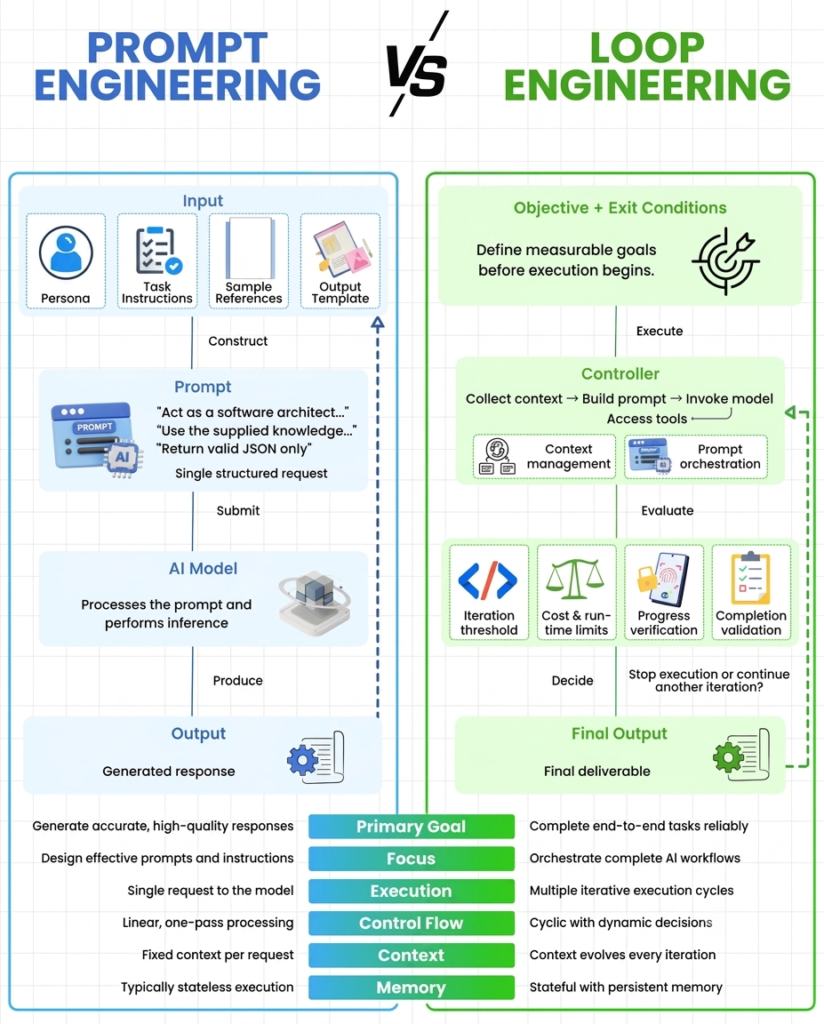
Prompt Engineering vs. Loop Engineering
Many people assume these two ideas compete with each other.
They don’t.
Prompt Engineering and Loop Engineering solve different problems.
Prompt Engineering focuses on improving the first response.
Loop Engineering focuses on improving the final outcome.
You still need a clear initial instruction.
However, once the task begins, the loop takes over.
Instead of waiting for another human prompt after every mistake, the agent can observe, revise, and continue toward the objective within predefined boundaries. This distinction between shaping the initial prompt and designing the broader workflow is a recurring theme in the reference articles.
Key Takeaways
- Loop Engineering is about designing systems, not just prompts.
- Modern AI coding agents rely on continuous feedback to improve their results.
- Prompt Engineering remains valuable, but it represents only the starting point.
- The future of AI development depends on workflows that can plan, act, verify, and adapt autonomously.
How an AI Agent Actually Solves Problems
To understand why Loop Engineering matters, it helps to look at how modern AI agents approach complex work.
Imagine you ask an AI coding agent to fix a failing login system.
A traditional chatbot might immediately generate replacement code based on the information you provided.
A loop-based agent behaves differently.
Before changing anything, it gathers evidence.
It may inspect authentication routes, search for recent commits, review test failures, read server logs, compare similar implementations elsewhere in the repository, and identify the smallest change that could solve the issue.
Only then does it begin modifying the code.
After making a change, it doesn’t simply assume success.
Instead, it validates the outcome.
If a test fails, that failure becomes new information.
If another error appears, the agent adjusts its hypothesis rather than blindly repeating the same solution.
Every iteration makes the next decision more informed than the previous one.
This feedback-driven approach mirrors how experienced software engineers work every day.
The Feedback Loop That Makes AI Smarter
Every successful engineering team relies on feedback.
Developers don’t guess whether software works.
They measure it.
They run tests.
They review logs.
They collect user reports.
They analyze performance.
Loop Engineering applies the same principle to AI.
Notice that feedback sits at the center of the process.
Without feedback, an AI can only guess.
With feedback, it can improve.
The Five Building Blocks of Loop Engineering
Loop Engineering isn’t a single algorithm or framework. Instead, it’s a design philosophy built around a handful of core principles that allow AI agents to solve complex problems through iteration.
Think of these principles as the engine behind every successful autonomous workflow. If one component is missing, the entire loop becomes less reliable.
Let’s explore each one.
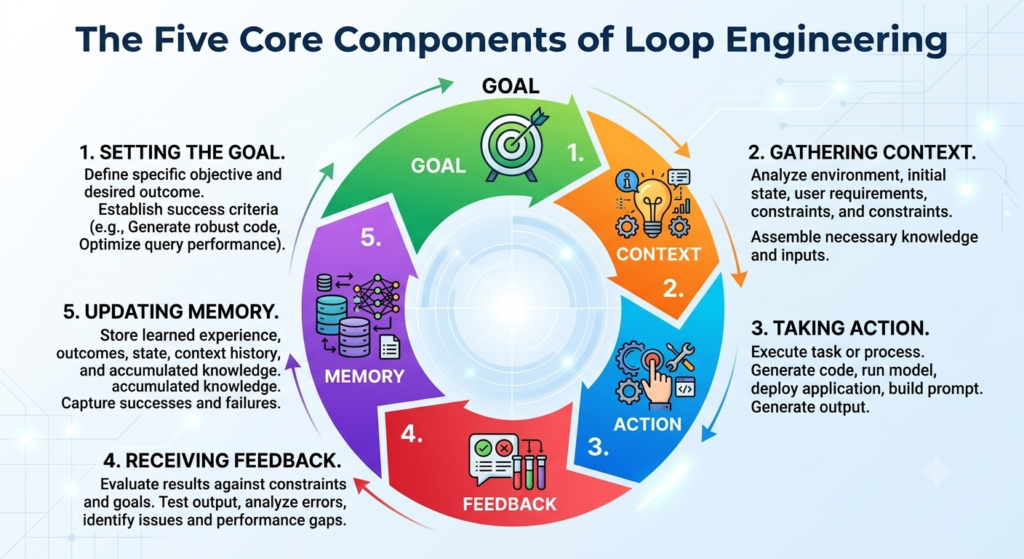
1. A Clearly Defined Goal
Every successful loop begins with a destination.
This sounds obvious, but vague objectives are one of the biggest reasons AI agents fail.
Consider these two instructions:
❌ “Improve my application.”
Now compare it with:
✅ “Reduce homepage loading time below two seconds without affecting SEO or accessibility.”
The second instruction gives the agent:
- A measurable objective
- A performance constraint
- A clear definition of success
Without this clarity, an AI has no reliable way to determine whether it has completed the task or should continue iterating. Source material consistently emphasizes that well-designed loops require specific, testable objectives and explicit success criteria.
2. Rich Context: The Fuel Behind Every Good Decision
Imagine asking a new developer to fix a bug without giving them access to the source code.
That’s exactly what happens when AI agents operate with poor context.
Modern coding agents don’t rely solely on your prompt.
They gather information from multiple sources, including:
- Source code
- Documentation
- Project architecture
- Git history
- Error logs
- Test results
- Coding conventions
This process dramatically reduces incorrect assumptions.
However, more context isn’t always better.
Dumping thousands of irrelevant files into the model can overwhelm it and increase both latency and cost.
Good Loop Engineering focuses on relevant context, not maximum context.
This idea aligns with research on agent workflows, where context gathering is treated as an active step rather than something provided only at the beginning.
3. Small, Reversible Actions
One mistake many beginners make is expecting AI to solve an entire feature in a single iteration.
Professional engineering rarely works that way.
Experienced developers break large problems into smaller pieces because small changes are:
- Easier to review
- Easier to debug
- Easier to test
- Easier to roll back
Loop Engineering follows the same philosophy.
Instead of rewriting an entire authentication system, an AI agent might:
- Update one API endpoint.
- Verify the change.
- Run related tests.
- Fix any failures.
- Continue to the next component.
Small iterations reduce risk while producing higher-quality results over time. This “small reversible actions” approach is one of the defining characteristics of effective AI engineering loops.
4. Continuous Feedback
If goals tell the AI where to go, feedback tells it whether it’s moving in the right direction.
Feedback is arguably the most important component of Loop Engineering.
Without feedback, an AI is simply making educated guesses.
With feedback, it can improve after every attempt.
Depending on the project, feedback may come from:
- Unit tests
- Integration tests
- Compiler errors
- Browser previews
- Performance metrics
- Security scans
- Human code reviews
For example:
An AI generates a database migration.
The migration fails.
Instead of stopping, the agent:
- Reads the error.
- Understands why it failed.
- Updates the migration.
- Executes it again.
- Confirms success.
Notice what’s happening.
The error itself becomes valuable information, not just a failure.
That’s exactly how experienced engineers think.
5. Memory and State Management
One challenge with today’s language models is that they don’t permanently remember previous sessions.
If an AI loses track of what it already tried, it may repeat the same mistakes over and over again.
That’s why advanced Loop Engineering introduces external memory.
This memory can take many forms:
- Markdown progress files
- Issue trackers
- GitHub Issues
- Linear boards
- Project databases
- Agent state files
Instead of relying entirely on the model’s context window, important information is stored externally and reused during future iterations. Your reference sources describe this persistent state as a critical ingredient for long-running autonomous workflows.
A Real-World Example: Fixing a Checkout Bug
Let’s see these concepts in action.
Imagine an online store where customers can’t complete checkout after applying a discount coupon.
Traditional Prompting
A developer types:
“Fix the checkout bug.”
The AI returns code.
If it doesn’t work, the developer writes another prompt.
The process repeats manually.
Loop Engineering Workflow
Now imagine a loop-driven agent.
Instead of guessing, it:
- Reproduces the issue.
- Reads the checkout module.
- Reviews recent Git commits.
- Executes the failing tests.
- Identifies the validation error.
- Updates only the affected files.
- Runs tests again.
- Checks browser behavior.
- Confirms the fix.
- Stops automatically once every validation passes.
Notice something important.
The AI wasn’t simply generating code.
It was following an engineering workflow.
That’s exactly why Loop Engineering is becoming the foundation of modern AI software development.
Why Loop Engineering Is Becoming the Industry Standard?
The conversation around AI has shifted dramatically.
A year ago, developers mostly asked:
“Which AI model writes the best code?”
Today, experienced teams ask a different question:
“How do we design a workflow that allows any capable model to solve problems reliably?”
That’s a much bigger question.
And that’s exactly what Loop Engineering answers.
Major AI platforms are increasingly investing in tools that support planning, tool use, verification, and iterative execution rather than one-shot code generation alone. While implementations differ, the underlying design philosophy is converging toward structured feedback loops.
The Biggest Benefits of Loop Engineering
Loop Engineering isn’t just another AI trend. It represents a fundamental shift in how developers interact with intelligent systems.
Instead of treating AI as a tool that generates code, Loop Engineering treats AI as an active collaborator capable of improving its work through continuous feedback.
When implemented correctly, this approach offers significant advantages for both individual developers and engineering teams.
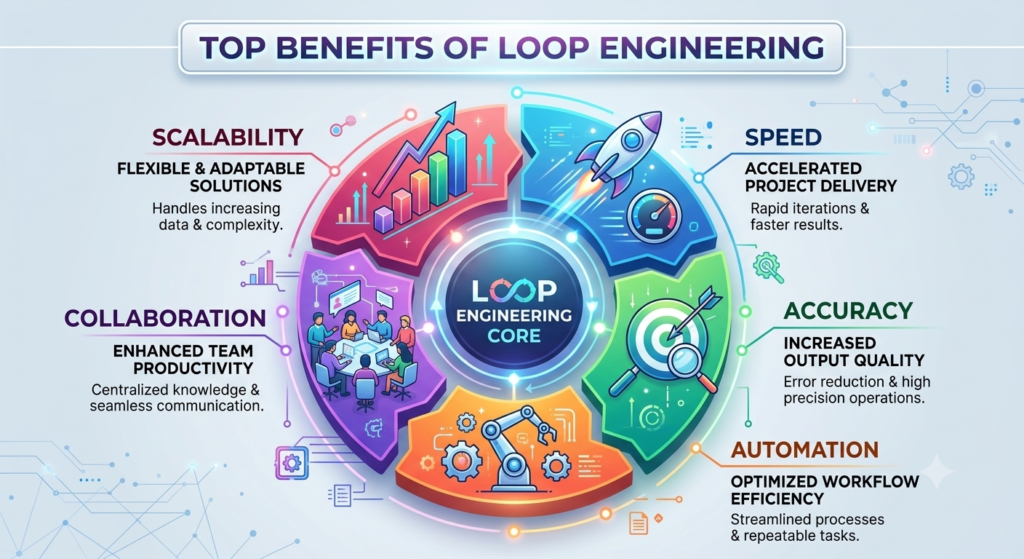
1. Better Software Quality
The biggest advantage of Loop Engineering is reliability.
Traditional prompting assumes the first answer is good enough.
Loop Engineering assumes the first answer is only the beginning.
Every iteration gives the AI another opportunity to:
- Detect mistakes
- Verify assumptions
- Improve implementation
- Reduce technical debt
Instead of relying on confidence, the AI relies on evidence.
That simple difference produces significantly better software.
2. Faster Development Cycles
Modern software projects involve hundreds of tiny decisions.
Developers constantly switch between:
- Writing code
- Running tests
- Reading logs
- Debugging issues
- Updating documentation
- Reviewing pull requests
Loop Engineering automates much of this repetitive cycle.
Rather than waiting for another human instruction after every failure, the AI can continue working until it reaches a predefined success condition.
This doesn’t replace developers—it removes repetitive mechanical work so engineers can focus on solving higher-level problems.
3. Improved Consistency Across Teams
Every engineering team has coding standards.
Some teams prefer specific naming conventions.
Others enforce strict testing requirements.
Many organizations require accessibility checks, security reviews, or documentation updates before code can be merged.
Loop Engineering allows these standards to become part of the workflow instead of relying entirely on individual developers to remember them.
The result is more predictable software and fewer inconsistencies across large teams.
4. Easier Scaling
A single engineer can only review so many changes each day.
Loop-based workflows make it easier to scale engineering efforts because routine validation becomes automated.
AI agents can simultaneously:
- Analyze documentation
- Generate tests
- Check linting
- Verify builds
- Review dependencies
- Monitor regressions
This doesn’t eliminate human review.
Instead, it allows reviewers to spend more time evaluating architecture, security, and business logic instead of mechanical corrections.
5. Better Learning Through Feedback
Perhaps the most underrated benefit is that loops encourage continuous improvement.
Every failed build…
Every compiler warning…
Every security alert…
Every user report…
becomes new information that guides the next iteration.
Instead of treating failures as obstacles, Loop Engineering treats them as learning opportunities.
Challenges and Limitations
As exciting as Loop Engineering is, it’s important to recognize its limitations.
Autonomous workflows are only as reliable as the systems surrounding them.
Poorly designed loops can create expensive, repetitive, and sometimes dangerous behavior.
Let’s examine the most common challenges.
Infinite Loops
Imagine an AI repeatedly attempting the same fix without changing its strategy.
It consumes API calls.
It modifies code.
It retries.
Nothing improves.
Without proper stopping rules, the workflow never ends.
This is why every loop needs explicit exit conditions.
Good loops know both:
- when to continue
and
- when to stop.
Context Drift
AI agents make decisions based on the information available to them.
But software projects evolve quickly.
Another developer may merge new code.
Requirements may change.
Tests may be updated.
If the agent continues working from outdated assumptions, it may begin solving the wrong problem.
This issue often referred to as context drift is one of the most common failure modes in long running AI workflows. Refreshing context after important observations helps prevent the agent from continuing with stale assumptions.
Rising Costs
Every iteration consumes resources.
Large autonomous workflows may execute:
- dozens of tool calls
- multiple reasoning steps
- repeated testing
- browser automation
- repository searches
Without sensible limits, costs can grow quickly.
Successful engineering teams therefore balance autonomy with practical limits, such as iteration budgets, validation checkpoints, and escalation rules.
Unsafe Autonomy
Should an AI automatically deploy production code?
Delete databases?
Merge pull requests?
Probably not.
Loop Engineering isn’t about removing human oversight.
It’s about deciding which decisions can safely be automated and which still require human judgment.
The strongest workflows define clear boundaries around high risk actions.
Best Practices for Designing Reliable Loops
After studying how modern AI coding workflows operate, several best practices consistently emerge.
These practices apply whether you’re building your own AI agent or simply using an existing coding assistant.
Define Success Before Writing the First Prompt
Many developers immediately ask an AI to solve a problem.
Professional engineering starts differently.
First define:
- What success looks like
- How success will be measured
- Which validation commands must pass
- When the agent should stop
Without measurable objectives, even powerful AI models can wander indefinitely.
Keep Changes Small
Large rewrites create unnecessary uncertainty.
Instead:
✔ Modify one module.
✔ Verify the result.
✔ Expand only after validation succeeds.
Smaller changes are easier to review, easier to debug, and far less likely to introduce hidden regressions.
Treat Feedback as Evidence
A failed test is not bad news.
It’s information.
The same is true for:
- stack traces
- runtime logs
- browser screenshots
- performance reports
- code review comments
Every observation should influence the next iteration.
That’s the essence of Loop Engineering.
Separate Planning From Verification
One increasingly popular practice is dividing responsibilities between different agents.
For example:
Agent A:
- plans the implementation
Agent B:
- writes the code
Agent C:
- reviews the implementation
Agent D:
- verifies testing
Separating responsibilities reduces bias and improves overall reliability, similar to how human engineering teams divide responsibilities across planning, implementation, and review.
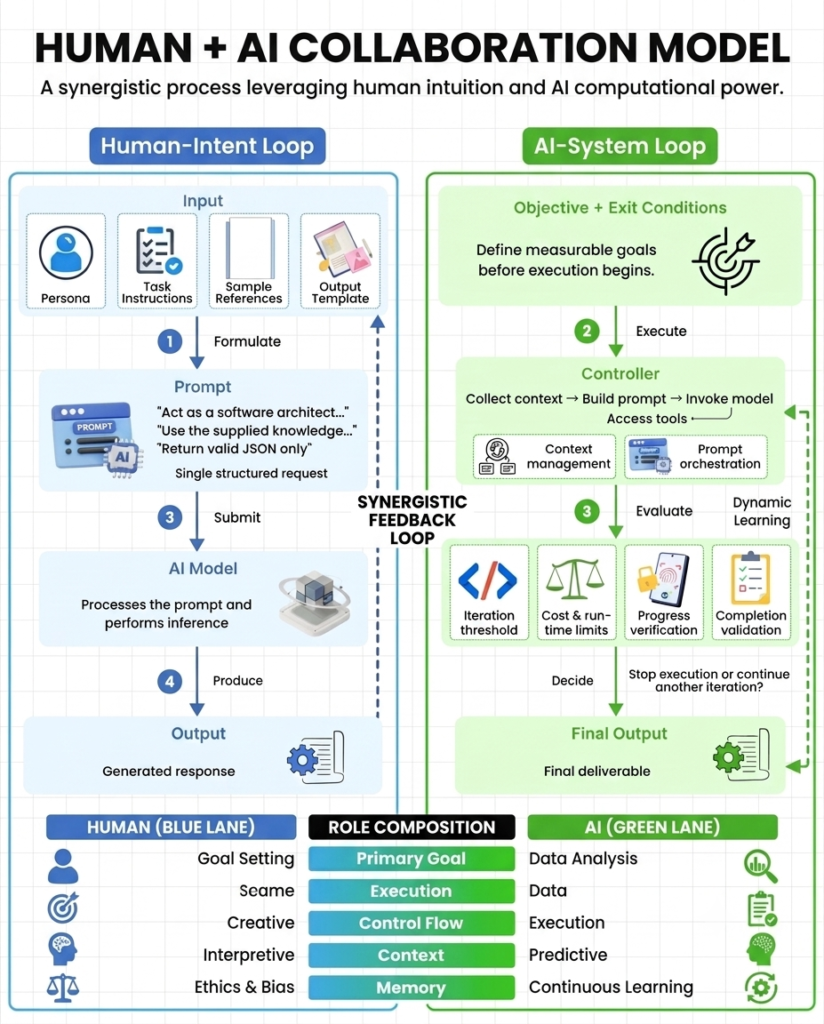
Keep Humans in the Decision Loop
AI is remarkably good at automation.
Humans remain remarkably good at judgment.
Engineering involves trade-offs that extend beyond code:
- customer experience
- business priorities
- legal requirements
- security risks
- long-term maintainability
Loop Engineering should enhance human decision-making not replace it.
The Future of Loop Engineering
We are still in the early stages of autonomous AI development.
Today’s coding agents are far more capable than those available just two years ago, yet they’re only beginning to demonstrate what’s possible.
Over the next few years, we’ll likely see AI agents capable of managing increasingly sophisticated workflows with less human intervention.
Instead of evaluating AI systems based only on their first response, developers will increasingly evaluate them by asking questions such as:
- Can the agent recover from mistakes?
- Can it verify its own work?
- Can it collaborate with other agents?
- Can it adapt to changing requirements?
- Can it stop at the appropriate time?
These questions represent the next stage of AI-assisted software engineering.
The emphasis is shifting away from writing better prompts and toward designing better systems.
Frequently Asked Questions (FAQs)
What is Loop Engineering in AI?
Loop Engineering is the practice of designing AI workflows where an agent repeatedly plans, performs actions, observes results, and adjusts its behavior until a defined goal is achieved.
How is Loop Engineering different from Prompt Engineering?
Prompt Engineering focuses on improving the quality of the initial instruction.
Loop Engineering focuses on designing the entire workflow—including context gathering, tool usage, validation, feedback, and stopping conditions—that guides the AI toward a successful final outcome.
Why is Loop Engineering important for AI coding agents?
Modern AI coding agents operate in complex environments where they must read code, execute tests, analyze failures, and refine solutions. Loop Engineering provides the iterative structure needed to perform those tasks reliably instead of relying on a single response.
Does Loop Engineering replace software engineers?
No.
Loop Engineering automates repetitive execution, but human engineers remain responsible for architecture, product decisions, security, and final approval.
The goal is collaboration not replacement.
Can beginners learn Loop Engineering?
Absolutely.
You don’t need to build autonomous AI systems from scratch.
Understanding feedback loops, validation, context management, and iterative problem-solving provides a strong foundation before moving on to advanced AI agent development.
Final Thoughts
Artificial intelligence is entering a new era.
The most important skill is no longer writing the perfect prompt—it’s designing intelligent systems that can reason, act, observe, and improve over time.
Loop Engineering represents this shift.
It transforms AI from a passive assistant into an active collaborator capable of solving complex engineering problems through continuous iteration.
Yet the most effective implementations will never rely on automation alone.
They combine autonomous workflows with human expertise, clear objectives, reliable validation, and thoughtful oversight.
As AI coding agents continue to evolve, developers who understand Loop Engineering won’t just use better tools—they’ll build better systems.
Further Reading (Authoritative Resources)
To deepen your understanding of the concepts discussed in this guide, explore these trusted resources:
- OpenAI: https://openai.com/
- Anthropic: https://www.anthropic.com/
- Google Research – React: Synergizing Reasoning and Acting in Language Models: https://research.google/blog/react-synergizing-reasoning-and-acting-in-language-models/
- Git Documentation: https://git-scm.com/docs
- Model Context Protocol (MCP): https://modelcontextprotocol.io/