Microservices Communication Patterns: REST, gRPC, and Messaging
Modern applications often consist of multiple independent services that must exchange data, coordinate business operations, and recover from failures without bringing down the entire system. Choosing the wrong communication approach can introduce unnecessary latency, tight coupling, cascading failures, and difficult debugging.
Microservices communication patterns define how services exchange information and coordinate their work in a distributed system. Common approaches include REST APIs, gRPC, message queues, and publish-subscribe messaging. Each approach has different benefits, trade-offs, and use cases.
In this guide, you’ll learn how microservices communicate with each other, how synchronous and asynchronous communication differ, when to choose REST or gRPC, and how to design reliable communication for real-world applications.
What Are Microservices Communication Patterns?
Microservices communication patterns are established approaches that define how independent services send requests, exchange messages, publish events, and receive responses.
In a microservices architecture, each service typically owns a specific business capability. For example, an e-commerce application might have separate order, payment, inventory, and notification services. These services must communicate to complete a customer’s purchase.
A service can communicate directly with another service through an API or indirectly through a message broker. The appropriate communication pattern depends on whether the operation needs an immediate response, can run in the background, or must notify multiple services about an event.
Well-designed communication patterns help improve scalability, maintain loose coupling, and support fault tolerance. However, adding more services also introduces network latency, distributed failures, and data consistency challenges.
How Do Microservices Communicate With Each Other?
Microservices communicate over a network using defined protocols, APIs, or messaging infrastructure. The main approaches are synchronous request-response and asynchronous message-based communication.
- REST APIs: Services exchange HTTP requests and responses, commonly using JSON.
- gRPC: Services invoke defined remote procedures using protocol buffers and typically HTTP/2.
- Message queues: A producer sends a message to a broker or queue for later processing by a consumer.
- Publish-subscribe: A producer publishes an event that can be received by multiple interested consumers.
An API Gateway can also route client requests to the appropriate service, enforce authentication, and provide a common entry point for external clients. Understanding the difference between an API Gateway and a load balancer can help you decide where routing, traffic distribution, and security responsibilities belong. However, not every internal service interaction needs to pass through a gateway.
Microsoft Learn’s guide to communication in a microservice architecture explains the main approaches and the trade-offs involved in service-to-service communication.
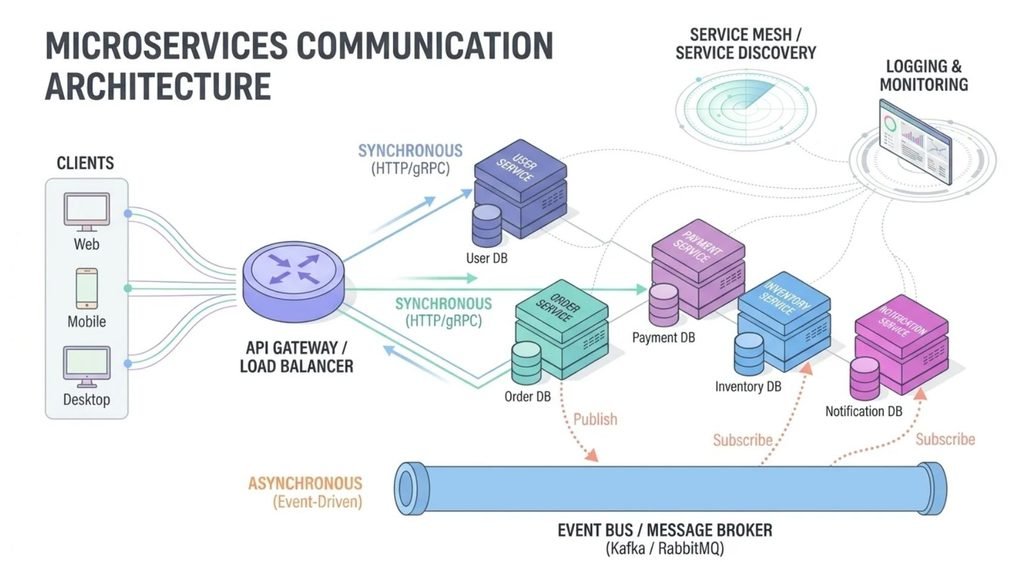
- Suggested filename:
microservices-communication-architecture.webp - Alt text: Microservices communication architecture showing an API gateway, direct service requests, and asynchronous messaging between services.
- Visual concept: Show a client connecting to an API Gateway, with REST and gRPC calls between services and a message broker distributing events to multiple consumers.
Synchronous vs. Asynchronous Communication in Microservices
The first major decision when designing communication in microservices is whether a service needs to wait for another service’s response.
Synchronous communication
With synchronous communication, a calling service sends a request and waits for a response before continuing the dependent operation. REST and gRPC commonly use this model.
For example, an order service might request a shipping quote from a delivery service before showing the final delivery cost to a customer.
The main benefit is straightforward request-response behavior. The caller can use the returned result immediately. The trade-off is that network delays or an unavailable dependency can slow down the calling service.
Long chains of synchronous calls can increase latency and create cascading failures, especially when several services must respond before one request can finish.
Asynchronous communication
With asynchronous communication, a service sends a message or publishes an event without necessarily waiting for the receiving service to finish processing it.
For example, after an order is accepted, the order service can publish an OrderCreated event. Inventory, analytics, and notification services can process that event independently.
This approach can improve scalability and reduce direct dependencies between services. It is particularly useful for background jobs, event-driven workflows, and operations that do not require an immediate result.
However, asynchronous systems require additional care around retries, duplicate messages, event ordering, and eventual consistency.
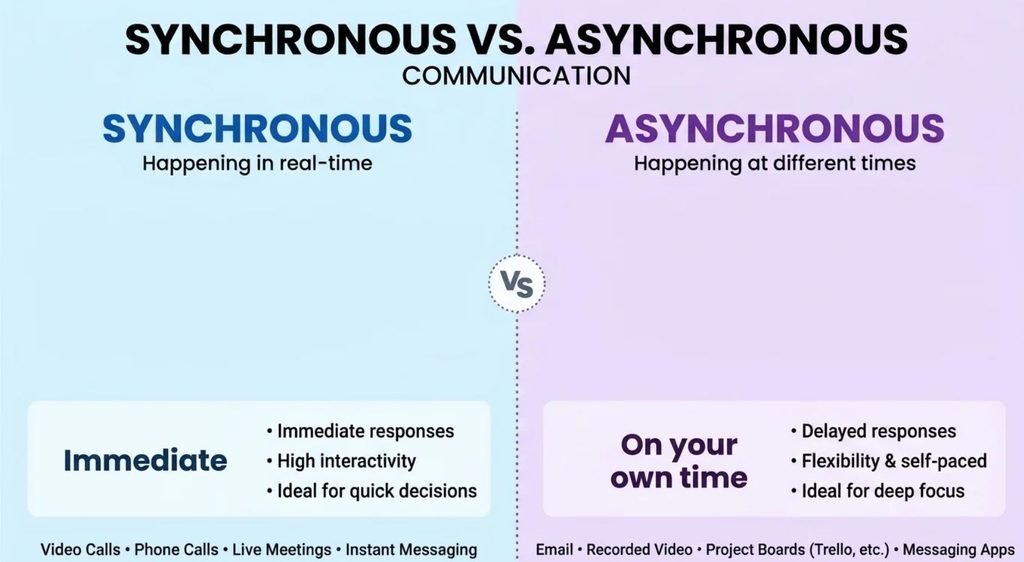
- Suggested filename:
synchronous-vs-asynchronous-microservices.webp - Alt text: Comparison of synchronous request-response and asynchronous message-based communication between microservices.
- Visual concept: In the synchronous flow, Service A waits for Service B’s response. In the asynchronous flow, Service A publishes a message and continues while a consumer processes it separately.
One important distinction: asynchronous programming and asynchronous messaging are not identical. An application can use asynchronous I/O while communicating over HTTP, and a message-based system can still contain synchronous steps elsewhere in its workflow.
Common Microservices Communication Patterns
Different communication patterns solve different problems. The following approaches are among the most widely used in distributed applications.
1. REST API and HTTP Request-Response
REST APIs provide a familiar way for services to exchange resources over HTTP. They commonly use methods such as GET, POST, PUT, and DELETE, with JSON as the data format.
For example, an order service might call a payment service using an HTTP endpoint to initiate a payment or retrieve its status.
Benefits:
- Widely supported across languages and platforms.
- Straightforward integration with web clients and external systems.
- Easy to inspect using standard HTTP tools.
- Suitable for resource-based APIs and many request-response interactions.
Trade-offs:
REST calls still depend on network availability and response times. Services must handle timeouts, errors, authentication, and API versioning carefully.
REST is a strong choice when interoperability and simplicity matter more than specialized high-performance service communication.
2. gRPC and Remote Procedure Calls
gRPC is a framework for remote procedure calls that allows one service to invoke an operation exposed by another service. It commonly uses Protocol Buffers to define service contracts and serialize messages efficiently.
For example, an inventory service might expose a gRPC method that allows the order service to check product availability.
Benefits:
- Compact binary serialization through Protocol Buffers.
- Generated client and server code.
- Strongly defined service contracts.
- Support for unary calls and streaming communication.
Trade-offs:
gRPC may require additional tooling and can be less convenient to inspect manually than JSON-based REST APIs. Browser integration can also require gRPC-Web or a suitable intermediary.
Choose gRPC when service-to-service communication benefits from strongly defined contracts, efficient serialization, or streaming. Choose REST when straightforward HTTP interoperability is the priority.
3. Message Queues and Point-to-Point Messaging
A message queue allows a producer to send a message for a consumer to process, often through a broker. The sender does not necessarily need to wait for the consumer to complete the operation.
For example, an order service can enqueue an invoice-generation task while the customer-facing request continues.
Technologies such as RabbitMQ and Apache Kafka support messaging workflows, although they use different messaging models and should not be treated as interchangeable.
Benefits:
- Separates message production from processing.
- Helps absorb temporary workload spikes.
- Supports background processing and retries.
- Can improve resilience when consumers are temporarily unavailable, provided the messaging infrastructure is configured appropriately.
Trade-offs:
Queues introduce operational complexity. Teams must consider message durability, delivery guarantees, duplicate processing, retry policies, dead-letter handling, and monitoring.
A queue is particularly useful when work can be processed later and the producer does not need an immediate result.
4. Publish-Subscribe and Event-Driven Communication
The publish-subscribe pattern allows a producer to publish a message or event to a topic, exchange, or event stream. Multiple subscribers can receive the information independently.
Consider an order service that publishes an OrderCreated event. The inventory service can reserve stock, the notification service can send a confirmation, and the analytics service can record the order.
This is an example of event-driven communication: services react to events instead of relying exclusively on direct calls between one another.
Benefits:
- Supports multiple independent consumers.
- Reduces direct dependencies between producers and consumers.
- Makes it easier to add new event consumers.
- Helps support scalable, event-driven workflows.
Trade-offs:
Events introduce questions about schema evolution, duplicate delivery, ordering, and eventual consistency. Publishing an event reliably alongside a database transaction may require a transactional outbox or another reliable publishing strategy.
Use publish-subscribe when several services need to react to the same business event. Use direct request-response communication when the caller needs an immediate answer from a specific service.
5. Request-Reply and Asynchronous Responses
Request-reply is a communication pattern in which a caller sends a request and receives a corresponding response. It can be implemented synchronously over HTTP or through asynchronous messaging.
For example, a service might send a message containing a correlation ID and later receive a response through a reply queue or topic.
This can be useful when a request must pass through messaging infrastructure but the workflow still requires a result. The caller may need to wait, poll for completion, or receive a callback, depending on the design.
Request-reply over messaging is more complex than a straightforward HTTP request. It requires correlation IDs, timeout handling, response routing, and safeguards against duplicate or late responses.
REST vs. gRPC vs. Message Queues
The best communication approach depends on the business requirement, response expectations, operational complexity, and reliability needs.
| Factor | REST/HTTP | gRPC | Message queues |
|---|---|---|---|
| Typical interaction | Request-response | Remote procedure call | Message delivery |
| Immediate response | Common | Common | Not usually required |
| Data format | Often JSON | Commonly Protocol Buffers | Depends on the implementation |
| Coupling | Direct endpoint dependency | Direct service contract dependency | Producers and consumers can be more loosely coupled |
| Common use case | Public and internal APIs | Efficient service-to-service calls | Background and deferred processing |
| Main trade-off | Network latency and API management | Tooling and client compatibility | Delivery, retries, and consistency complexity |
Publish-subscribe is another important option, particularly when multiple consumers need the same event. It is a messaging interaction model rather than a direct replacement for every request-response API.
For additional architecture guidance, see the AWS overview of microservices communication mechanisms and the Azure Architecture Center’s guide to interservice communication.
Real-World Example of Microservices Communication
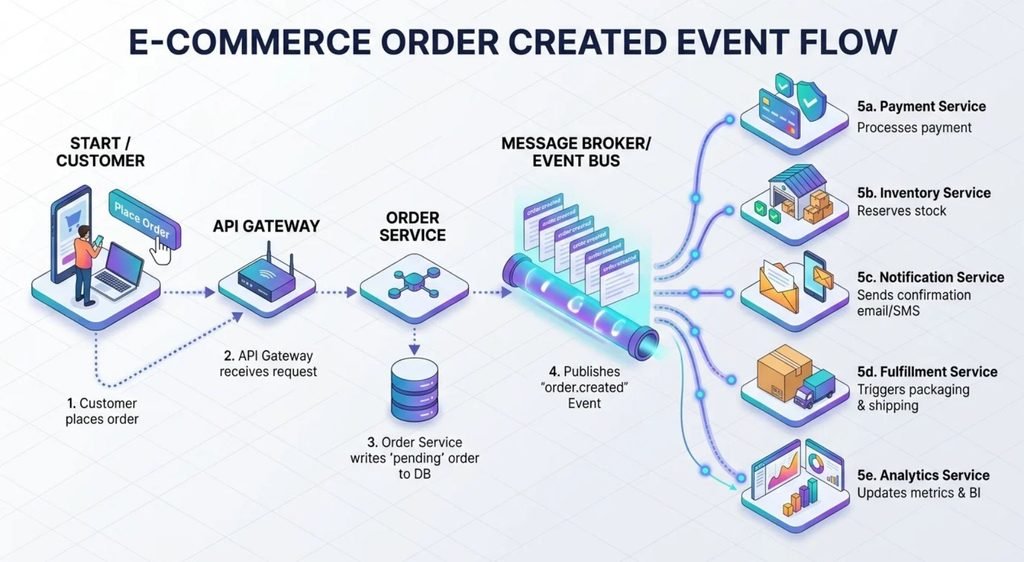
Consider an e-commerce application in which a customer places an order. The workflow involves several services, each responsible for a different business capability.
Communication in an e-commerce order workflow
A possible design looks like this:
- Client request: The client sends an order request through an API Gateway.
- Order creation: The order service validates the request and records the order in its database.
- Event publishing: Once the order has been committed, the system reliably publishes an
OrderCreatedevent. - Payment processing: The payment service processes or initiates the required payment workflow.
- Inventory management: The inventory service checks or reserves stock.
- Notification: The notification service sends an order confirmation or a later status update.
- Suggested filename:
microservices-order-created-event-flow.webp - Alt text: E-commerce order service publishing an OrderCreated event to payment, inventory, and notification services.
- Visual concept: Show the client, API Gateway, order service, database, event broker, and separate consumers. Distinguish the database write from reliable event publication.
The exact order of these operations depends on business requirements. For example, an application may need to authorize payment and reserve inventory before confirming an order. An event being published does not automatically mean payment has succeeded or inventory is available.
Handling service failures and delayed messages
Suppose the notification service is unavailable when an order is created. With asynchronous messaging, the event can remain available for later processing if the broker and consumer are configured appropriately.
The consumer should use bounded retries and appropriate error handling. Messages that repeatedly fail may be moved to a dead-letter queue for investigation.
If payment succeeds but inventory reservation fails, the application may need a distributed workflow with compensating actions. The Saga pattern can coordinate these steps through orchestration or choreography.
For reliable event publishing, the transactional outbox pattern can help prevent a database update from succeeding while its corresponding event is lost.
These mechanisms improve resilience, but they do not eliminate the need for monitoring, idempotent processing, and clear business rules.
Microservices Communication Best Practices
Effective communication between microservices requires more than selecting a protocol. The design must account for failure, security, data consistency, and operational visibility.
1. Choose the pattern based on the requirement
Use synchronous request-response when a caller needs a result before proceeding. Prefer asynchronous messaging when processing can happen later or multiple services need to react independently.
Hybrid approaches are often appropriate: a service may use REST for a customer-facing query and publish an event for background processing.
2. Set timeouts and use bounded retries
Every network call should have a reasonable timeout. Retries should be limited and use backoff, often with jitter, to avoid overwhelming a struggling dependency.
Only retry operations when doing so is safe. Use idempotency keys or other safeguards for operations such as payment processing that must not be executed twice accidentally.
3. Apply circuit breakers and bulkheads
A circuit breaker can stop repeated calls to a failing dependency temporarily, allowing the system to recover rather than continually retrying. You can learn more about implementing the Circuit Breaker Pattern in Microservices and how it helps reduce cascading failures.
The bulkhead pattern isolates resources so that a failure or overload in one area is less likely to consume all available capacity. Both patterns can help reduce cascading failures, but they address different failure modes.
4. Design for message delivery failures
Do not assume every message will be delivered exactly once or processed only once. Delivery semantics depend on the broker, configuration, and application design.
Consumers should be idempotent where necessary. Plan for duplicate messages, dead-letter handling, retries, and event schema changes. For important business events, ensure database updates and event publication are coordinated reliably.
5. Secure service-to-service communication
Use appropriate authentication and authorization, protect data in transit, manage credentials securely, and limit access to APIs and messaging infrastructure.
An API Gateway can help enforce policies for external traffic, while rate limiting can help control excessive requests and protect backend services. Internal service communication also needs its own security controls.
6. Monitor latency, failures, and message backlogs
Use centralized logs, metrics, distributed tracing, and correlation IDs to follow requests across service boundaries.
Track relevant signals such as request latency, error rates, timeout frequency, retry volume, consumer processing time, and queue backlog. Monitoring helps engineers locate bottlenecks and identify failures before they spread.
7. Avoid unnecessary synchronous chains
Long chains of synchronous calls can make overall response time dependent on several services. Where the business process allows it, consider asynchronous workflows, aggregation, or redesigning service responsibilities to reduce unnecessary network calls.
For broader architectural guidance, explore S4Stack’s System Design Cheat Sheet and learn how the API Gateway vs. Load Balancer distinction affects routing and traffic management in distributed systems.
Common Microservices Communication Challenges
Even a well-designed system can encounter challenges as the number of services grows.
- Network latency: Multiple remote calls can make a request slower than a local operation.
- Cascading failures: A failing dependency can affect services that depend on it.
- Data consistency: Asynchronous processing means services may temporarily hold different views of business state.
- Message duplication: A consumer may receive a message more than once, depending on delivery behavior.
- Service discovery: Callers need a reliable way to locate service instances as deployments and scaling change.
- Observability: Debugging a single business operation across many services requires correlated logs, traces, and metrics.
- Operational complexity: Brokers, retries, schemas, security, and versioning all need ongoing management.
These are reasons to design communication deliberately—not reasons to adopt every available pattern. Start with the simplest approach that satisfies the system’s requirements, then add complexity when there is a clear benefit. For a broader overview of architectural decisions, including load balancing, message queues, scalability, and fault tolerance, explore S4Stack’s System Design Cheat Sheet.
Frequently Asked Questions
1. How should microservices communicate?
Microservices can communicate through synchronous APIs such as REST and gRPC, or asynchronously through message queues and publish-subscribe messaging. Choose based on whether an immediate response is necessary, how tightly services should be coupled, and what reliability requirements the workflow has.
2. What are microservices communication patterns?
They are approaches for exchanging data and coordinating work between independent services. Common examples include REST request-response, gRPC, point-to-point messaging, publish-subscribe, and event-driven communication.
3. What is the difference between synchronous and asynchronous communication in microservices?
Synchronous communication generally requires the caller to wait for a response. Asynchronous messaging allows the sender to continue without waiting for the consumer to finish processing. Synchronous calls simplify immediate interactions, while asynchronous messaging can improve decoupling and support background workloads.
4. When should you use REST vs. gRPC in microservices?
Use REST when HTTP interoperability, straightforward APIs, and broad client support are important. Consider gRPC when strongly defined contracts, code generation, efficient serialization, or streaming are valuable for service-to-service interactions. The right choice depends on client compatibility and operational needs.
5. What is the role of message queues in microservices?
Message queues decouple producers from consumers and allow work to be processed later. They are useful for background jobs, workload buffering, and workflows that do not require an immediate response. Reliable implementations need appropriate delivery, retry, and duplicate-processing strategies.
6. How does event-driven communication work in microservices?
A service publishes an event when something meaningful happens, and interested services consume that event independently. For example, an OrderCreated event can trigger inventory processing, notifications, and analytics without requiring the order service to call every consumer directly.
7. How can you handle communication failures between microservices?
Use timeouts, bounded retries, appropriate backoff, circuit breakers, and resource isolation. For asynchronous messaging, also plan for duplicate delivery, dead-letter handling, idempotent consumers, and monitoring. The exact safeguards depend on the operation and the guarantees provided by the communication infrastructure.
Conclusion
Choosing the right microservices communication patterns is essential for building scalable, reliable, and maintainable distributed systems. REST and gRPC are useful for request-response interactions, while message queues and publish-subscribe support asynchronous processing and looser coupling.
There is no universally best pattern. Evaluate response requirements, latency, failure behavior, data consistency, security, and operational complexity before choosing. Start with a clear business requirement, keep service interactions as simple as practical, and add resilience mechanisms where the risks justify them.
When these decisions are made deliberately, teams can build microservices that communicate effectively without creating unnecessary dependencies or complexity.