If you’re wondering how to become an AI engineer in 2026, here’s the short answer: learn Python and the core AI skills (prompt engineering, RAG, model deployment), build a portfolio of real projects, and apply with proof of work instead of just a resume. That’s the whole roadmap the rest of this guide breaks down exactly how to do each step.
AI engineering is one of those rare tech careers where the demand curve and the salary curve are climbing at the same time. Every recommendation you get on Netflix, every chatbot that resolves your customer support ticket, every fraud alert your bank sends there’s an AI engineer somewhere behind it. And in 2026, companies are still hiring for this role faster than they can find qualified people.
The good news? You don’t need a PhD to break into this field. You don’t even need a computer science degree, though it helps. What you need is a clear roadmap, real skills, and a portfolio that proves you can actually build things. This guide walks through exactly how to become an AI engineer in 2026 no fluff, no recycled listicle advice, just what actually gets you hired.

How to Become an AI Engineer in 2026: Quick Overview
Before diving into the details, here’s the roadmap at a glance:
- Learn Python and core AI skills (prompt engineering, RAG, model deployment)
- Build a portfolio of real, deployed projects
- Apply strategically and prepare for AI-specific interviews
- Skill up further with LangChain, Hugging Face, and AI agents
Now let’s break down each step.
What Does an AI Engineer Actually Do?
Before chasing the title, it’s worth understanding the job. An AI engineer takes machine learning models often ones that already exist, like large language models and turns them into real, working products. That means:
- Designing and building the infrastructure that AI systems run on
- Turning trained models into APIs that other apps and teams can use
- Working with data pipelines to keep models fed with clean, relevant data
- Collaborating with product managers and data scientists to solve actual business problems
- Monitoring, testing, and improving systems once they’re live
It’s different from being a data scientist, whose job leans more toward research and analysis, and it’s different from a traditional software developer, who typically isn’t training or fine tuning models. AI engineering sits at the intersection of software engineering and machine learning you’re building production systems, not just running experiments in a notebook.
Why 2026 Is a Good Time to Get Into This Field
If you’re deciding whether it’s worth learning how to become an AI engineer in 2026, the numbers make a strong case. Job growth for roles adjacent to AI engineering — like computer and information research scientists — is projected at roughly 20% between 2024 and 2034, which is far above the average for all occupations. Salaries reflect that demand too. Depending on the source and location, AI engineers in the U.S. are earning anywhere from the high $130,000s to well over $150,000 in median total compensation, with senior and specialized roles (especially at software publishers and large tech firms) pushing past $230,000.
That said, competition for entry-level roles is real. Because the field is attractive and the barrier to entry (no degree required) is lower than most tech careers, you’ll be up against a lot of self-taught applicants. The people who get hired are the ones who can prove their skills, not just list them.
Step 1: Learn the Core Technical Skills
You don’t need to learn everything at once. Work through these in order, and don’t jump ahead until you’re comfortable with the fundamentals.
Python (and the basics of programming)
Python is the backbone of almost every AI and machine learning workflow you’ll touch. It’s readable, has a massive ecosystem of libraries, and is the language most job postings ask for. Start here before anything else even before you touch AI specific tools. You should be comfortable with data structures, functions, working with APIs, and basic debugging before moving on.
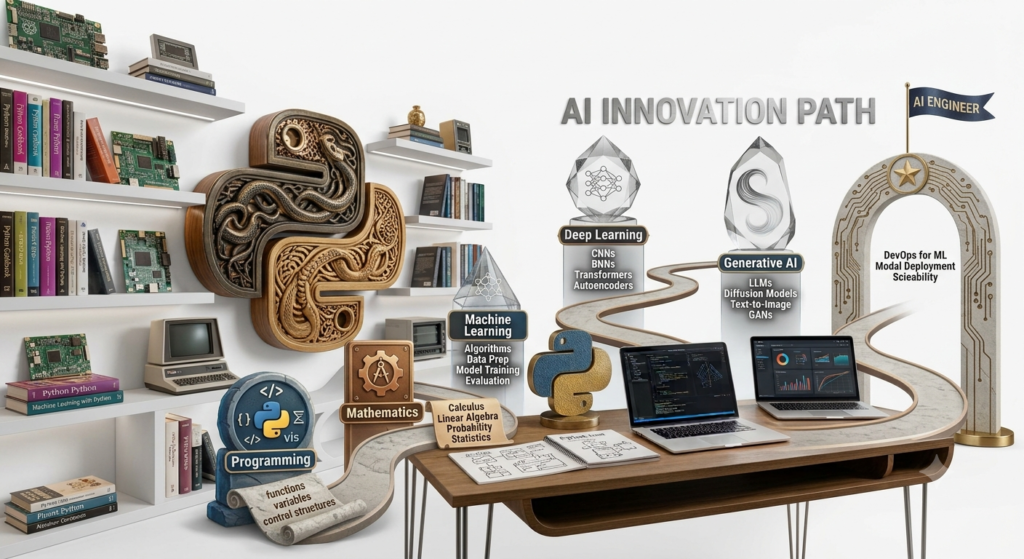
Math Fundamentals: Statistics, Probability, and Linear Algebra
You don’t need to be a mathematician, but you do need enough statistics and linear algebra to understand how models actually work under the hood otherwise you’re just copy-pasting code you don’t understand. This matters most when you’re debugging a model that isn’t performing well and need to reason about why.
Prompt Engineering
With most modern AI products built on top of large language models, knowing how to reliably get useful output from an LLM is now a foundational skill, not a nice-to-have. This includes understanding how models interpret instructions, why they sometimes go off track, and techniques for getting consistent, structured results.
Retrieval-Augmented Generation (RAG)
Out of the box, an LLM only knows what it was trained on — it has no idea about your company’s internal documents or anything that happened after its training cutoff. RAG solves this by connecting a language model to your own data sources so it can pull in relevant, up-to-date information before generating a response. This is one of the most widely used patterns in production AI systems today, and it shows up constantly in interviews.
Machine Learning Frameworks
Get hands-on with at least one deep learning framework — TensorFlow or PyTorch are the two you’ll see most often in job listings. You should understand common algorithms (like linear regression and classification models) as well as how neural networks are structured, even if you’re mostly working with pre-trained models rather than building architectures from scratch.
Model Deployment
Building a model that works on your laptop and getting it to run reliably for thousands of real users are two very different challenges. Learn how to deploy and scale models using a cloud platform — AWS SageMaker, Google Cloud’s Vertex AI, or similar tools. This is where a lot of self-taught candidates fall short, and it’s exactly why employers value it so highly.
Step 2: Build a Portfolio That Proves You Can Do the Work
Portfolio-building is arguably the most overlooked part of how to become an AI engineer in 2026. Here’s the truth most people don’t want to hear: nobody cares about your certificates. They care about whether you can ship working software.
Your portfolio should include 2–4 real projects, not tutorials you followed step by step. Some ideas that actually demonstrate AI engineering skill:
- A RAG-based chatbot that answers questions from a specific document set (like a PDF knowledge base)
- An API that wraps a fine-tuned or pre-trained model and serves predictions
- A small AI agent that can complete a multi-step task autonomously
- A deployed model with monitoring, so you can show you understand what happens after launch
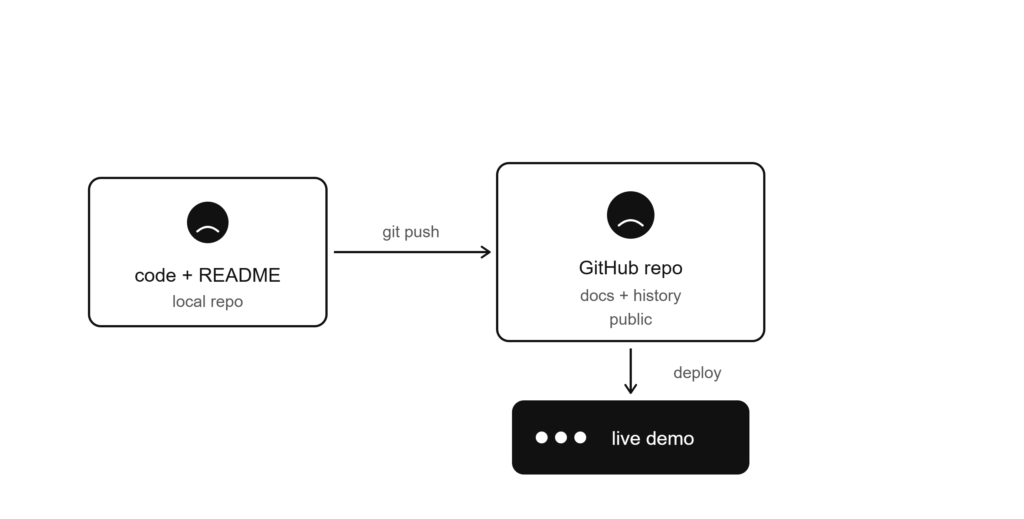
Push everything to GitHub with clear documentation, and if you can, deploy at least one project somewhere live so people can actually interact with it instead of just reading code.
Step 3: Apply for Jobs — and Prepare for a Different Kind of Interview
AI engineering interviews tend to follow a fairly predictable structure, though it varies company to company:
- An initial screening or online assessment — a basic filter given the volume of applicants
- A technical assessment, often done remotely
- A live technical interview, where you’ll be asked to reason through AI-specific problems
- A take-home or live project, simulating real day-to-day work
- A behavioral interview to assess team fit
One thing that trips people up: interviewers usually care more about how you think through a problem than whether you land on the “correct” answer immediately. If you don’t know something, talk through your reasoning out loud. Employers are hiring for problem solving ability, not a memorized answer key.
When it comes to your resume, lead with specific projects, not generic skill lists. “Built a RAG chatbot using LangChain and OpenAI’s API that answers questions from a 200 page internal wiki” tells a hiring manager far more than “experienced in machine learning.”
Step 4: Level Up With In-Demand Specializations
Once you’ve landed your first role or if you want to stand out even before that these skills will make you significantly more competitive:
LangChain and LangGraph: As AI applications grow more complex (multiple models, memory, decision logic), managing everything manually gets messy fast. LangChain gives you a structured way to chain these components together, while LangGraph lets you build workflows where the AI can make decisions and complete multi-step tasks on its own.
Hugging Face: Almost every major AI lab shares open-source models on Hugging Face. Knowing how to find, fine tune, and deploy models from the Hub and being comfortable with the Transformers library is a practical, employer-recognized skill.
AI Agents and Multi Agent Systems: Instead of a single reactive chatbot, agents can take a goal and work through multiple steps to complete it independently. Multi agent systems, where several agents collaborate and hand off tasks, are increasingly used in production at large companies. This is where the field is heading, and getting familiar with it now puts you ahead of most candidates.
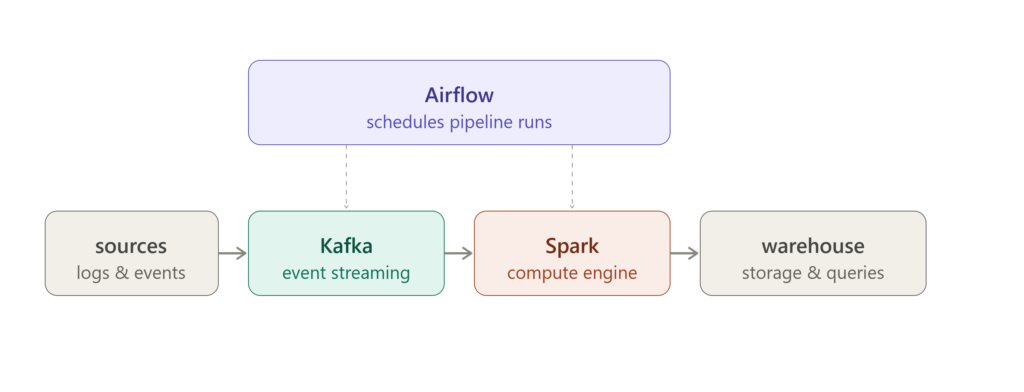
Data Engineering fundamentals: You don’t need to become a full-time data engineer, but understanding how data pipelines work tools like Apache Spark, Airflow, or Kafka that makes you far more effective when debugging production issues or collaborating with data teams.
Do You Need a Degree to Become an AI Engineer in 2026?
Not necessarily. Many companies now accept a strong portfolio and relevant certifications in place of a formal degree, especially for engineering-heavy roles where practical skill is easy to verify. That said, some employers particularly larger, more traditional companies still require or strongly prefer a bachelor’s degree in computer science or a related field, and a master’s degree can help for senior or research-focused roles.
If you don’t have a degree, lean harder into your portfolio and be ready to demonstrate depth in interviews. Self-taught engineers get hired constantly — they just have to work a little harder to prove it upfront
How Long Does It Actually Take to Become an AI Engineer in 2026?
Realistically, if you’re starting from zero (no programming background at all), expect somewhere in the range of 9–12 months of consistent, focused learning before you’re ready to apply confidently. If you already know how to code, you could cut that down significantly possibly to 3–6 months since you’ll skip straight to the AI-specific skills.
The people who move fastest aren’t necessarily the smartest they’re the ones who build in public, ship real projects along the way instead of waiting until they “feel ready,” and treat the job search as a skill in itself.
Who’s Hiring AI Engineers Right Now
Once you’ve worked through how to become an AI engineer in 2026 skill by skill, the next question is where to actually apply. Demand isn’t limited to Silicon Valley giants anymore. Companies actively hiring for AI engineering roles in 2026 span a few different categories:
- Big tech: Google, Microsoft, Meta, Amazon, and Apple all run dedicated AI engineering teams, though these roles are the most competitive and often expect prior experience.
- AI-native startups: Companies building directly on top of foundation models (chat products, coding assistants, automation tools) tend to hire faster and are often more open to portfolio-over-credentials candidates.
- Traditional enterprises going digital: Banks, healthcare companies, and retailers are building internal AI teams to automate operations, and they’re often less competitive to break into than pure tech companies.
- Government and research institutions: Public sector demand for AI talent is growing too, particularly around public services and research applications.
Job boards worth checking regularly include LinkedIn, Indeed, and specialized boards like Wellfound (formerly AngelList) for startup roles.
Salary Expectations by Experience Level
One of the most-asked questions alongside how to become an AI engineer in 2026 is simply: what does it pay? Pay varies a lot by company size, location, and specialization, but here’s a rough sense of where things typically land in the U.S. market:
- Entry-level / Junior AI Engineer: roughly $90,000–$120,000
- Mid-level (3–6 years): roughly $120,000–$160,000
- Senior / Lead AI Engineer: roughly $160,000–$230,000+
Location matters significantly — roles at software publishers and large tech hubs tend to pay well above the median, while roles in academia or smaller regional companies often pay less but may offer better work-life balance or growth into leadership faster.
Final Thoughts
That’s the complete picture of how to become an AI engineer in 2026 and it’s far more accessible than most people assume. You don’t need a prestigious degree or years of prior experience you need Python, a solid grasp of how modern AI systems (especially LLMs and RAG) actually work, hands-on deployment experience, and a portfolio that proves all of it.
Start with the fundamentals, build something real as you go, and don’t wait until you know “everything” to start applying. The field is moving fast enough that the best way to learn it is often by building alongside it.
Frequently Asked Questions
What are the exact steps for how to become an AI engineer in 2026? In short: learn Python and the core AI skills (prompt engineering, RAG, model deployment), build 2–4 real portfolio projects, apply with a project-focused resume, and keep skilling up with tools like LangChain and Hugging Face once you land your first role. Follow the four-step roadmap above for the full breakdown.
Is AI engineering a good career in 2026?Yes demand is still outpacing supply. Roles tied to AI and machine learning are growing far faster than the average for all occupations, and salaries remain among the highest in tech. The main risk isn’t the field itself, it’s underpreparing and applying without a portfolio to back up your resume.
Can I become an AI engineer without any coding experience? You can start from zero, but expect to spend real time on programming fundamentals first this is step one in how to become an AI engineer in 2026 no matter your background. Python is usually the starting point, and most people need a few months of consistent practice before AI-specific skills start to click. Skipping this step and jumping straight to “AI tools” tends to backfire in interviews.
Is AI engineering the same as being a data scientist? No. Data scientists focus more on analysis, experimentation, and extracting insights from data. AI engineers focus on building and shipping production systems , turning models into working products with APIs, infrastructure, and monitoring. There’s overlap, but the day to day work is different.
Do I need to know how to build a model from scratch? Not usually. Most AI engineering roles involve working with existing pre trained or foundation models fine tuning, deploying, and integrating them rather than designing new architectures from the ground up. Understanding the fundamentals still matters, but you’re rarely reinventing the model itself.
What’s the fastest way to stand out to employers? A working, deployed project beats a certificate every time. Something as simple as a RAG chatbot connected to a real dataset, with clean documentation and a live demo link, tells an employer more in two minutes than a resume full of course names.
Which pays more AI engineer or software developer? On average, AI engineering roles tend to pay more than general software development roles, largely because of the skills gap and higher demand relative to the number of qualified candidates. That gap narrows as more developers pick up AI specific skills, so it’s not guaranteed to stay this wide forever.
External links: