Model Context Protocol (MCP): The Missing Link That Makes AI Truly Intelligent
Artificial intelligence has advanced at an incredible pace over the past few years. Today’s large language models (LLMs) can write code, summarize documents, generate creative ideas, and even solve complex technical problems. Yet despite these impressive capabilities, every AI model shares one major weakness—it only knows what it has learned during training.
Ask an AI assistant about yesterday’s stock market, your company’s latest sales report, or the contents of a private database, and you’ll quickly discover its limitations. Without access to external systems, even the smartest AI becomes isolated from the real world.
This challenge has slowed the development of truly autonomous AI agents. Developers have often been forced to build custom integrations for every application, database, API, and service they wanted their AI to use. The result? Thousands of fragile connections that are difficult to maintain, expensive to scale, and often incompatible with different AI platforms.
That’s where the Model Context Protocol (MCP) changes everything.
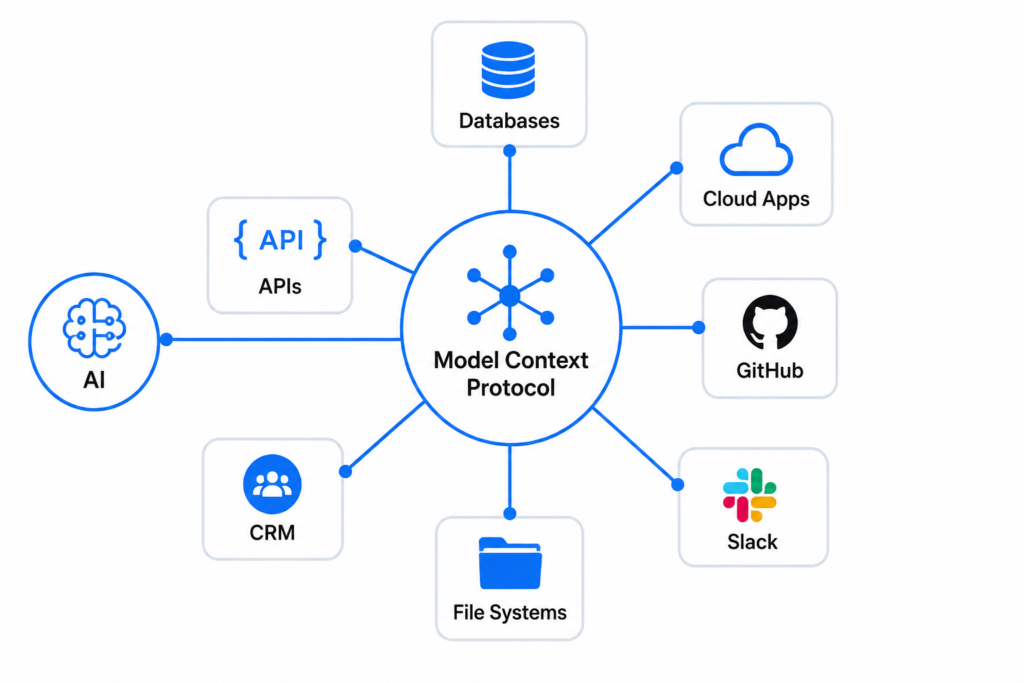
Often described as the “USB-C for AI,” MCP introduces a universal communication standard that allows AI assistants to securely connect with external tools, databases, APIs, and business applications using a single, standardized approach. Instead of creating dozens of custom integrations, developers can build one MCP-compatible connection that works across multiple AI systems.
This seemingly simple idea has become one of the most important developments in modern AI infrastructure. Major companies such as Anthropic, OpenAI, Google, Microsoft, and many enterprise software providers are embracing MCP because it makes AI agents significantly more capable, flexible, and reliable.
Whether you’re building AI-powered applications, exploring agentic AI, or simply trying to understand where artificial intelligence is heading, learning MCP is becoming an essential skill.
What Is Model Context Protocol (MCP)?
Model Context Protocol (MCP) is an open standard introduced by Anthropic in late 2024 that enables AI applications to securely communicate with external tools, services, databases, APIs, and data sources through a standardized protocol.
Rather than teaching every AI model how to interact with hundreds of different systems individually, MCP provides a common language that every compatible application can understand.
Think of it this way:
Imagine buying a new smartphone. Instead of carrying separate chargers for every device, you simply use a USB-C cable because every modern device understands that standard.
Model Context Protocol brings the same concept to artificial intelligence.
Instead of building separate integrations for:
- Google Drive
- GitHub
- Slack
- PostgreSQL
- Salesforce
- Notion
- Local files
- Internal company databases
developers only need to implement MCP once.
Once connected, AI assistants can automatically discover available tools, understand their capabilities, retrieve relevant information, and perform actions safely all without requiring custom code for every new integration.
This standardized approach dramatically reduces development complexity while making AI systems far more powerful.
How Does Model Context Protocol (MCP) Work?
Understanding MCP becomes much easier once you know what happens behind the scenes. Although the protocol powers advanced AI systems, its overall workflow is surprisingly straightforward.
At its core, MCP acts as a communication bridge between an AI model and external services. Instead of expecting the AI model to know how every database, API, or software platform works, MCP provides a common language that all compatible systems understand.
When a user asks an AI assistant to perform a task, the assistant doesn’t directly connect to databases or APIs. Instead, it communicates with an MCP server that specializes in those resources.
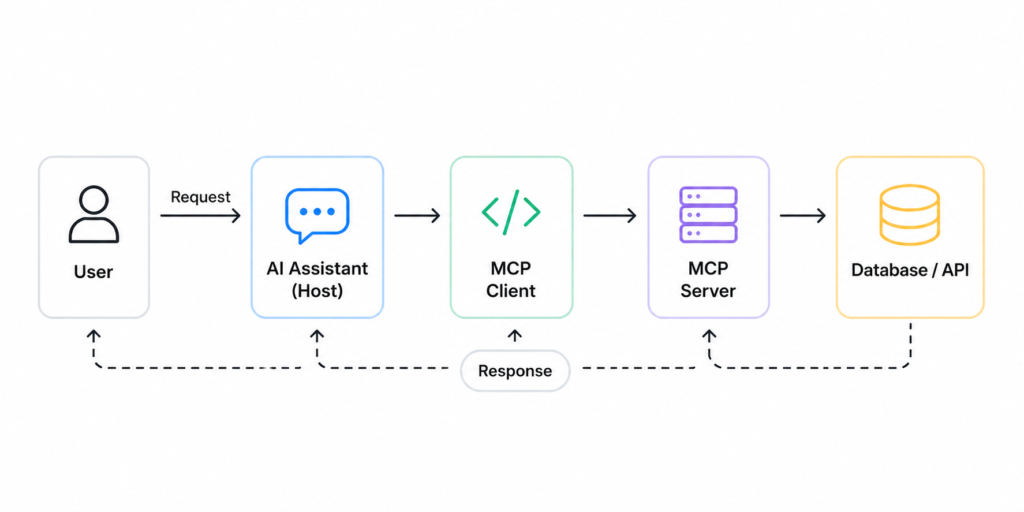
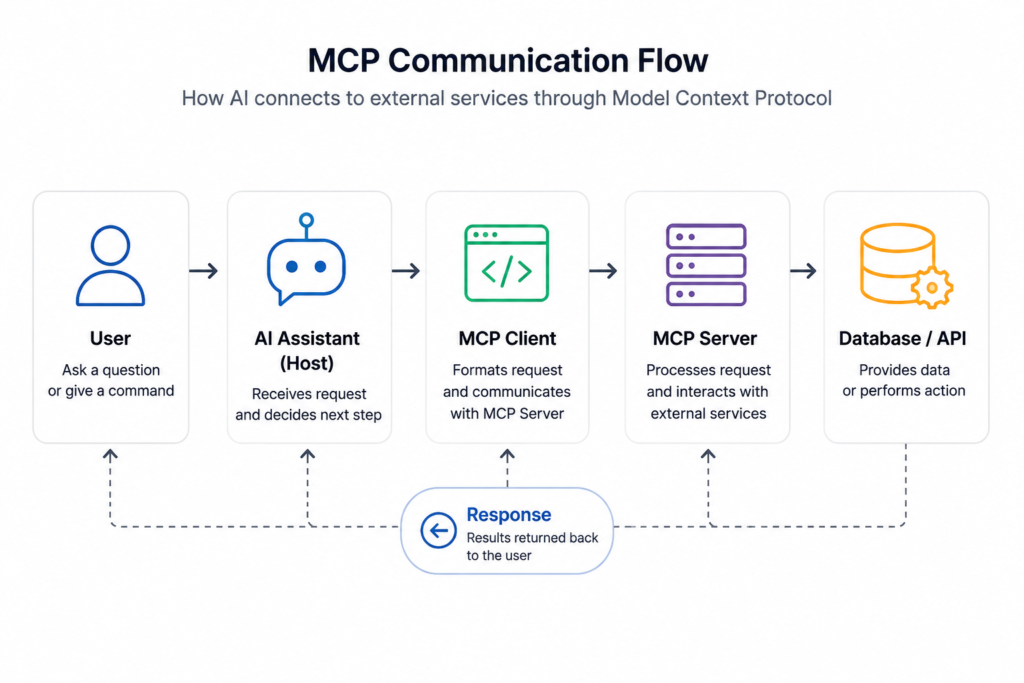
Here’s a simplified workflow:
- The user submits a request to the AI assistant.
- The AI determines whether it needs external information or tools.
- The MCP client discovers the appropriate MCP server.
- The MCP server executes the requested action securely.
- Results are returned to the AI.
- The AI generates a natural, human-friendly response.
Instead of manually integrating dozens of different services, developers only need to integrate with MCP once.
Understanding the MCP Architecture
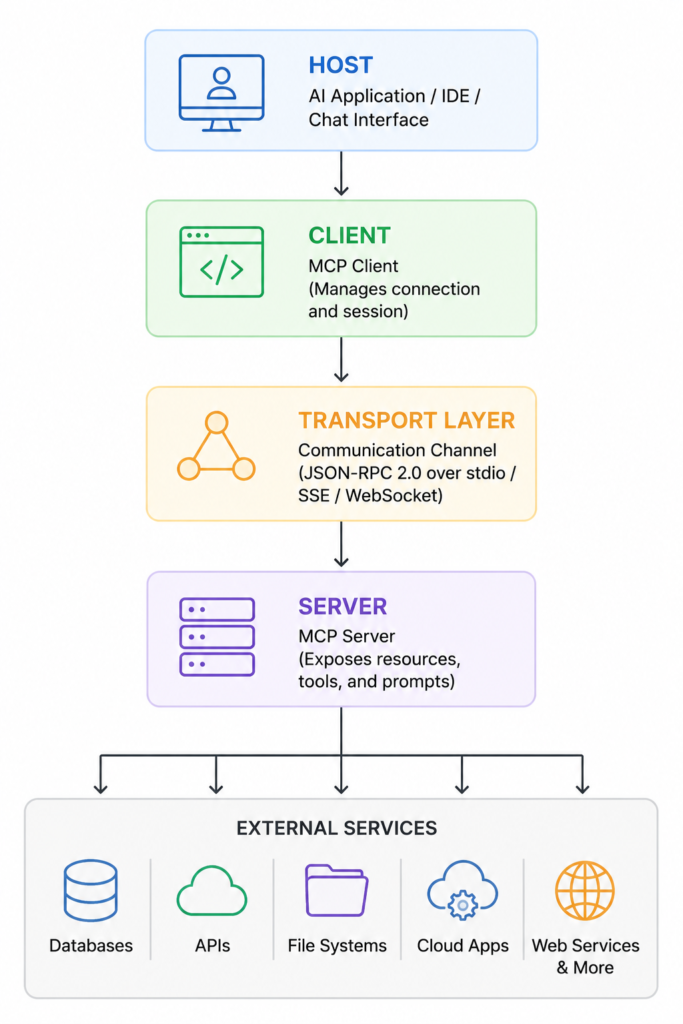
One of the biggest strengths of the Model Context Protocol is its clean and modular architecture. Rather than creating one massive system, MCP divides responsibilities among several specialized components.
These components work together to securely exchange information between AI models and external applications.
1. MCP Host
The MCP Host is the AI application that users interact with directly.
Examples include:
- Claude Desktop
- AI-powered IDEs
- Coding assistants
- Enterprise AI chatbots
- Customer support assistants
The host is responsible for:
- Receiving user requests
- Managing conversations
- Coordinating external tool usage
- Sending context to the language model
Think of the host as the control center of the entire MCP ecosystem.
2. MCP Client
The MCP Client acts as a translator between the AI application and external servers.
It performs several important tasks, including:
- Discovering available MCP servers
- Converting AI requests into MCP-compatible messages
- Handling authentication
- Managing sessions
- Receiving responses
- Detecting errors
- Returning structured information to the AI model
Each client usually maintains a dedicated connection with one MCP server, ensuring reliable and secure communication.
3. MCP Server
The MCP Server is where the real work happens.
Instead of generating text like an LLM, the server provides access to external capabilities.
Depending on its purpose, an MCP server may connect to:
- Databases
- GitHub repositories
- Slack workspaces
- Google Drive
- PostgreSQL
- CRM systems
- Calendar applications
- Cloud services
- Internal company tools
The server receives requests from the MCP client, performs the requested operation, and returns structured results.
For example, if an AI assistant needs today’s sales report, the MCP server retrieves the data from the company’s database and sends it back to the AI.
4. Transport Layer
Communication between MCP clients and servers happens through the transport layer.
Most implementations use JSON-RPC 2.0, a lightweight protocol that enables structured, reliable message exchange.
Common transport methods include:
Standard Input/Output (stdio)
Best suited for:
- Local applications
- Desktop software
- Development environments
- File systems
Advantages:
- Extremely fast
- Low latency
- Simple implementation
- Ideal for local resources
Server-Sent Events (SSE)
Designed for remote services running over the internet.
Ideal for:
- Cloud applications
- Enterprise systems
- Web APIs
- Real-time streaming
Benefits include:
- Continuous communication
- Live updates
- Efficient streaming
- Better scalability
📊 MCP Architecture at a Glance
| Component | Primary Responsibility |
|---|---|
| MCP Host | Handles user interaction and orchestrates AI workflows |
| MCP Client | Discovers servers and manages communication |
| MCP Server | Provides tools, resources, and external capabilities |
| Transport Layer | Securely transfers messages between clients and servers |
Why MCP Is Becoming So Important in AI
The AI industry is rapidly moving from simple chatbots toward AI agents capable of completing real tasks.
Instead of only answering questions, modern AI is expected to:
- Schedule meetings
- Search internal documents
- Update CRM records
- Write and execute code
- Query databases
- Analyze spreadsheets
- Trigger workflows
- Communicate with business applications
None of these actions are possible using an LLM alone.
Large language models generate text—they don’t naturally interact with software systems.
MCP fills this critical gap.
It provides a secure bridge between AI reasoning and real-world execution.
Without MCP, every company builds unique integrations.
With MCP, AI systems become portable, reusable, and significantly easier to develop.
This is one of the primary reasons why MCP is now considered a foundational technology for Agentic AI, where intelligent systems can reason, make decisions, and interact with external environments.
How MCP Makes AI Smarter
One of the biggest misconceptions about AI is that larger models automatically become smarter.
In reality, intelligence often depends on access to the right information at the right time.
Imagine asking an AI assistant:
“Show me today’s sales numbers and email a summary to my manager.”
Without MCP, the assistant cannot:
- Access today’s database
- Retrieve the report
- Send an email
- Confirm the action
With MCP, the AI can securely:
- Find the appropriate database tool.
- Retrieve the latest sales data.
- Generate a professional summary.
- Connect to an email service.
- Send the report.
- Confirm successful delivery.
The language model hasn’t changed.
Its capabilities have.
That’s exactly what makes MCP such a transformative innovation—it extends AI beyond conversation into real-world productivity.
What Can MCP Servers Provide?
Unlike traditional APIs that expose fixed endpoints, MCP servers publish capabilities that AI models can discover dynamically.
These capabilities generally fall into three categories.
Resources
Resources provide read-only context.
Examples include:
- Documentation
- Company knowledge bases
- PDF files
- Database records
- Configuration files
- Reports
Resources allow AI models to retrieve information without modifying it.
Tools
Tools allow AI to perform actions.
Examples include:
- Running SQL queries
- Sending emails
- Creating GitHub issues
- Updating CRM records
- Performing calculations
- Executing code
- Calling external APIs
This transforms AI from a conversational assistant into an action-oriented agent.
Prompts
Prompts are reusable templates that standardize interactions between AI applications and MCP servers.
Organizations can use prompts to:
- Enforce consistent workflows
- Standardize business processes
- Improve prompt quality
- Reduce repetitive instructions
This makes AI behavior more reliable across teams and applications.
A Real-World Example of MCP in Action
Let’s imagine you’re using an AI assistant at work.
You ask:
“Find last month’s marketing report, summarize the key insights, and email them to my team.”
Without MCP, the AI has no way to:
- Access company storage
- Open the report
- Generate a summary using fresh data
- Send an email
With MCP, the process looks like this:
- The AI recognizes it needs external tools.
- The MCP client discovers a document server and an email server.
- The document server retrieves the latest marketing report.
- The AI analyzes the report and writes a concise summary.
- The email server sends the summary to your team.
- The AI confirms that the task has been completed successfully.
To the user, it feels like one seamless interaction, but behind the scenes, multiple MCP components are working together.
Benefits of Model Context Protocol (MCP)
The growing popularity of MCP isn’t just because it’s an open standard. It’s because it solves real-world problems that developers, enterprises, and AI engineers have faced for years.
Instead of building countless custom integrations, organizations can create smarter AI applications that are easier to develop, maintain, and scale.
Let’s explore the biggest advantages of using the Model Context Protocol.
1. Access to Real-Time Information
One of the biggest weaknesses of traditional large language models is that their knowledge eventually becomes outdated.
For example, if an AI model was trained in 2025, it won’t automatically know:
- Today’s stock prices
- Breaking news
- New customer records
- Updated product inventory
- Recent code changes
- Live analytics
With MCP, AI can retrieve live information directly from connected systems whenever it’s needed.
Instead of guessing, it asks the right tool.
This dramatically improves response quality while reducing outdated answers.
2. Reduced AI Hallucinations
Hallucinations occur when an AI confidently generates information that isn’t actually correct.
By allowing AI models to verify facts from trusted external sources before responding, MCP significantly improves factual accuracy.
For example:
Instead of inventing today’s weather forecast, an AI assistant can retrieve the latest forecast from a weather API.
Instead of estimating sales numbers, it can query the company’s database.
This simple shift makes AI systems far more reliable.
3. Easier Tool Integration
Before MCP, connecting an AI model to multiple applications meant writing custom code for every integration.
Imagine connecting an AI assistant to:
- Slack
- GitHub
- Jira
- Google Drive
- Salesforce
- PostgreSQL
- Gmail
Each integration required separate development, authentication, maintenance, and testing.
MCP replaces this fragmented approach with one standardized protocol, dramatically reducing development effort.
4. Better Developer Experience
Developers spend less time writing boilerplate integration code and more time building intelligent features.
Benefits include:
- Faster development
- Cleaner architecture
- Easier debugging
- Better maintainability
- Consistent interfaces
This is one reason many developers compare MCP to USB-C for AI—one universal connection instead of dozens of incompatible adapters.
5. Supports Autonomous AI Agents
Modern AI agents don’t just answer questions—they complete tasks.
With MCP, an AI agent can:
- Search databases
- Send emails
- Update CRM records
- Execute SQL queries
- Run automation workflows
- Analyze files
- Trigger cloud functions
This transforms conversational AI into action-oriented AI.
6. Reduces Vendor Lock-In
Many AI integrations depend heavily on vendor-specific APIs.
Switching providers often means rebuilding integrations from scratch.
Because MCP is an open standard, organizations gain greater flexibility to adopt different AI models without redesigning every connection.
7. Enterprise-Ready Scalability
Large organizations often use hundreds of internal tools.
MCP provides a unified communication layer that allows AI systems to interact with all of them using a consistent protocol.
This simplifies enterprise AI deployment while improving long-term scalability.
MCP Security Best Practices
Giving AI access to external systems also introduces new security challenges.
Without proper safeguards, an AI assistant could accidentally expose sensitive information or misuse connected tools.
Fortunately, the MCP ecosystem has been designed with security in mind.
Here are the most important best practices.
User Authorization
Users should always approve sensitive actions before they’re executed.
For example:
- Sending emails
- Deleting files
- Updating databases
- Executing transactions
Human approval prevents accidental misuse.
Least-Privilege Access
Every MCP server should receive only the permissions it actually needs.
For example:
- A weather server shouldn’t access customer records.
- A calendar server shouldn’t modify financial data.
Limiting permissions reduces security risks.
Encrypt Data
All communication between MCP clients and servers should use encrypted connections to protect sensitive information during transmission.
Validate Tools
Only trusted MCP servers should be connected to production environments.
Organizations should verify server authenticity before granting access.
Monitor Activity
Logging every interaction helps organizations:
- Detect suspicious behavior
- Audit AI actions
- Investigate security incidents
- Improve governance
Monitoring is especially important for enterprise deployments.
Local vs Remote MCP Servers
Organizations can deploy MCP servers in different ways depending on their requirements.
Local MCP Servers
Local servers run on the same machine as the AI application.
Ideal for:
- IDE integrations
- Desktop software
- Local file access
- Offline environments
Advantages
- Lower latency
- Better privacy
- Faster communication
- Works without internet access
Remote MCP Servers
Remote servers run on cloud infrastructure.
Ideal for:
- Enterprise applications
- Shared business tools
- APIs
- Cloud databases
- Multi-user environments
Advantages
- Scalable
- Accessible from anywhere
- Easier collaboration
- Centralized management
Real-World Use Cases of MCP
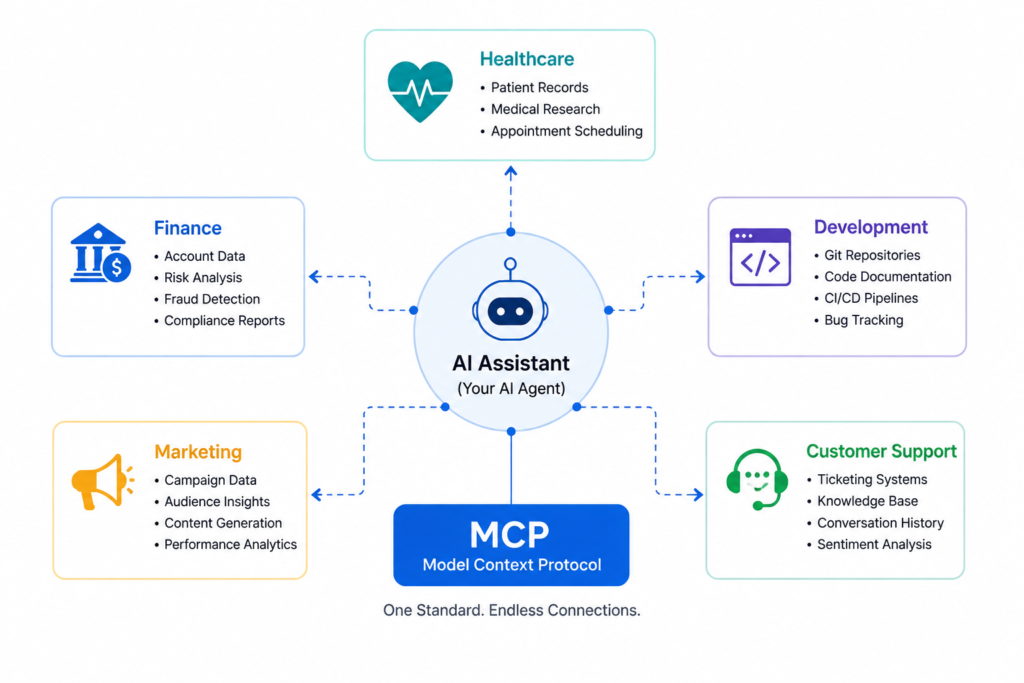
The flexibility of MCP enables powerful AI applications across industries.
Software Development
Developers use MCP-powered coding assistants to:
- Read repositories
- Create pull requests
- Search documentation
- Execute tests
- Review code
Customer Support
AI assistants can:
- Access CRM systems
- Retrieve customer history
- Create support tickets
- Update records
- Recommend solutions
Healthcare
Healthcare organizations can securely retrieve:
- Patient records
- Medical guidelines
- Laboratory results
- Appointment schedules
while respecting privacy controls.
Finance
Financial institutions can use MCP to:
- Query transaction databases
- Generate reports
- Monitor fraud alerts
- Analyze market data
Marketing
Marketing teams can automate:
- Campaign reporting
- Analytics dashboards
- Customer segmentation
- Content generation
- Performance tracking
Enterprise Productivity
Employees can ask AI to:
- Schedule meetings
- Search company documents
- Create presentations
- Summarize emails
- Generate reports
Common Misconceptions About MCP
Despite its growing popularity, several myths still surround the Model Context Protocol.
❌ MCP Replaces APIs
No.
MCP works on top of APIs, providing a standardized way for AI systems to use them.
❌ MCP Replaces RAG
No.
RAG retrieves knowledge.
MCP retrieves knowledge and enables actions.
The two technologies complement each other.
❌ MCP Is Only for Anthropic
Not anymore.
MCP has become an open standard adopted across the AI ecosystem, with support from multiple vendors and growing community adoption.
❌ MCP Makes AI Fully Autonomous
Not necessarily.
Developers still define permissions, workflows, security policies, and approval mechanisms.
MCP enables capability—it doesn’t remove human oversight.
The Future of Model Context Protocol
The AI industry is rapidly moving toward autonomous AI agents capable of completing increasingly sophisticated workflows.
As organizations adopt more AI-powered systems, standardized communication will become essential.
MCP is well-positioned to become the foundation for this new generation of AI applications because it:
- Simplifies integrations
- Supports interoperability
- Reduces development costs
- Encourages open innovation
- Improves enterprise scalability
In the coming years, we can expect a growing ecosystem of MCP servers, SDKs, tools, and frameworks that make AI development even more accessible.
Final Thoughts
The Model Context Protocol (MCP) is far more than another AI buzzword. It represents a major step toward making AI systems truly useful in real-world environments.
By creating a standardized way for AI models to access live data, interact with external tools, and perform meaningful actions, MCP eliminates many of the integration challenges that have slowed enterprise AI adoption.
Whether you’re building AI assistants, autonomous agents, coding tools, or enterprise automation platforms, understanding MCP today will prepare you for the next generation of AI development.
As the ecosystem continues to grow, mastering the Model Context Protocol won’t just be an advantage—it will become an essential skill for developers, AI engineers, and technology leaders alike.
Frequently Asked Questions (FAQs)
What is Model Context Protocol (MCP)?
Model Context Protocol is an open standard that enables AI applications to securely communicate with external tools, APIs, databases, and services using a standardized interface.
Who created MCP?
MCP was originally introduced by Anthropic in November 2024 and has since gained broad industry adoption as an open standard.
Is MCP open source?
Yes. MCP is an open standard with open-source SDKs and community-driven implementations.
Does MCP replace APIs?
No. MCP standardizes how AI applications interact with APIs and external systems rather than replacing them.
What’s the difference between MCP and RAG?
RAG retrieves information to improve AI responses, while MCP enables both information retrieval and real-world actions such as executing tools or updating external systems.
Can MCP work with any LLM?
Yes. Any AI application that implements the protocol can use MCP regardless of the underlying language model.
Is MCP secure?
Yes, when implemented correctly with authentication, authorization, encryption, auditing, and least-privilege access controls.
Where can I learn more about MCP?
The following resources are excellent starting points:
- Official Website: https://modelcontextprotocol.io
- GitHub Repository: https://github.com/modelcontextprotocol
- Anthropic Announcement: https://www.anthropic.com/news/model-context-protocol
- Google Cloud Guide: https://cloud.google.com/discover/what-is-model-context-protocol
- IBM Think: https://www.ibm.com/think/topics/model-context-protocol
- Databricks Guide: https://www.databricks.com/blog/what-is-model-context-protocol