Real-Time Database Replication: How It Works, Types, Strategies, and Use Cases
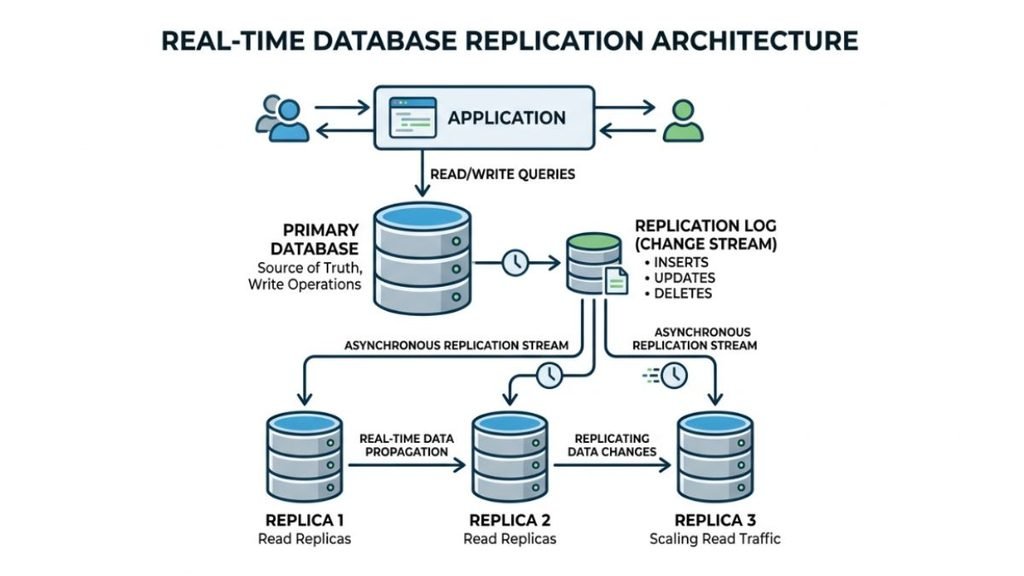
Real-time data replication means capturing database changes and transferring them to one or more replicas with minimal delay. Instead of maintaining a single copy, organizations can keep multiple copies across database servers, data centers, or geographic regions. MySQL documents source-to-replica replication as a mechanism for copying data from one database server to one or more replicas.
This approach can improve data availability, support read scaling, strengthen disaster recovery, and provide fresher data for analytics. However, real-time replication is not simply about copying data faster. The architecture must also handle consistency, replication lag, network failures, conflicts, and recovery. MySQL specifically documents scale-out reads, analytics, and long-distance data distribution among replication use cases.
What Is Database Replication?
Database replication is the process of creating and maintaining copies of data across multiple database systems. In simple terms, data replication means that changes made in one database are transferred to another database so the target can maintain a corresponding copy.
The source is often called the primary database, primary server, leader, or publisher. The systems receiving those changes may be called replica databases, replica servers, secondary servers, followers, or subscribers. The terminology depends on the database platform and replication model.
For example, MySQL describes replication as copying data from a source server to one or more replicas, while PostgreSQL logical replication uses a publisher-and-subscriber model. (MySQL Replication documentation) (PostgreSQL Logical Replication documentation)
The goal of real-time replication is to reduce the delay between a change on the source and its appearance on the target. A replica does not necessarily receive every update at the exact same instant. Depending on the synchronization method, replication may be synchronous, asynchronous, or somewhere between the two.
The practical goal is data freshness. A replica should receive and apply changes quickly enough to support its intended workload, whether that workload involves customer requests, analytics, reporting, disaster recovery, or data integration.
Why Replicate Data?
Organizations replicate data for several reasons. They may need multiple copies for availability, replicas for read scaling, copies in different locations for disaster recovery, or downstream systems for analytics.
Replication can also separate workloads. An operational database can handle transactions while a replica or downstream system handles reporting and business intelligence queries. MySQL documents replication for scale-out, analytics, and remote data distribution.
How Does Database Replication Work?
The Database Replication Process
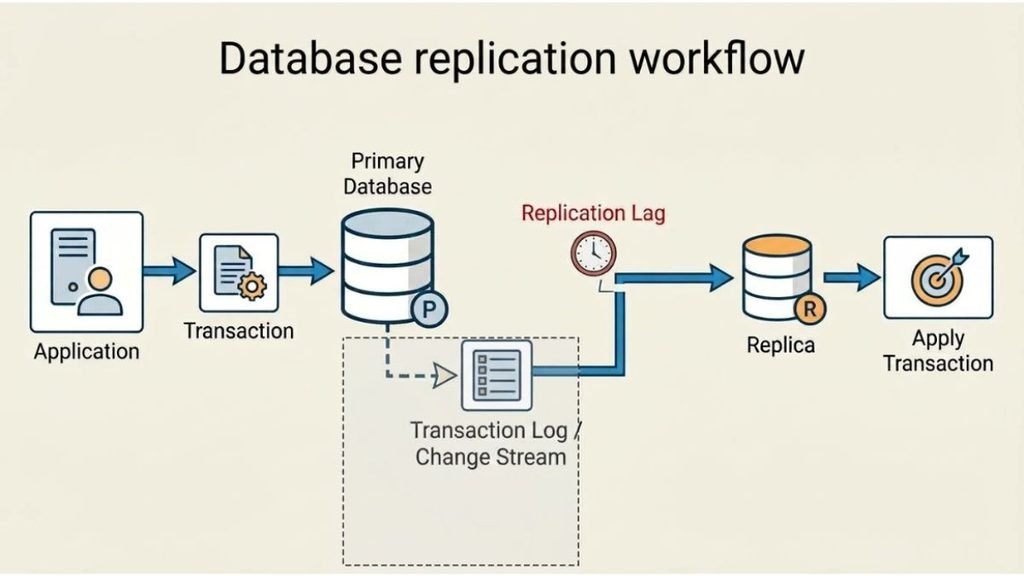
The replication process begins when an application performs a transaction against the primary database. The database records the transaction through a mechanism such as a transaction log, binary log, write-ahead log, or change stream.
A replication component then captures those data changes and sends them to the appropriate replica or target system. The replica receives the changes and applies them to its local copy.
A simplified workflow is:
Application → Write Transaction → Primary Database → Replication Log → Network → Replica Database → Apply Changes
PostgreSQL logical replication, for example, starts with an initial snapshot and then sends subsequent changes as they occur. MySQL source-to-replica replication uses binary logging and relay logs to transfer and apply changes. (PostgreSQL Logical Replication) (MySQL Replication Implementation)
Full Copies and Incremental Changes
Replication normally begins with existing data. The target needs an initial copy before it can continuously receive new changes.
After that initial synchronization, systems generally avoid copying the entire database after every transaction. Instead, they transfer incremental changes such as inserts, updates, and deletes.
This is why log-based replication, key-based incremental methods, and change data capture (CDC) are important for continuous workloads.
MySQL’s binary log records changes to database content and structure, while PostgreSQL logical replication takes an initial snapshot and then continuously sends subsequent changes.
How Replicas Receive Updates
The receiving database can process changes through an apply process, replication worker, subscriber, or another database-specific mechanism.
In a PostgreSQL publish-and-subscribe architecture, subscribers receive changes from publications on a publisher. MySQL uses source, replica, binary-log, relay-log, and replication-thread components for its traditional replication architecture. (PostgreSQL Logical Replication) (MySQL Replication Implementation)
The exact implementation differs between database engines, but the basic principle remains the same: capture changes, transfer them, apply them, and monitor whether the replica remains synchronized.
Database Replication Architecture
Primary-Replica Architecture
The most familiar database replication architecture uses one primary server and one or more replica servers. The primary accepts write operations, while replicas receive those changes.
This model can support read scaling because applications may send selected read requests to replicas. MySQL documents this type of scale-out architecture, where writes occur on the source and reads can be distributed across replicas. (MySQL Replication)
A primary-replica design is also easier to reason about than a system where many servers can modify the same records. However, the primary can become a write bottleneck if the workload grows significantly.
Multi-Primary and Multi-Master Replication
In multi-primary replication, multiple database servers can accept writes. This can reduce dependence on one write server, but it introduces additional coordination and conflict-management requirements.
MySQL Group Replication supports both single-primary and multi-primary modes. In single-primary mode, one member accepts writes while others are read-only; multi-primary mode allows multiple members to operate as write-capable servers. (MySQL Group Replication)
A multi-master design therefore needs strong rules for conflict detection, transaction ordering, and consistency.
Publisher-Subscriber Architecture
A publisher-subcriber model separates the system that publishes changes from systems that subscribe to them.
PostgreSQL logical replication uses this architecture. A publisher defines publications, while subscribers receive the selected changes. The model can support selective replication and more complex distributed configurations. (PostgreSQL Logical Replication)
Multi-Region Replication
A global application may maintain replica databases in several geographic regions. This can improve data locality and provide an additional recovery location.
However, distance affects replication latency. A replica across the country or on another continent generally has more network delay than one located near the primary.
The architecture should therefore consider network distance, bandwidth, consistency requirements, and the application’s tolerance for stale data.
| Architecture | Main Model | Typical Purpose |
|---|---|---|
| Primary-replica | One writer, multiple replicas | Read scaling and availability |
| Single-primary | One group leader accepts writes | Controlled write coordination |
| Multi-primary | Multiple write-capable servers | Distributed write workloads |
| Publisher-subscriber | Publisher sends selected changes | Logical and selective replication |
| Multi-region | Replicas across geographic regions | Data locality and recovery |
| Cascading | Replica forwards changes to another replica | Reducing direct source connections |
Types of Database Replication
Full and Partial Replication
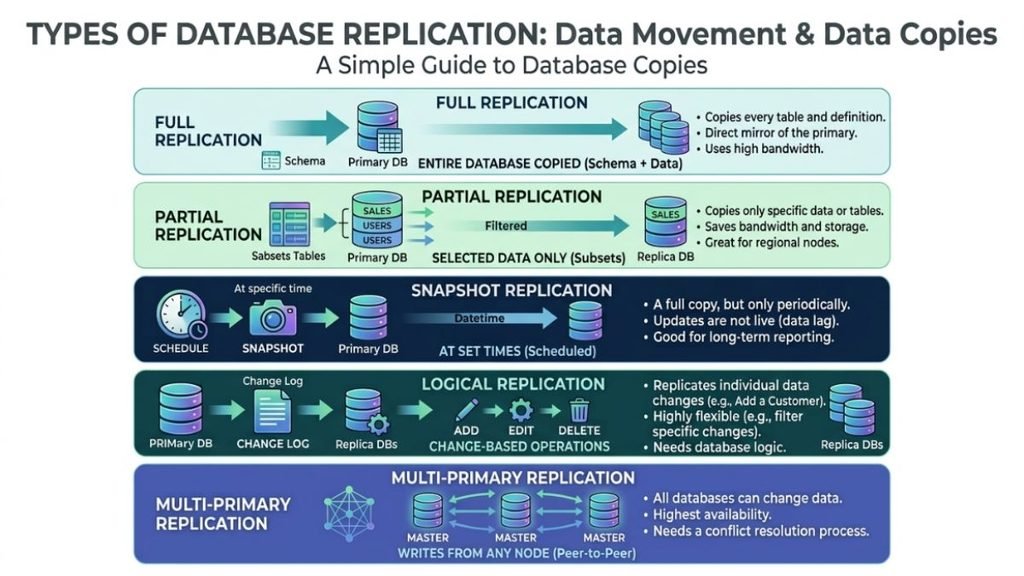
Full replication copies the entire relevant database or dataset to each participating replica. This provides broad data availability but requires more storage and network capacity.
Partial replication copies only a selected subset. Organizations may replicate particular databases, tables, rows, columns, or records to specific target systems.
Selective replication can be useful when an analytics system needs only certain transactional tables or when a regional application requires only a defined dataset. MySQL supports replication filtering so replicas can be configured to process selected databases or tables. (MySQL Binary Log Replication)
Snapshot Replication
Snapshot replication transfers a point-in-time copy of data. It can work well when data does not need continuous synchronization or when a target system needs an initial dataset.
A snapshot is also useful as part of the initial setup for some continuous replication architectures. PostgreSQL logical replication, for example, initially takes a snapshot of the publisher’s table data before continuing with ongoing changes.
Logical and Physical Replication
Logical replication works with logical changes to data objects, while physical replication generally operates at a lower storage or database-block level.
PostgreSQL supports both physical and logical replication. Its logical replication system can select specific data objects and uses a publication/subscription model. (PostgreSQL Logical Replication)
Leader-Based and Leaderless Models
A leader-based system assigns write responsibility to a primary or leader. Replica servers then receive those changes.
A leaderless or quorum-based approach distributes responsibility across multiple nodes. These systems can offer different consistency and availability characteristics but require more sophisticated coordination.
Merge and Bidirectional Replication
Merge replication allows changes to occur at multiple locations and later combines those changes.
Bidirectional replication similarly allows data changes to flow in both directions. These approaches are useful for certain distributed workloads but make conflict resolution much more important.
PostgreSQL notes that conflicts can arise when a subscriber also receives writes from applications or other subscribers affecting the same replicated tables.
Synchronous vs Asynchronous Database Replication
Synchronous Replication
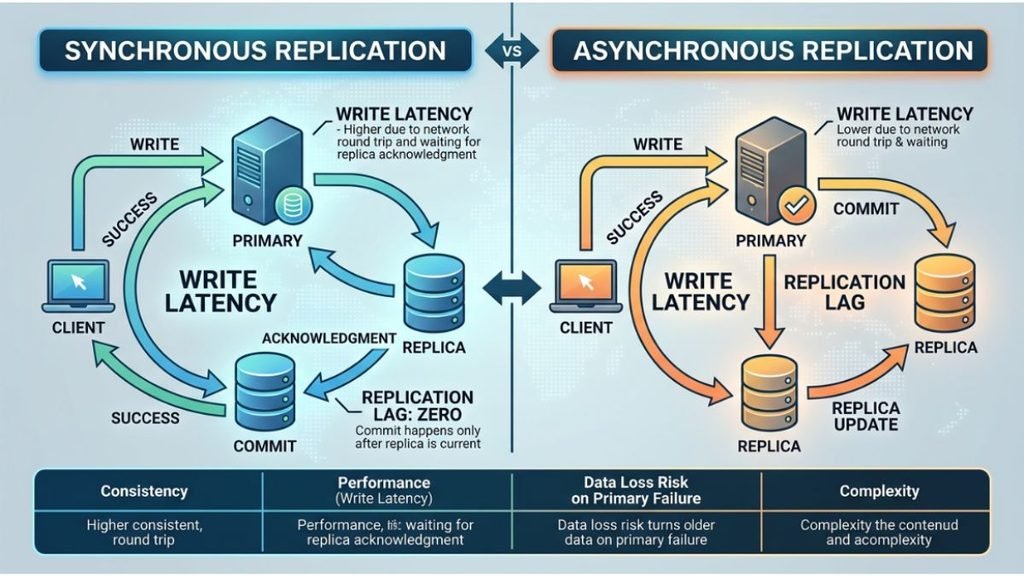
Synchronous replication requires a defined replica or set of replicas to acknowledge a transaction before the primary considers the operation complete.
This can provide stronger consistency because the primary knows the required replica has received the transaction. PostgreSQL supports synchronous replication configurations where transaction commit behavior depends on configured synchronous standbys. (PostgreSQL Synchronous Replication)
The tradeoff is write latency. If the replica is far away or temporarily slow, the primary may need to wait longer before confirming the transaction.
Asynchronous Replication
With asynchronous replication, the primary can commit without waiting for every replica to confirm the change.
This often reduces write latency, but replicas can fall behind. MySQL replication is asynchronous by default, meaning replicas do not have to be connected permanently to receive updates. (MySQL Replication)
The resulting replication lag matters when applications require fresh reads immediately after a write.
Semi-Synchronous Replication
Semi-synchronous replication sits between the two approaches. MySQL’s semisynchronous replication can require at least one replica to acknowledge that it has received and logged the transaction before the source completes the commit. (MySQL Semisynchronous Replication)
This creates a tradeoff between stronger durability characteristics and additional latency.
| Factor | Synchronous | Asynchronous | Semi-Synchronous |
|---|---|---|---|
| Primary waits | Yes, for configured acknowledgments | No | Yes, for required acknowledgment |
| Replication lag | Very low for acknowledged changes | Possible | Usually limited |
| Write latency | Higher | Lower | Moderate |
| Consistency | Stronger possible | Eventual consistency possible | Between the two |
| Network sensitivity | High | Lower | Moderate |
| Typical use | Critical consistency | Read scaling and flexible replication | Durability with lower overhead |
Read-After-Write Consistency
A common application problem appears when a user writes data to the primary and immediately reads from a lagging replica.
The user may experience a missing update even though the transaction succeeded. This affects read-your-writes, read-after-write, and related consistency expectations.
Applications can address this by routing specific reads to the primary, waiting for replica confirmation, or using a consistency-aware routing strategy.
Database Replication Strategies and Techniques
Log-Based Replication
Log-based replication reads database changes from a transaction log rather than repeatedly scanning complete tables.
This makes it suitable for high-volume workloads because only relevant changes need to move after the initial synchronization.
MySQL uses binary logs in its replication architecture, while PostgreSQL uses WAL-based mechanisms for physical replication and logical decoding for logical replication. (MySQL Replication Implementation) (PostgreSQL Logical Replication)
Change Data Capture
Change data capture (CDC) identifies inserts, updates, and deletes as they happen and makes those changes available to downstream systems.
CDC is useful for real-time data pipelines, analytics, data integration, warehouses, search systems, and event-driven architectures.
The important distinction is that CDC focuses on capturing changes, while database replication usually describes the broader process of maintaining copies or distributing those changes.
Snapshot and Incremental Techniques
Snapshot replication transfers an existing state at a point in time. Incremental replication then transfers only subsequent changes.
This combination can reduce the amount of data that must be transferred continuously.
A key-based incremental method may use an increasing ID, timestamp, or another change marker. However, this approach requires careful handling of updates, deletes, late-arriving records, and transactions that modify existing rows.
Single-Leader and Multi-Leader Strategies
A single leader keeps write ownership centralized. This can simplify conflict management and transaction ordering.
A multi-leader or multi-master strategy allows multiple systems to accept writes. It can reduce geographic write distance but introduces conflict detection, conflict resolution, and consistency challenges.
MySQL Group Replication supports single-primary and multi-primary configurations, illustrating the architectural difference between centralized and distributed write models. (MySQL Group Replication)
Automated Replication and Failover
Modern replication systems often automate parts of synchronization, health checking, recovery, and failover.
However, automated replication does not mean that every failure scenario can be solved automatically. A system still needs clear rules for leader election, replica promotion, recovery, and application routing.
MySQL Group Replication includes distributed recovery mechanisms that can bring joining servers up to date. (MySQL Group Replication)
Benefits of Database Replication
High Availability and Fault Tolerance
One of the strongest reasons to replicate data is high availability. If a primary database fails, a synchronized replica can potentially continue serving workloads or become the new primary.
Replication can therefore support business continuity, especially when replicas are placed on separate infrastructure.
However, replication is not automatically a complete disaster recovery plan. Recovery procedures, backups, failover testing, and data-retention policies still matter.
Read Scaling and Performance
Replication can improve performance by distributing read requests across multiple replicas.
For read-heavy applications, this can reduce pressure on the primary database. MySQL explicitly documents replication as a scale-out approach where reads can be distributed across multiple replicas. (MySQL Replication)
Replication does not automatically increase write capacity in a primary-replica architecture. The primary may still process the majority of write operations.
Data Locality and Lower Latency
Replicas can be placed closer to users or application services. This can reduce network distance for read requests and improve the user experience.
Multi-region replication is particularly useful when applications serve customers in multiple geographic locations.
Disaster Recovery
A replica in another data center or region can provide an additional recovery path during an infrastructure failure.
However, asynchronous replication may still have replication lag, so the recovery point can differ from the primary’s latest state.
| Benefit | Practical Effect |
|---|---|
| High availability | Provides another database instance |
| Read scaling | Distributes read workload |
| Data locality | Places data closer to users |
| Disaster recovery | Maintains another recovery copy |
| Business continuity | Supports service during failures |
| Fault tolerance | Reduces dependence on one server |
| Analytics isolation | Moves reporting away from transactions |
| Lower read latency | Can serve reads from nearby replicas |
Database Replication Use Cases
Disaster Recovery and Business Continuity
Organizations often replicate production databases to another availability zone, data center, or geographic region.
If the primary infrastructure experiences an outage, the replica can become part of the recovery process. The actual recovery point depends on the replication mode and replication lag.
Read-Heavy SaaS Applications
A SaaS platform may serve thousands or millions of users while generating far more read requests than writes.
Read replicas can distribute queries such as account dashboards, product catalogs, profile pages, and reporting requests.
MySQL specifically identifies scale-out replication as a way to distribute reads across multiple replicas.
Analytics and Business Intelligence
Transactional systems are usually optimized for application workloads rather than large analytical queries.
Replicating transactional data to a separate analytical database can isolate reporting workloads from production transactions. This supports business intelligence, analytics, dashboards, and operational reporting.
MySQL documents analytics as a replication use case where analysis can take place on a replica without affecting the source workload.
Data Integration and Real-Time Streaming
Real-time data replication can feed downstream systems that need fresh transactional changes.
A CDC pipeline may send updates into a warehouse, lake, search index, messaging system, or another application. This creates a bridge between the operational database and other data systems.
PostgreSQL documents logical replication use cases including sending incremental changes as they occur and consolidating databases for analytical purposes.
Healthcare and Patient Systems
Healthcare environments may use replication to make authorized data available across different systems or locations.
For patient information, replication architecture must account for access controls, encryption, auditability, regulatory requirements, and data residency.
Online Multiplayer Gaming
An online multiplayer game can use replicated database infrastructure to distribute workloads and improve availability.
The correct model depends on the type of game data. Highly sensitive state may require stronger consistency, while less critical information may tolerate small replication delays.
Multi-Region Applications
Global applications can use multi-region replication to maintain data copies in different locations.
This can improve regional availability and data locality, but cross-region replication also introduces network latency, bandwidth costs, and consistency considerations.
Challenges and Limitations of Database Replication
Replication Lag and Stale Data
The most visible problem with asynchronous replication is replication lag.
A replica can temporarily contain older information than the primary. This becomes noticeable when applications send a read to a replica immediately after writing to the primary.
Monitoring should therefore track replication delay, transaction position, apply rate, and replica health. MySQL provides replication status information and monitoring mechanisms for source and replica states.
Data Consistency
Different replication models provide different consistency guarantees.
Synchronous approaches can provide stronger consistency for acknowledged transactions, while asynchronous systems can expose eventual consistency.
Applications need to decide which operations require the newest data and which can tolerate slightly stale results.
Conflicts and Split-Brain
Multi-primary and bidirectional systems can encounter conflicting updates.
A split-brain event is especially dangerous because two systems may incorrectly believe they can act as the authoritative primary.
Strong membership controls, leader election, fencing, conflict resolution, and tested failover procedures are important safeguards.
MySQL Group Replication includes transaction certification and group membership mechanisms designed to coordinate distributed replication members.
Network and Resource Costs
Continuous replication consumes network bandwidth, CPU, storage, and processing resources.
Large data volumes can increase replication traffic, while geographically distant replicas can increase latency.
Replication can also increase infrastructure costs because every additional replica requires storage, monitoring, maintenance, and operational capacity.
Monitoring and Operational Complexity
A replicated environment needs continuous observability.
Teams should monitor:
| Metric | Why It Matters |
|---|---|
| Replication lag | Shows how far a replica is behind |
| Apply rate | Indicates how quickly changes are processed |
| Network throughput | Reveals replication bandwidth pressure |
| Replica health | Identifies unavailable targets |
| Storage growth | Tracks capacity requirements |
| Error rate | Highlights failed replication operations |
| Recovery time | Measures failover effectiveness |
| Data freshness | Shows whether replicas meet application needs |
Replication is therefore not a set-and-forget feature. It requires monitoring, testing, capacity planning, and recovery procedures.
Database Replication vs Database Sharding
Replication Copies Data; Sharding Divides Data
The fundamental difference is straightforward.
Database replication creates additional copies of data, while database sharding divides data into separate subsets across servers.
Suppose an application stores 1 TB of customer data. A replicated architecture may place a copy of that 1 TB on several database servers. A sharded architecture may divide the 1 TB into several smaller portions, with each server storing a different subset.
MySQL’s replication documentation describes replicas as copies of source data, while PostgreSQL’s logical replication can also replicate selected subsets of database objects.
Scaling and Availability
Replication is commonly used for high availability, disaster recovery, read scaling, and data locality.
Sharding is primarily a horizontal scaling technique for distributing large datasets and workloads across multiple servers.
The two approaches can also be combined. A production system might divide data into shards and then replicate each shard for availability.
| Feature | Database Replication | Database Sharding |
|---|---|---|
| Primary goal | Availability and additional copies | Data and workload distribution |
| Data relationship | Copies of data | Different subsets |
| Read scaling | Common | Possible |
| Write scaling | Depends on architecture | Stronger potential |
| Disaster recovery | Common use | Not its main purpose |
| Data locality | Regional replicas | Region-specific shards possible |
| Complexity | Moderate to high | High |
| Can combine? | Yes | Yes |
When to Use Each
Replication makes sense when the main problem involves availability, recovery, read traffic, or keeping data available in several locations.
Sharding becomes relevant when a single database can no longer provide enough storage, throughput, or workload capacity.
For large systems, using both can provide distributed capacity and redundancy. The architecture should still be designed around access patterns, consistency requirements, workload distribution, and operational limits.
Conclusion
Real-time database replication continuously moves database changes from a source to one or more target systems. It can maintain multiple copies of important data while supporting high availability, read scaling, disaster recovery, analytics, and multi-region applications.
The replication strategy matters. Synchronous replication can provide stronger consistency but may increase write latency. Asynchronous replication can reduce latency but introduces replication lag. Multi-primary and bidirectional approaches can distribute writes but require stronger conflict-management mechanisms.
The best architecture depends on your workload, consistency requirements, recovery objectives, network environment, and data-access patterns. When those factors are designed together, real-time data replication can become a reliable foundation for scalable and distributed database systems.
FAQs
What is a real-time database?
A real-time database updates and synchronizes data immediately or with very low delay as changes occur.
What is database replication?
Database replication copies data from a primary database to one or more replica databases to improve availability, performance, or recovery.
What are three types of data replication?
Three common types are synchronous replication, asynchronous replication, and snapshot replication.
Which database is best for real-time data?
The right choice depends on your workload, consistency needs, scale, and latency requirements. PostgreSQL, MySQL, and Firebase are common options.
Which is better, Firestore or Realtime Database?
Firestore offers richer querying and scalability, while Realtime Database is designed for simple, low-latency synchronization.
What are the 7 types of databases?
Common categories include relational, document, key-value, graph, wide-column, time-series, and hierarchical databases.