What Is Sharding in Database? How It Works, Types, Benefits, and Challenges
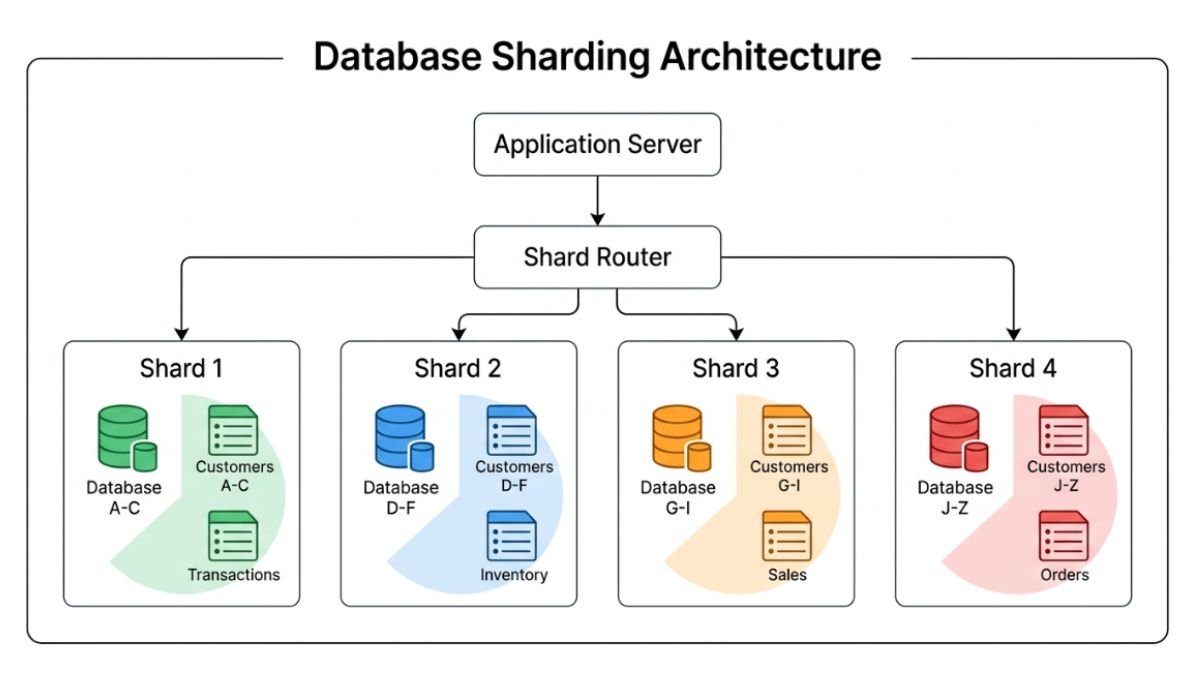
Database sharding is a horizontal scaling technique that divides a large dataset into smaller pieces called shards. These shards are distributed across multiple database servers or nodes. Instead of forcing one machine to store and process everything, a sharded database spreads the workload across several machines.
In simple terms, sharding lets you scale a database by adding more resources horizontally. It can improve scalability, storage capacity, and workload distribution when designed around real application access patterns.
Why Database Sharding Is Important for Modern Applications
A growing application can quickly outgrow the limits of a single database server. Millions of users may generate simultaneous reads and writes, while large datasets consume storage, CPU, memory, and I/O resources. At that point, simply buying a larger server may become expensive or eventually stop being practical.
Database sharding addresses this problem by distributing data across multiple servers. This is another example of horizontal scaling, where additional infrastructure is used to distribute workloads rather than relying on a single increasingly powerful machine. Similar scaling principles appear in load balancing, where traffic is distributed across multiple backend servers.
For example, an online marketplace with 50 million customers could distribute customer records across several shards. Each shard might handle a portion of the customers while the application routes requests to the correct location.
How Database Sharding Works
So, what is database sharding in practical terms? Imagine a customer table containing 100 million records. Instead of keeping every row on one database server, the system divides those records into smaller groups.
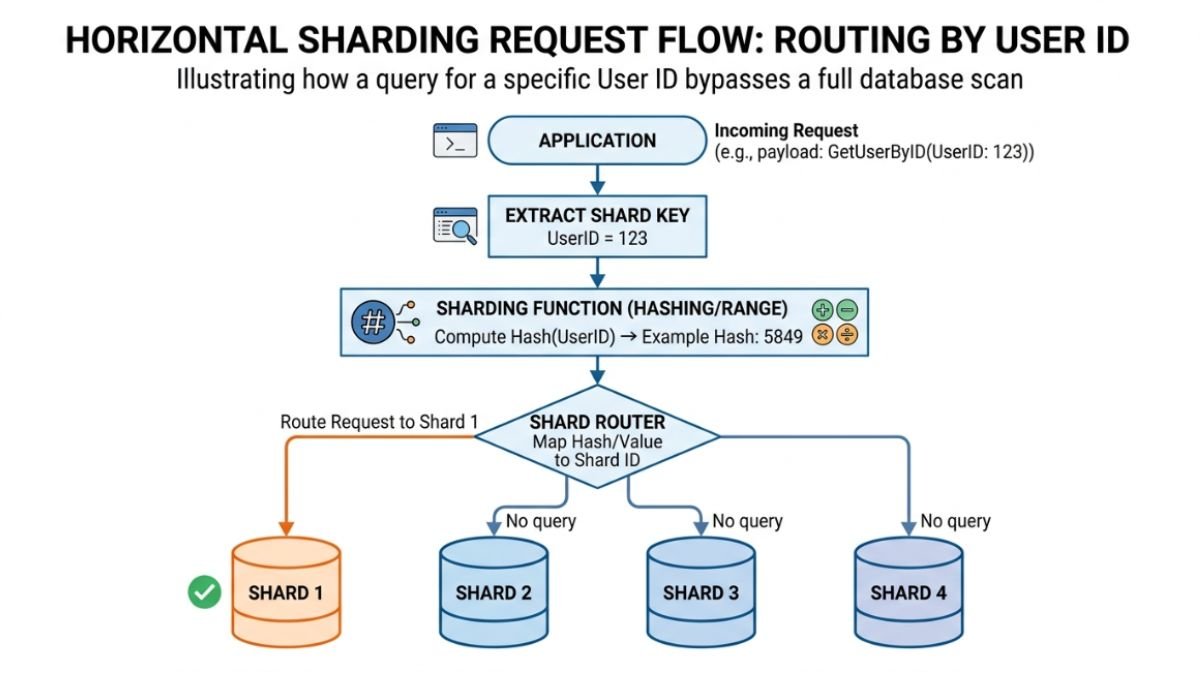
Suppose the application uses user_id as the shard key. Users 1–10 million could be distributed across one group of shards, while other users are routed to different shards. The exact distribution depends on the selected sharding strategy.
The application or database infrastructure needs a way to determine where each record belongs. This is called query routing or shard routing. A request containing a user’s ID can therefore be directed toward the specific shard that stores the required data instead of querying every database node. AWS — What Is Database Sharding?
Some database technologies provide native sharding capabilities, while other systems require application-level routing or an additional distribution layer.
Core Components of a Sharded Database Architecture
A typical shard database architecture contains several logical components. The first is the data itself, divided into multiple logical shards. A logical shard represents a subset of the overall dataset.
This kind of component-based thinking is central to system design, where engineers consider how databases, application services, routing layers, and infrastructure interact as a complete system.
| Component | Purpose |
|---|---|
| Shard | Stores a subset of the overall dataset |
| Shard key | Determines how records are distributed |
| Database node | Physical or logical resource hosting shard data |
| Router | Directs requests to the appropriate shard |
| Metadata or directory | Maps data to specific shards |
| Balancer | Helps maintain balanced distribution when supported |
| Replicas | Provide additional availability and recovery options |
The architecture can also use a central directory or lookup mechanism. This approach stores mappings between keys and shards, making it possible to locate data without embedding physical server details throughout application code.
Understanding Shard Keys and Their Role in Data Distribution
The shard key is one of the most important decisions in a sharded architecture. It determines how the database distributes records across shards. A poorly selected key can create uneven data distribution, overloaded nodes, and slower queries. MongoDB — Shard Keys
For example, a multi-tenant SaaS application might use tenant_id as its sharding key. Requests belonging to the same customer can then be routed to the same shard, improving data locality.
However, a good shard key needs more than high uniqueness. You should examine access patterns, cardinality, request frequency, data growth, and whether values change over time.
Types of Database Sharding Methods
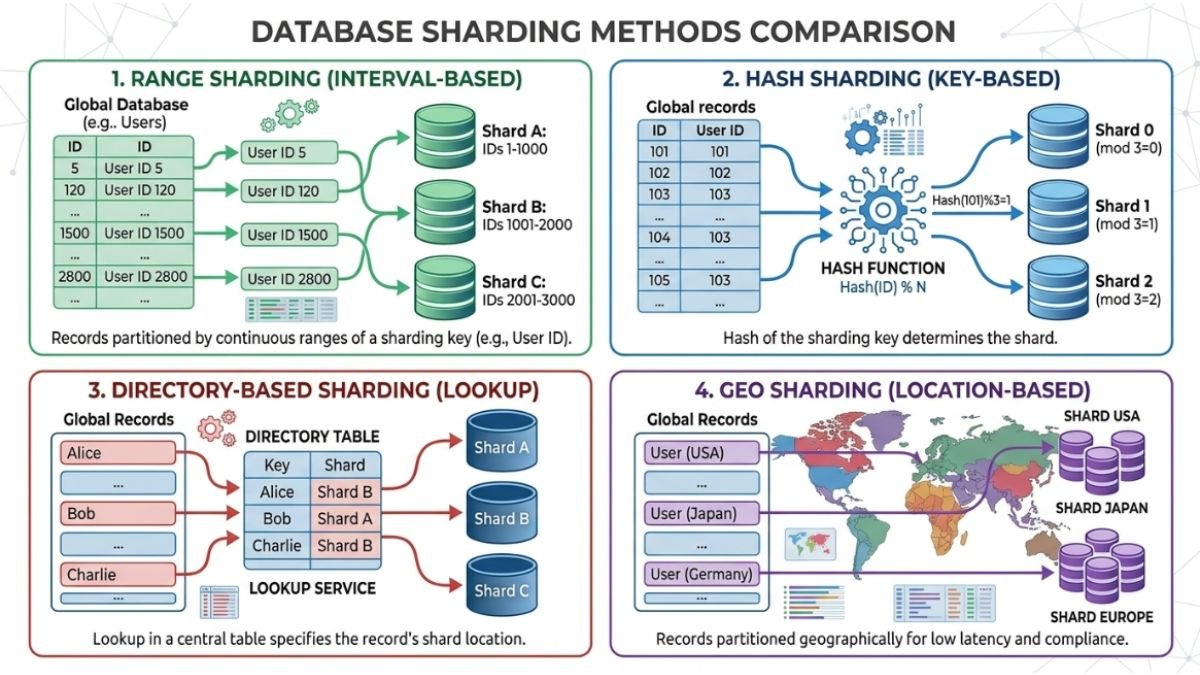
Different workloads need different sharding methods. The most common approaches include range-based, hash-based, directory-based, and geographic sharding. MongoDB — Sharding Documentation
| Sharding Method | How It Works | Common Strength |
|---|---|---|
| Range sharding | Divides records into value ranges | Efficient range queries |
| Hash sharding | Applies a hash function to the shard key | More even distribution |
| Directory sharding | Uses a lookup table to map records to shards | Flexible mapping |
| Geo sharding | Places data according to geographic regions | Better data locality |
| Key-based sharding | Uses a deterministic key-to-shard mapping | Predictable routing |
Range-Based Sharding
Range sharding divides records according to ranges of values. For example, customer IDs from 1–10 million could map to one group while higher IDs map elsewhere.
This can make range queries efficient because related values are often stored together. However, monotonically increasing values can create data hotspots when new writes concentrate on one shard.
Hash-Based Sharding
Hash sharding applies a hash function to the selected key before determining the destination shard. This can distribute records more evenly, particularly when the original key follows a predictable or sequential pattern.
MongoDB supports both hashed and ranged sharding. Its documentation notes that hashed distribution can provide more even distribution, while range sharding can make range-based queries more efficient. MongoDB — Sharding Documentation
Directory-Based Sharding
With directory-based sharding, a lookup table or central directory maps records, tenants, or key ranges to specific shards.
This provides flexible data distribution, but the directory becomes another system component that must remain reliable, fast, and consistent.
Geo Sharding
Geo sharding distributes data based on geographic requirements. For example, a global application could place European customer data closer to European infrastructure while routing U.S. customers to North American shards.
Geographic zones can also help improve data locality and support regional architecture requirements.
Benefits of Database Sharding
The biggest advantage of database sharding is horizontal scalability. Instead of continuously upgrading one database server, you can distribute data and workload across additional nodes.
Sharding can also increase storage scalability, reduce resource contention, and improve throughput for workloads that can be distributed effectively.
Another benefit is workload isolation. If one shard experiences unusually high activity, other shards may continue serving their workloads independently. When combined with replication and appropriate fault-tolerant architecture, sharding can also contribute to higher availability.
However, sharding does not automatically make every query faster. Its value depends heavily on shard key selection, workload distribution, and query design.
Common Challenges and Limitations of Database Sharding
Sharding introduces operational complexity. Instead of managing one database, your engineering team must manage multiple shards, routing, monitoring, migrations, backups, and schema changes.
Cross-shard operations can also become expensive. A query that requires data from several shards may generate additional network overhead and query coordination.
Rebalancing is another challenge. As data grows, some shards may become larger or busier than others. Moving data between nodes can consume network, storage, and database resources.
There is also application complexity. If routing logic is implemented in application code, developers must understand how data is mapped to shards. Changes to the sharding model can therefore affect application architecture.
How to Choose the Right Sharding Strategy
Choosing a sharding strategy should start with your workload rather than the database technology. First analyze how users access data, which queries dominate traffic, how quickly data grows, and which records are commonly retrieved together. Microsoft Azure — Sharding Pattern
A strong shard key usually provides sufficient cardinality, distributes requests effectively, and aligns with important query patterns. A key that looks unique but concentrates most traffic on one shard can still create a bottleneck.
For example, tenant_id may work well for a multi-tenant SaaS application when most requests are tenant-specific. A geographic key may make more sense when regional data locality matters. A hash-based approach can be useful when even distribution is more important than range locality.
The goal is not simply to make shard sizes equal. Workload distribution matters just as much as storage distribution.
Best Practices for Optimizing Database Sharding
Start with realistic production workloads before committing to a sharding design. Measure query frequency, data growth, read/write ratios, and the resources consumed by important operations.
Keep frequently related data together when possible. This can reduce cross-shard queries and improve data locality. Index important query fields, monitor shard utilization, and continuously track query latency rather than assuming that distribution automatically creates faster queries.
Plan for data rebalancing from the beginning. Your database growth pattern will change, and a shard allocation that works today may become inefficient later.
For systems that support automatic balancing, monitor migration activity because moving large amounts of data can temporarily affect performance.
Preventing Data Hotspots and Uneven Distribution
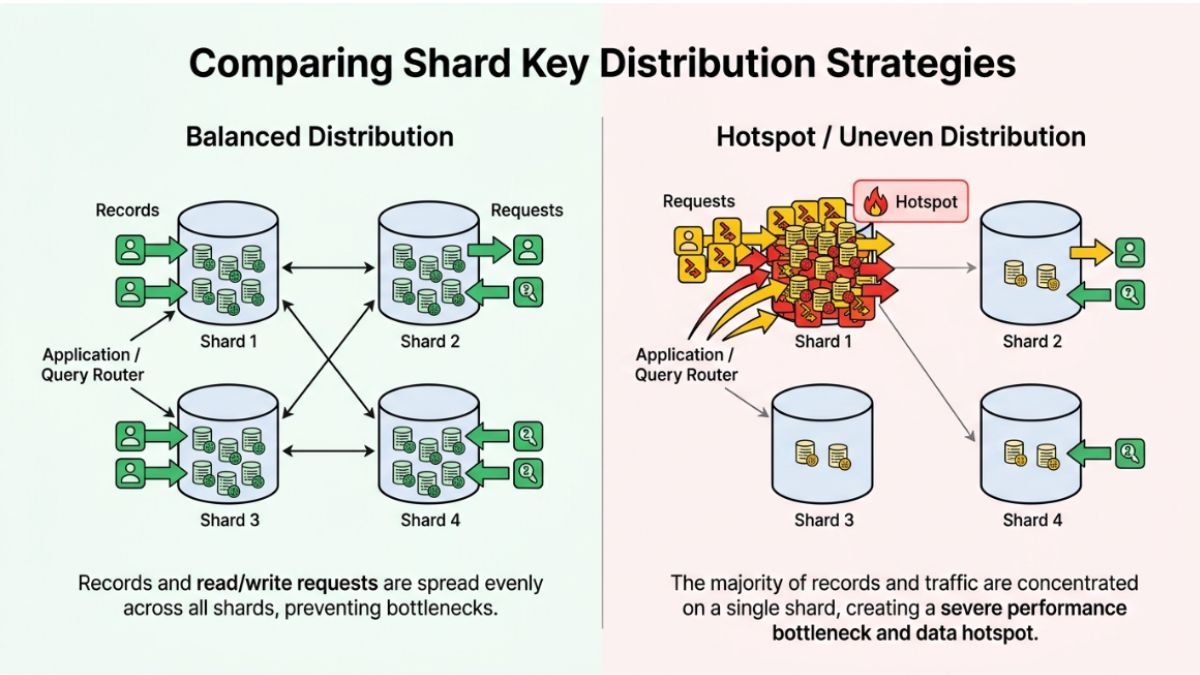
A data hotspot occurs when a disproportionate amount of traffic or data lands on one shard. This can turn a theoretically scalable architecture into a single-node bottleneck. Microsoft Azure — Sharding Pattern
Sequential identifiers are a common example. If new records continually receive increasing IDs and the sharding strategy places the newest range on one shard, most writes may concentrate there.
Hash-based distribution can reduce this pattern because values are spread according to their hash rather than their original sequence. Consistent hashing can also help certain distributed architectures minimize data movement when nodes are added or removed.
You should also monitor request frequency, storage growth, CPU usage, and query latency independently. Two shards may contain similar amounts of data but receive dramatically different workloads.
Cross-Shard Queries and Performance Considerations
A cross-shard query occurs when a request needs data from multiple shards. These queries can require parallel execution, network communication, and result aggregation. Microsoft Azure — Sharding Pattern
Suppose customer data is distributed by customer_id, but an analytics query needs orders from every customer. The system may need to query several shards and combine their results. That can increase query latency and network overhead compared with a targeted request.
This is why efficient sharding designs prioritize queries that can identify a specific shard. Queries containing the shard key can often be targeted to the relevant shard or shards, while queries that cannot be targeted may require broader operations.
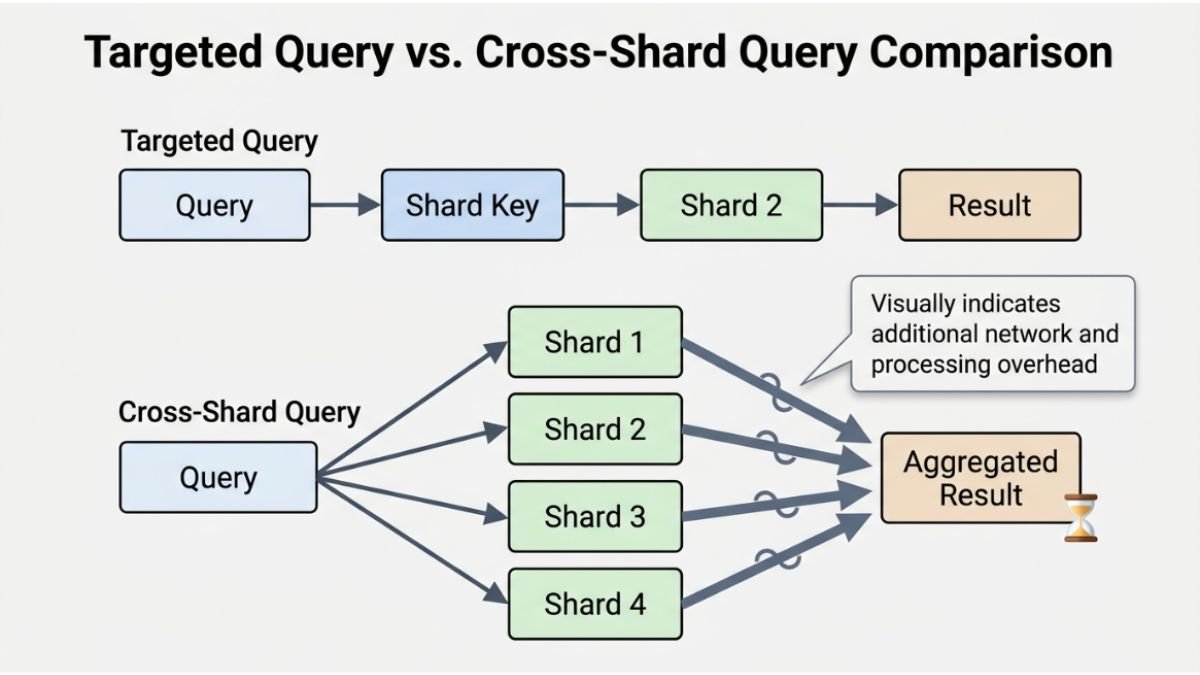
A good architecture therefore designs both the data distribution and the query model together.
Database Sharding vs Replication vs Partitioning
These concepts are related, but they solve different problems.
| Approach | Main Purpose | Data Relationship |
|---|---|---|
| Sharding | Horizontal scalability and workload distribution | Different shards store different subsets |
| Replication | Availability and redundancy | Replicas contain copies of data |
| Partitioning | Organizing a large dataset | Data is divided into logical or physical partitions |
| Vertical partitioning | Separating columns or fields | Different partitions hold different attributes |
In simple terms, sharding spreads different data across multiple nodes, while replication creates additional copies of data. Partitioning is a broader concept that can divide data by rows, ranges, lists, hashes, or columns depending on the system.
PostgreSQL, for example, provides built-in table partitioning with range, list, and hash methods. Its partitioning system divides a logical table into smaller physical pieces and routes rows to the appropriate partition based on the partition key. PostgreSQL — Table Partitioning
Therefore, database sharding PostgreSQL should not automatically be treated as the same thing as PostgreSQL’s native table partitioning. PostgreSQL partitioning can organize data within a database, while distributed sharding generally involves spreading data across independent database resources.
Real-World Use Cases of Database Sharding
Database sharding is most valuable when applications have substantial data volumes or sustained traffic that cannot be handled efficiently by a single database server.
Large SaaS platforms may shard by tenant so that customer workloads are distributed across database nodes. E-commerce systems can shard customer or order records when transaction volumes become very large.
Social platforms, gaming systems, financial applications, and high-traffic analytics platforms may also use sharding to distribute large datasets and database workloads.
For NoSQL sharding, systems such as MongoDB provide native mechanisms for distributing collections across shards. MongoDB can use range-based or hashed strategies and supports balancing mechanisms for moving data between shards. MongoDB — Sharding Documentation
SQL systems can also use sharding patterns. Azure SQL Database, for example, supports architectures where data is distributed across multiple databases, with shard maps helping applications determine where data belongs.
When to Use Database Sharding (and When Not To)
You should consider sharding when your database is approaching the storage, compute, throughput, or concurrency limits of a single server. It can also make sense when workload distribution and horizontal scalability are central architectural requirements.
However, sharding should not be your first response to ordinary database performance problems. Better indexing, query optimization, caching, vertical scaling, connection management, and database partitioning may solve the problem with considerably less operational complexity.
If your dataset is still comfortably supported by one database server, introducing multiple shards may add unnecessary infrastructure costs and maintenance work. Sharding becomes more compelling when the benefits of distributed capacity outweigh the additional complexity.
The most important lesson is simple: sharding is a scaling strategy, not a universal database optimization technique. Choose it because your workload requires distributed capacity, not simply because your database is getting larger.
Conclusion
Database sharding divides a large dataset into smaller shards and distributes those shards across multiple database servers or nodes. This approach enables horizontal scaling, increases available storage and processing capacity, and can distribute database workloads more effectively.
The difficult part is not creating multiple shards. The real challenge is choosing the right shard key, routing queries efficiently, preventing hotspots, and planning for growth.
Whether you are evaluating NoSQL sharding, PostgreSQL architectures, SQL Server workloads, or a distributed database platform, start with your access patterns and scaling requirements. A well-designed sharded architecture can support large-scale applications, but a poorly designed one can create more complexity without solving the original performance problem.
FAQs
What is sharding vs. partitioning?
Partitioning splits data within a database, while sharding distributes data across multiple database servers.
Is sharding for SQL or NoSQL?
Sharding can be used with both SQL and NoSQL databases, depending on the database system and workload.
What is the difference between clustering and sharding?
Clustering groups servers for availability or performance, while sharding splits data across servers.
What are the downsides of database sharding?
Sharding adds complexity to queries, transactions, data management, and scaling operations.
Can SQL databases be sharded?
Yes. Many SQL databases support sharding through built-in features, extensions, or application-level solutions.
What is the best sharding strategy?
The best strategy depends on your workload; range, hash, and directory-based sharding are common approaches.