Saga Pattern in Microservices: Architecture, Examples, and Implementation
When an online customer places an order, several services may need to work together: the order service creates the order, the inventory service reserves products, and the payment service processes the payment. Each service may own a separate database and manage its own transactions.
The challenge appears when one step fails after earlier steps have succeeded. For example, payment may be declined after the inventory service has already reserved the product. A traditional database rollback cannot simply undo changes across independently managed services.
The Saga Pattern addresses this problem by coordinating a sequence of local transactions and defining what should happen when a step fails. It helps developers manage distributed transactions in microservices without requiring one global database transaction. However, it does not provide full ACID guarantees across services. Instead, it relies on compensating transactions, coordination, and eventual consistency to bring the system toward a valid business state.
This guide explains the Saga Design Pattern, how it works, its two coordination approaches, a practical e-commerce example, and the engineering practices needed to use it reliably.
1. What Is the Saga Pattern in Microservices?
The Saga Pattern is a distributed transaction management pattern in which a business operation is divided into a sequence of smaller, independent local transactions. Each transaction is executed by a service and updates data within that service’s own database.
After completing its local transaction, a service triggers the next step in the workflow. This may happen by publishing an event, sending a command, or communicating through a central coordinator.
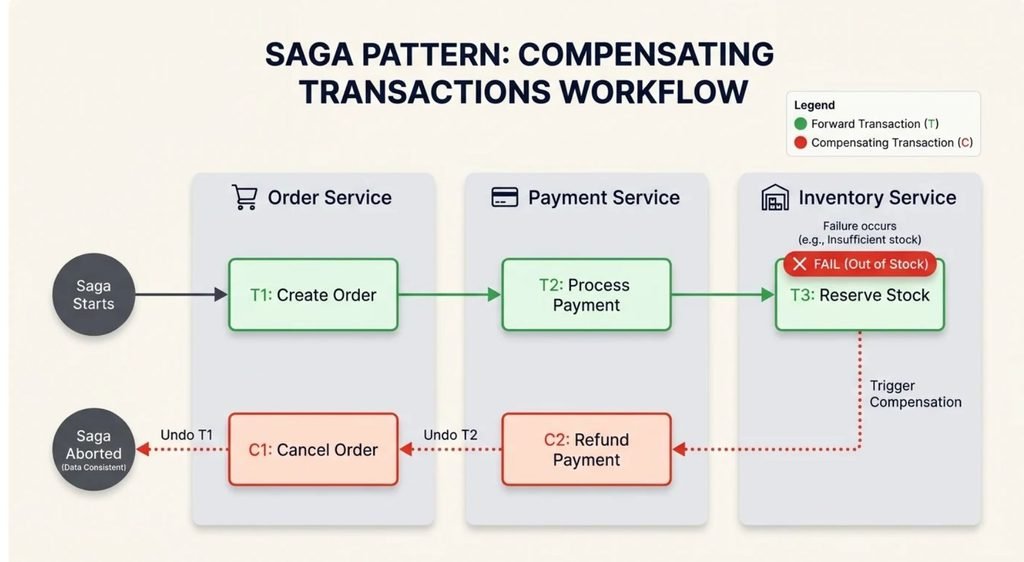
If every step succeeds, the overall business operation is considered complete. If a step fails, the Saga executes predefined compensating transactions to reverse or offset the business effects of previously completed steps.
Consider an e-commerce order:
- The Order Service creates an order.
- The Inventory Service reserves the requested products.
- The Payment Service processes the payment.
- The Order Service confirms the order.
Each step commits its own database transaction. There is no single database transaction spanning all three services.
A Saga therefore consists of three important elements:
- Saga participants: The services responsible for executing individual local transactions.
- Local transactions: Independent database operations performed by each participant.
- Compensating transactions: Business operations that counteract completed steps when the workflow cannot continue.
The key distinction is that a Saga coordinates a business workflow across services rather than creating one globally atomic database transaction.
For the foundational pattern definition and its original microservices context, see Chris Richardson’s Saga Pattern explanation on microservices.io.
2. Why Do Microservices Need the Saga Pattern?
Microservices commonly follow the database-per-service approach. Each service owns its data and controls how that data is accessed and modified. This improves service autonomy, but it makes operations involving multiple services more complicated.
Imagine a travel booking platform that needs to reserve a flight, book a hotel, and collect payment. Each operation belongs to a different service and database.
If the flight reservation succeeds but the hotel booking fails, the platform must decide what to do with the existing flight reservation. Simply returning an error does not undo the completed operation.
The distributed transaction problem
In a traditional monolithic application, multiple database changes can often be grouped into one ACID transaction. If an operation fails, the database can roll back the entire transaction.
In a microservices architecture, however, each service may use a separate database and transaction boundary. A normal database transaction cannot automatically guarantee atomicity across all these independent systems.
One possible approach is Two-Phase Commit (2PC), a distributed transaction protocol that coordinates participating resources through a prepare phase and a commit phase. However, distributed coordination can introduce blocking, availability, and operational complexity. It may also conflict with the autonomy and scalability goals of many microservices architectures.
The Saga Pattern offers another approach: each service commits its own local transaction, while the overall workflow handles failures through compensating actions.
This approach is useful when a business process spans multiple services and can tolerate temporary inconsistency while the workflow completes or recovers.
For a broader understanding of how distributed components communicate and fit into system architecture, see the S4Stack System Design Cheat Sheet.
3. How Does the Saga Pattern Work?
A Saga workflow executes a business transaction as a sequence of local transactions. Each successful step triggers the next one until the workflow finishes or a failure requires recovery.
The general process is:
- A request starts the Saga.
- The first participant executes its local transaction.
- On success, the next participant receives an event or command.
- Each participant commits its own transaction and triggers the following step.
- If all steps succeed, the Saga completes.
- If a step fails, the system initiates the required compensating transactions.
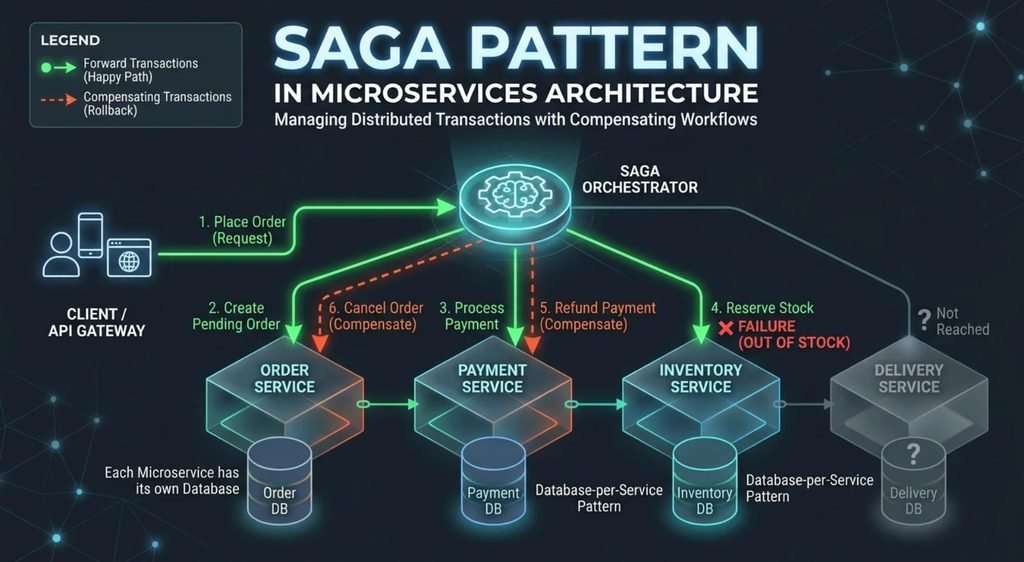
For example, an order workflow might reserve inventory, process payment, and confirm the order. If payment fails, the system can release the reserved inventory and mark the order as failed.
Forward execution and failure handling
The normal sequence of local transactions is sometimes called the forward path. When a failure occurs, the Saga may execute a compensation path to counteract the effects of earlier successful steps.
Compensation does not necessarily restore the exact previous database state. Instead, it performs a new business operation that addresses the consequences of the completed transaction.
For example, if a product has been reserved, compensation may release that reservation. If a payment has been captured, compensation may issue a refund.
This distinction is important because distributed systems cannot always reverse real-world effects as if they had never happened.
4. What Are the Two Types of Saga Pattern?
There are two common ways to coordinate a Saga: choreography and orchestration. Both execute local transactions and support compensating actions, but they differ in how services coordinate the workflow.
Choreography-Based Saga
In Saga Choreography, there is no central coordinator controlling the entire workflow. Instead, services communicate through events.
A service completes its local transaction and publishes an event describing what happened. Other services subscribe to relevant events and decide which action to perform.
For example:
- The Order Service creates an order and publishes
OrderCreated. - The Inventory Service receives the event, reserves stock, and publishes
InventoryReserved. - The Payment Service receives that event and processes payment.
- After successful payment, it publishes
PaymentCompleted. - The Order Service receives the event and confirms the order.
If payment fails, the Payment Service can publish a failure event. The Inventory Service can then release the reserved stock, while the Order Service updates the order status.
Advantages of choreography:
- Services remain relatively independent.
- No central coordinator is required.
- Event-driven communication can support loosely coupled workflows.
- It can work well for short, straightforward processes.
Limitations of choreography:
- The complete workflow is harder to understand as the number of services grows.
- Event dependencies can become difficult to trace.
- Debugging and monitoring distributed workflows can be challenging.
- Poorly designed event relationships can create cyclic dependencies.
Orchestration-Based Saga
In Saga Orchestration, a central component called a Saga Orchestrator controls the workflow. It knows the sequence of steps, sends commands to participating services, and decides what should happen after each response.
For example:
- The orchestrator instructs the Order Service to create an order.
- It asks the Inventory Service to reserve the products.
- After receiving confirmation, it instructs the Payment Service to process payment.
- If payment succeeds, it tells the Order Service to confirm the order.
- If payment fails, it initiates the required compensation, such as releasing inventory.
The orchestrator also tracks the workflow’s progress and can coordinate recovery when a participant reports an error.
Advantages of orchestration:
- The workflow is defined in one place.
- Complex business processes are easier to visualize.
- Centralized coordination can simplify monitoring and debugging.
- Compensation and failure-handling logic can be managed explicitly.
Limitations of orchestration:
- The orchestrator introduces an additional component to build and operate.
- Poorly designed orchestration can create tight coupling between workflow logic and services.
- The orchestrator itself needs reliable state management and recovery.
- It can become a bottleneck if its responsibilities are not designed carefully.
Saga Choreography vs Orchestration: Key Differences
| Comparison | Choreography | Orchestration |
|---|---|---|
| Coordination | Services coordinate through events | A central orchestrator coordinates steps |
| Workflow control | Distributed across participants | Defined by the orchestrator |
| Communication | Primarily event-driven | Commands and responses |
| Coupling | Can be loosely coupled, but event dependencies still matter | Participants depend on the orchestrator’s workflow contract |
| Debugging | Can become difficult as event flows grow | Central workflow state can make tracing easier |
| Complexity | Suitable for simpler workflows | Often better suited for complex workflows |
| Central component | No central coordinator | Requires an orchestrator |
| Best suited for | Short, straightforward event-driven processes | Multi-step workflows with complex decisions and compensation |
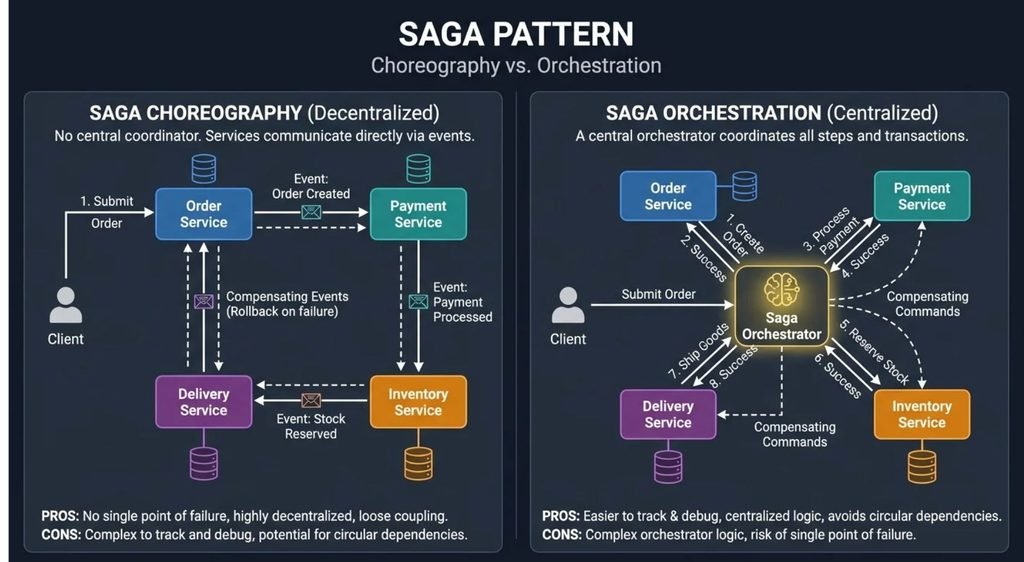
There is no universally better approach. Choose choreography when the workflow is relatively simple and event-driven coordination is natural. Consider orchestration when the process has many steps, conditional paths, or complex recovery requirements.
For a detailed comparison of the two approaches, see AWS Prescriptive Guidance: Saga Patterns.
5. How Do Compensating Transactions Handle Saga Failures?
A compensating transaction is a new business operation that counteracts the effect of a previously completed local transaction.
Suppose an order workflow has completed these steps:
- The Order Service creates an order.
- The Inventory Service reserves the product.
- The Payment Service attempts to charge the customer, but the payment fails.
The system cannot simply roll back the inventory database transaction from the Payment Service. Instead, it executes a separate compensation operation that releases the reserved stock.
This is why Saga rollback is different from a traditional database rollback.
A database rollback reverses uncommitted changes within a transaction. A compensating transaction runs after a local transaction has already committed and creates a new state that addresses the business consequences of the earlier action.
Forward recovery vs backward recovery
Saga failure handling generally involves two approaches:
- Backward recovery: Execute compensating transactions to counteract previously completed operations.
- Forward recovery: Retry or continue the workflow until it reaches a successful state.
The appropriate strategy depends on the failed operation and the business requirements. For example, a temporary service outage may justify retrying the operation, while a permanently declined payment may require compensation.
What happens if compensation fails?
Compensation is not guaranteed to succeed. A service may be unavailable, a downstream system may reject the request, or a network failure may prevent the compensation response from reaching the coordinator.
Production systems therefore need retry policies, persistent workflow state, alerts, and a recovery process for workflows that cannot complete automatically. Some failures may require manual intervention.
Microsoft’s Saga design guidance discusses these recovery concerns and the limitations of compensating transactions.
6. Important Saga Transaction Concepts
Microsoft’s Saga guidance describes three useful categories of transactions: compensable, pivot, and retryable transactions. Understanding them helps developers design reliable workflows.
Compensable transactions
A compensable transaction is an operation that has a corresponding compensation. For example, reserving inventory can be compensated by releasing the reservation.
Pivot transactions
A pivot transaction is the point in a Saga after which the workflow is expected to proceed toward completion rather than being undone through the normal compensation path.
It represents an important business boundary. For example, a payment capture or an irreversible external action may serve as a pivot, depending on the system’s business rules.
Retryable transactions
A retryable transaction is an operation designed to be retried until it succeeds. These operations commonly appear after the pivot transaction.
For example, after payment has been captured, the system may retry order confirmation if the Order Service is temporarily unavailable. Such retries require careful idempotency design so that repeated requests do not create duplicate business effects.
For the underlying transaction categories and their role in Saga workflows, refer to Microsoft’s Saga Pattern documentation.
7. Saga Pattern Example: An E-Commerce Order Workflow
Consider an online store where a customer purchases a laptop. The order requires coordination between three microservices:
- Order Service: Creates and manages the order.
- Inventory Service: Checks and reserves product stock.
- Payment Service: Processes the customer’s payment.
Each service manages its own database. The Saga coordinates the overall business process.
Successful order workflow
| Step | Service | Local transaction | Result |
|---|---|---|---|
| 1 | Order Service | Create order | Order marked as pending |
| 2 | Inventory Service | Reserve laptop | Stock reserved |
| 3 | Payment Service | Process payment | Payment successful |
| 4 | Order Service | Confirm order | Order confirmed |
When all four steps succeed, the business workflow is complete.
Failed payment workflow
Now imagine the Payment Service declines the customer’s payment after inventory has been reserved.
The system needs to handle the failure:
| Step | Service | Action | Result |
|---|---|---|---|
| 1 | Order Service | Create order | Order pending |
| 2 | Inventory Service | Reserve laptop | Stock reserved |
| 3 | Payment Service | Process payment | Payment declined |
| 4 | Inventory Service | Release reservation | Stock available again |
| 5 | Order Service | Update order status | Order marked as failed |
The compensation does not delete the history of the original inventory reservation. It performs a new operation that releases the reserved stock.
A simplified orchestration-based example might look like this:
startSaga(order):
    createOrder(order)

    try:
        reserveInventory(order)
        processPayment(order)
        confirmOrder(order)

    catch error:
        releaseInventory(order)
        cancelOrder(order)
        markSagaAsFailed(order)
This pseudocode illustrates the workflow only. A production implementation also needs durable Saga state, timeout handling, retry policies, idempotent operations, and compensation-failure handling. The actual sequence of compensation should reflect which steps successfully completed.
8. Saga Pattern Best Practices and Common Challenges
The Saga Pattern makes cross-service business workflows possible, but it introduces operational responsibilities. A reliable implementation must account for message delivery, retries, state management, and failures that occur during recovery.
Design idempotent operations
An idempotent operation produces the same intended business result when the same request is processed more than once.
This matters because message brokers and distributed communication systems may deliver duplicate messages. If an inventory reservation request is processed twice, the service should not reserve the same stock twice.
Use unique operation identifiers, idempotency keys, or persisted transaction records to recognize previously processed requests.
Handle retries, timeouts, and duplicate messages
A service may fail temporarily because of network problems, database overload, or an unavailable dependency. Define timeouts and retry policies for operations that can safely be repeated.
Use exponential backoff where appropriate, limit retry attempts, and distinguish temporary failures from permanent business failures. For example, a temporary payment gateway timeout is different from a card being declined.
Also define what happens when a service does not respond before the workflow’s deadline.
Failure handling is closely related to other resilience mechanisms. For example, the Circuit Breaker Pattern in Microservices can help prevent repeated calls to a dependency that is currently failing. A circuit breaker does not replace Saga compensation or retry logic, but it can complement them.
Use the Transactional Outbox Pattern
A common problem in event-driven microservices is the dual-write problem. A service may successfully update its database but fail to publish the corresponding event. The database change is committed, but other services never receive the message.
The Transactional Outbox Pattern helps address this problem. The service writes its business data and an outgoing event record in the same local database transaction. A separate process then publishes the stored event to the message broker.
This approach reduces the risk of losing events between a database update and message publication. It does not eliminate the need for idempotent consumers, duplicate detection, and reliable message delivery.
For further implementation context, see AWS’s Saga Patterns guidance, which discusses the dual-write problem and related event-driven design concerns.
Track Saga state and monitor failures
A long-running Saga needs durable state so that the system can determine which steps have completed, which are pending, and which require compensation.
Track important workflow events, transaction identifiers, failure reasons, retry counts, and compensation status. Use distributed tracing, structured logs, and monitoring to follow a workflow across multiple services.
Without adequate observability, identifying the cause of a failed distributed transaction can become difficult.
Plan for failed compensations
A compensation can fail just like any other service operation. Do not assume that sending a compensation request means the business state has been restored.
Persist compensation status, retry recoverable failures, and alert operators when a workflow becomes stuck. For critical workflows, define a manual recovery procedure and make sure operators can identify the affected business transaction.
Understand eventual consistency and isolation limitations
The Saga Pattern provides eventual consistency, not immediate global consistency. During execution, some services may have committed their local transactions while others have not yet completed their steps.
It also does not provide global transaction isolation across participating services. Concurrent workflows may interact with the same business data, so developers may need semantic locks, version checks, reservations, or other business-level controls.
These limitations should influence the design of the workflow from the beginning.
9. When Should You Use the Saga Pattern (and When Should You Avoid It)?
The Saga Pattern is useful when a business operation spans multiple independently managed services and can be completed through a sequence of local transactions and compensating actions.
Common use cases include:
- E-commerce order processing: Coordinating order creation, inventory reservation, and payment.
- Travel booking systems: Managing flight, hotel, and payment operations.
- Financial workflows: Coordinating business operations across services, where the workflow and recovery rules are explicitly defined.
- Logistics platforms: Coordinating shipment creation, inventory updates, and delivery processes.
However, Saga is not the right solution for every distributed operation.
Avoid using it when a simple local database transaction can solve the problem. Be cautious when the business process requires strict, immediate consistency across all participants or when an operation cannot be meaningfully compensated and no suitable recovery strategy exists.
Also consider the operational cost. A Saga introduces workflow state, failure handling, retries, monitoring, and recovery logic. For a simple operation, that complexity may not be justified.
Before adopting it, evaluate whether the business process can tolerate eventual consistency, whether each step has a clear failure strategy, and whether compensating actions are practical.
10. Frequently Asked Questions About the Saga Pattern
What is the Saga Pattern in microservices?
The Saga Pattern in microservices is a way to manage a distributed business transaction through a sequence of local transactions. If a step fails, compensating transactions counteract the effects of previously completed steps.
How does the Saga Pattern work?
A Saga executes local transactions across multiple services. Each successful step triggers the next one. If the workflow cannot continue, the system performs compensating actions or retries operations according to its recovery strategy.
What are the two types of Saga Pattern?
The two main types are choreography and orchestration. Choreography coordinates services through events, while orchestration uses a central coordinator to control the workflow.
What is the difference between Saga orchestration and choreography?
In orchestration, a central component sends commands and tracks workflow progress. In choreography, services react to events published by other services without relying on a central workflow coordinator.
What is a compensating transaction?
A compensating transaction is a new business operation that counteracts the effect of an earlier committed local transaction. For example, releasing reserved inventory compensates for a previous inventory reservation.
Does the Saga Pattern support rollback?
The Saga Pattern does not provide a traditional global database rollback. Instead, it uses compensating transactions to address the business effects of completed operations.
What is the difference between the Saga Pattern and Two-Phase Commit?
Two-Phase Commit (2PC) coordinates a distributed transaction through prepare and commit phases. The Saga Pattern uses independent local transactions and compensating actions. Saga can fit loosely coupled microservices better, but it does not provide the same global atomicity and isolation guarantees.
Is the Saga Pattern eventually consistent?
Yes. A Saga generally provides eventual consistency. Individual services may temporarily hold different views of a business process while the workflow is still running. Once the Saga completes successfully or its recovery actions finish, the participating services should reach the intended business state.
Conclusion
The Saga Pattern provides a practical way to coordinate distributed transactions in microservices without depending on one global database transaction. By combining local transactions, choreography or orchestration, and compensating actions, it helps services manage complex business workflows.
However, successful implementation requires more than connecting services together. Developers must design idempotent operations, handle retries and timeouts, persist workflow state, address the dual-write problem, and monitor failed compensations.
Choose the Saga Pattern when a distributed business process can tolerate eventual consistency and has clear recovery rules. When designed carefully, it can make complex microservices workflows more resilient and manageable.