Factuality and faithfulness metrics for RAG help measure whether a generated answer is both grounded in retrieved information and factually correct.
A RAG system retrieves information from an external knowledge source and then uses that information to generate a response. Because retrieval and generation can fail independently, evaluating only the final answer is not enough.
RAG evaluation metrics help identify whether the problem comes from retrieval quality, missing context, irrelevant context, or the generated response itself.
Two particularly important areas are factuality and faithfulness.
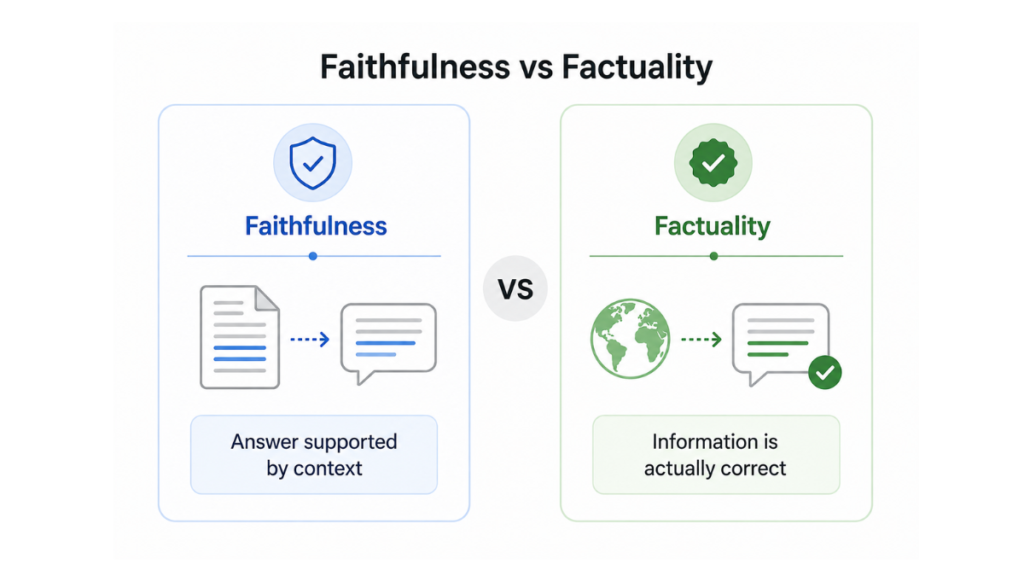
Factuality focuses on whether the information in an answer is correct.
Faithfulness focuses on whether the generated answer is supported by the retrieved context.
These measurements help make RAG systems more reliable, measurable, and easier to improve.
What Are RAG Evaluation Metrics?
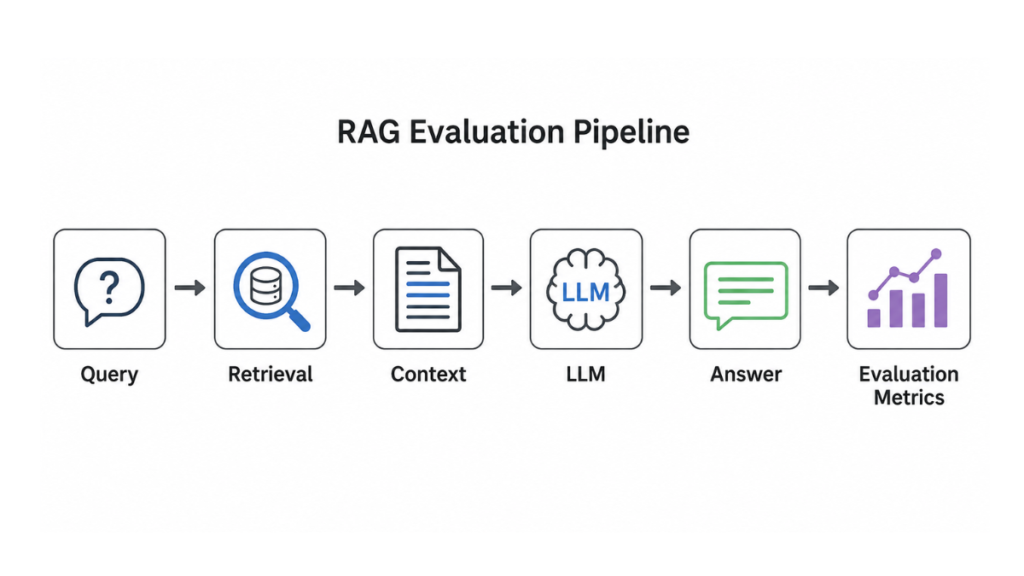
RAG evaluation metrics are measurements used to assess different parts of a Retrieval Augmented Generation system.
A useful evaluation process normally looks at three areas:
Retrieval quality
Checks whether the system retrieves relevant and useful information.
Generation quality
Checks whether the model produces an appropriate and well grounded response.
Answer quality
Checks whether the final response is correct, relevant, and useful.
This separation matters because a poor answer does not always mean the language model itself is the problem.
The retriever may have returned poor context, or the model may have failed to use good context correctly.
What Is Faithfulness in RAG?
Faithfulness measures whether a generated response is supported by the retrieved context.
A highly faithful response stays within the information available in the retrieved documents instead of introducing unsupported claims.
This makes faithfulness particularly important for detecting hallucination in RAG applications.
According to the RAGAS metrics documentation, faithfulness is one of the metrics available for evaluating RAG systems.
What does a high faithfulness score mean?
A high score indicates that most of the generated claims are supported by the retrieved information.
A low score indicates that the response contains claims that are not adequately supported by the retrieved context.
Faithfulness therefore evaluates the connection between:
Retrieved Context → Generated Answer
It does not automatically prove that the retrieved information itself is factually correct.
What Is Factuality in RAG?
Factuality focuses on whether the claims in a generated answer are factually correct.
This is slightly different from faithfulness.
An answer can be faithful to the retrieved context while still being factually incorrect if the retrieved information itself is inaccurate, outdated, or incomplete.
This distinction is important when designing factuality and faithfulness metrics for RAG.
Using both perspectives gives a more complete view of RAG answer quality.
Factuality vs Faithfulness in RAG
| Metric | Main focus |
|---|---|
| Faithfulness | Support from retrieved context |
| Factuality | Correctness of factual claims |
| Answer Relevancy | Relevance to the user’s question |
| Context Precision | Quality of retrieved context |
| Context Recall | Coverage of relevant information |
These metrics measure different failure points, so replacing all of them with a single score can hide important problems.
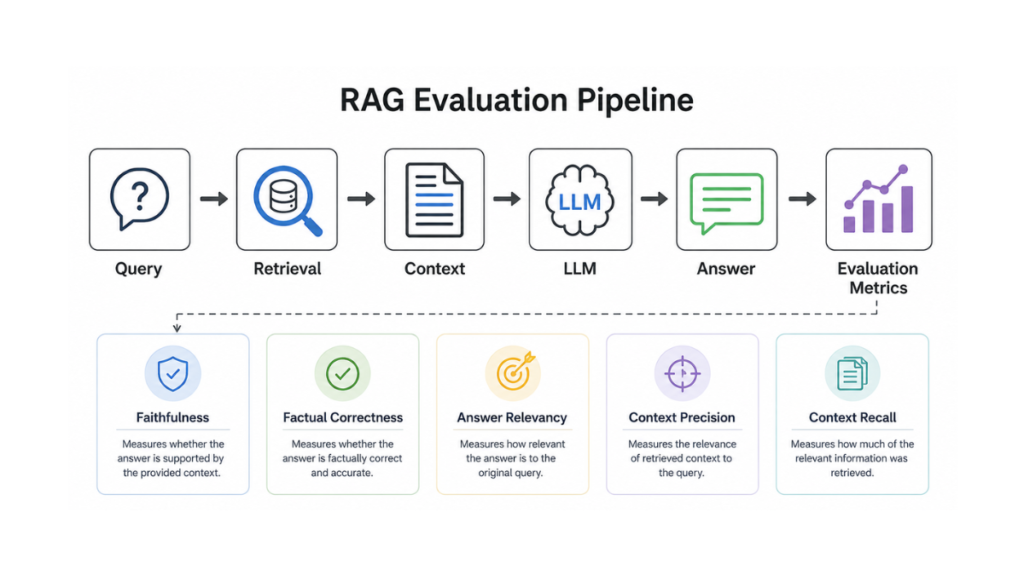
What Are the Most Important RAG Evaluation Metrics?
A practical RAG evaluation process should examine both retrieval and generation.
1. Faithfulness
Measures whether the generated response is grounded in the retrieved context.
2. Factual Correctness
Measures whether factual claims correspond to a trusted reference or expected answer.
3. Answer Relevancy
Measures whether the generated response directly addresses the user’s query.
4. Context Precision
Measures whether the retrieved information is relevant rather than filled with unnecessary content.
5. Context Recall
Measures whether the retrieval process found the relevant information needed to answer the query.
RAGAS documents metrics including context precision, context recall, and faithfulness as part of its RAG evaluation capabilities.
Why Is Contextual Relevance Important?
Contextual relevance evaluates whether the retrieved information is actually useful for the query.
This is especially important when the RAG system relies on a vector database for semantic retrieval.
Poor contextual relevance usually points toward problems in the retrieval stage.
Possible causes include:
- Weak embeddings
- Poor chunking
- Incorrect retrieval configuration
- Inadequate metadata
- Poor query formulation
- Irrelevant documents in the knowledge base
Improving retrieval quality can therefore improve the quality of the final generated response.
How Do Factuality and Faithfulness Work Together?
Factuality and faithfulness answer different questions.
Faithfulness checks the relationship between the answer and retrieved context.
Factuality checks the correctness of the information itself.
Using both metrics helps separate two different types of problems.
A system can have strong retrieval but generate unsupported information.
A system can also generate an answer that faithfully follows retrieved content even when that content contains incorrect information.
This is why RAG evaluation metrics should be interpreted together rather than treated as isolated scores.
What Is the RAGAS Framework?
RAGAS is an evaluation framework designed to measure the quality of RAG pipelines.
It provides metrics for evaluating areas such as:
- Faithfulness
- Answer relevancy
- Context precision
- Context recall
- Factual correctness
The available metric set has expanded over time, allowing RAGAS to cover different evaluation requirements beyond the basic RAG metrics.
RAG Evaluation Frameworks
RAGAS is not the only option for evaluating RAG systems.
Different RAG evaluation frameworks focus on different parts of the evaluation process.
Common tools and frameworks include:
RAGAS
Focused on evaluating RAG pipelines using metrics for retrieval and generated responses.
DeepEval
Provides evaluation capabilities for LLM applications and RAG systems.
Official documentation: DeepEval
Arize Phoenix
Provides observability and evaluation capabilities for AI and RAG applications.
Official documentation: Arize Phoenix
ARES
ARES is another approach for evaluating retrieval augmented generation systems using automated evaluation methods.
The right framework depends on the RAG architecture, evaluation dataset, available infrastructure, and the type of quality signals being measured.
When Should You Use RAG Evaluation Metrics?
RAG evaluation should not be limited to the final development stage.
It can be used during:
Development
To compare retrieval and generation configurations.
Testing
To identify quality regressions before deployment.
Production monitoring
To track changes in response quality over time.
Model changes
To compare different models or prompts.
Retrieval changes
To measure the effect of different chunking, embedding, or retrieval strategies.
This makes evaluation part of the development cycle rather than a one time quality check.
How to Build a RAG Evaluation Dataset
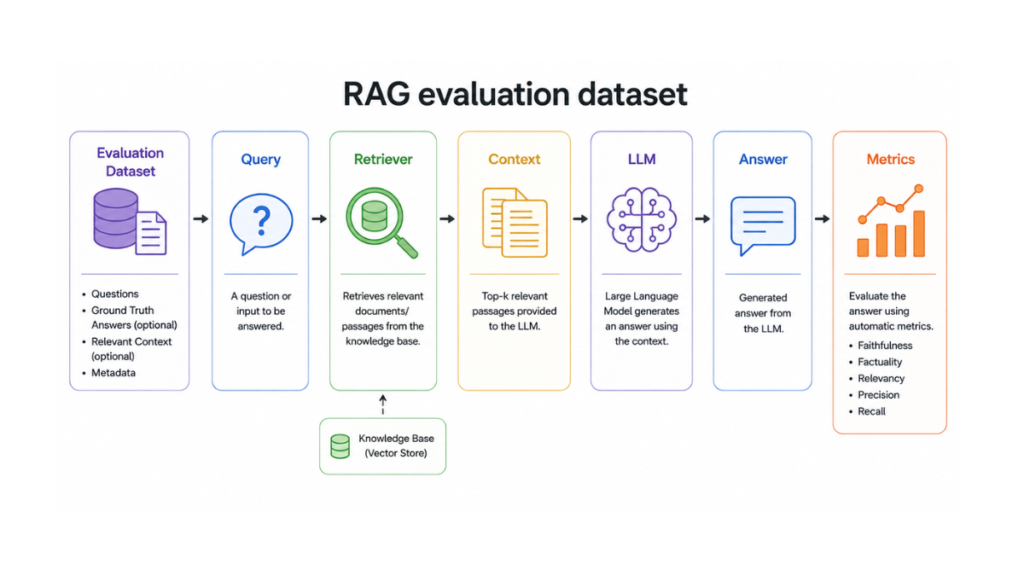
Reliable evaluation requires a consistent test dataset.
A useful dataset should contain:
- User queries
- Retrieved contexts
- Generated responses
- Expected answers where available
- Relevant reference information
- Evaluation criteria
The dataset should represent the types of queries the RAG application is expected to handle.
Evaluation quality depends heavily on the quality and coverage of the dataset.
A dataset that does not represent real application queries can produce misleading evaluation results.
How to Improve RAG Evaluation Scores
Improving a poor score requires identifying the specific stage causing the problem.
Low faithfulness
Review prompts, retrieved context, model behavior, and grounding instructions.
Low factual correctness
Review the source data, reference answers, model output, and factual verification process.
Low context precision
Improve retrieval ranking and remove irrelevant results.
Low context recall
Improve document coverage, chunking, query processing, or retrieval configuration.
Low answer relevancy
Review query understanding, prompt instructions, and response generation.
The important principle is simple:
Do not optimize the entire RAG pipeline based on one metric.
Find the failing component first.
How Should RAG Metrics Be Interpreted?
A single evaluation score does not explain why a RAG system is performing poorly.
Metrics should be interpreted together.
High context recall but low faithfulness
The system is finding relevant information, but the generated answer may not be properly grounded in that information.
Low context precision and low answer relevancy
The retrieval system may be returning too much irrelevant information.
High faithfulness but low factual correctness
The answer may closely follow the retrieved context while the underlying source information is inaccurate.
This is why RAG metrics should be treated as diagnostic signals rather than simple pass or fail numbers.
What Is the Best RAG Evaluation Strategy?
A practical evaluation strategy should combine multiple measurements.
Start with retrieval quality.
Then evaluate the retrieved context.
Then measure the generated response.
Finally, evaluate factual correctness and overall answer quality.
Final Thoughts
Factuality and faithfulness metrics for RAG are important because a RAG system can fail at several different stages.
A useful evaluation process should measure:
Retrieval quality
Contextual relevance
Faithfulness
Factual correctness
Answer relevancy
Frameworks such as RAGAS, DeepEval, Arize Phoenix, and ARES can help developers evaluate and monitor RAG applications.
The objective is not simply to achieve a high evaluation score.
The objective is to understand where the RAG system is failing and what needs to be improved.