Generative search is changing how people discover information online. Instead of opening several search results and comparing them, users can now ask AI systems a question and receive a synthesized response with links and citations to supporting sources.
That creates a new visibility opportunity for websites.
Generative Engine Optimization (GEO) is the practice of improving the chances that your content is discovered, selected, cited, and meaningfully used in AI-generated responses.
But GEO is not about finding a secret trick to “rank ChatGPT.” Google’s current guidance makes an important point: SEO best practices still matter for generative AI features because Google’s AI search experiences rely on its existing Search ranking and quality systems.
So the best GEO strategy is not to abandon SEO. It is to build on strong SEO with content that is easy for both people and AI systems to understand, retrieve, verify, and use.
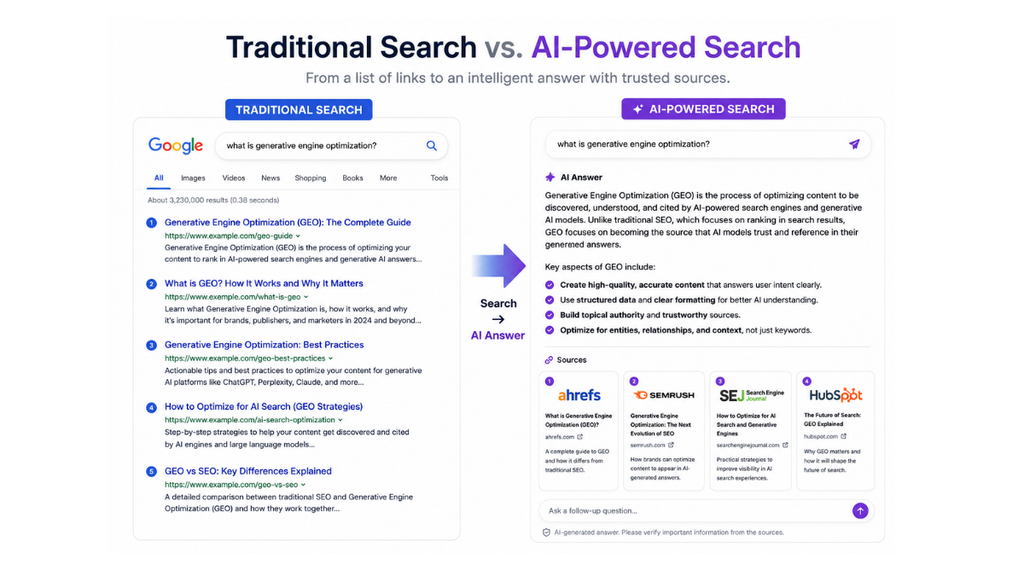
What Is Generative Engine Optimization?
Generative Engine Optimization is the process of creating and structuring web content so that generative search systems can better discover, understand, retrieve, and potentially cite it in their responses.
Traditional SEO mainly focuses on visibility in search results.
GEO focuses on visibility inside AI-generated answers, including experiences such as Google AI Overviews, AI Mode, and other generative search systems.
A simple way to understand the difference:
- SEO: Help search engines discover and rank your page.
- GEO: Help generative systems discover, understand, select, and use information from your page.
- AEO: Often focuses specifically on providing content that can answer questions directly in answer-engine experiences.
These concepts overlap heavily. In fact, Google explicitly describes optimizing for its generative AI search features as part of optimizing the overall Search experience rather than as a completely separate SEO system.
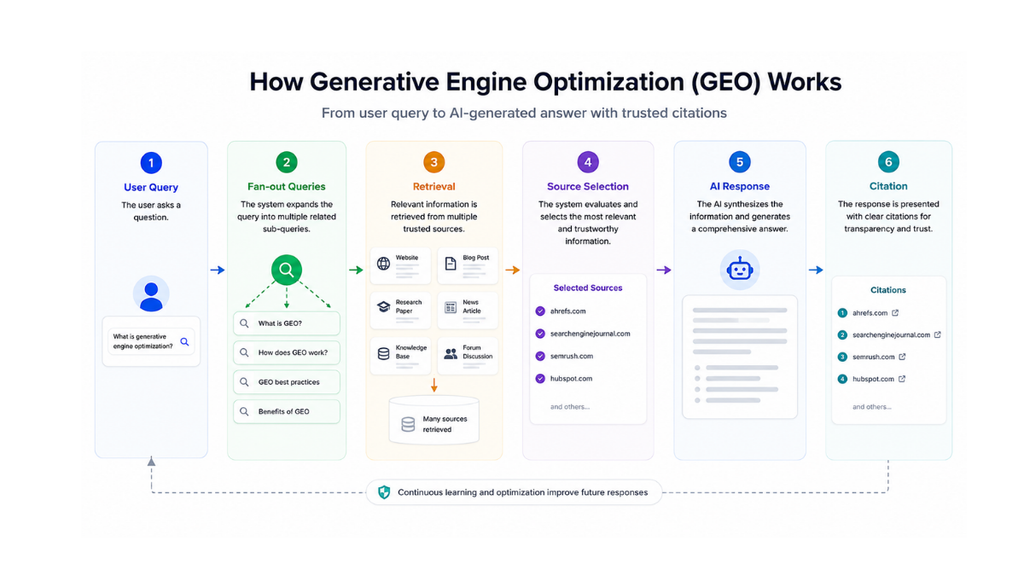
How Does GEO Work?
Generative search systems can use multiple stages before producing an answer.
For more complex questions, an AI search system may also break the original question into multiple related searches. Google calls this query fan-out.
SEO Still Matters for GEO
One of the biggest GEO misconceptions is that traditional SEO no longer matters.
It does.
Google’s current documentation says its generative AI features are built on its core Search ranking and quality systems, meaning foundational SEO remains relevant.
That includes making your website:
- crawlable
- indexable
- technically accessible
- logically structured
- fast and usable
- clear about its content
- supported by relevant structured data where appropriate
- useful to real users
Before trying advanced GEO techniques, make sure search engines can actually access and understand your website.
Foundational SEO comes first. GEO builds on it.
1. Create Unique, Valuable, Non-Commodity Content
This is one of the most important GEO strategies.
AI systems already have access to enormous amounts of common information. Rewriting the same information that hundreds of other websites already provide gives your page little reason to become a valuable source.
Instead, create content that adds something useful. Instead of writing:
“SEO helps websites get more visibility in search engines.”
you could provide:
- original examples
- first-hand observations
- comparisons
- original data
- experiments
- practical workflows
- screenshots
- case studies
- expert analysis
- specific recommendations
- useful tables
Google’s current AI-search guidance specifically emphasizes non-commodity content and unique value.
The goal is simple:
Don’t just repeat information. Give the web something worth citing.
2. Answer the User’s Question Clearly
AI systems need information they can understand and use.
That makes clear writing particularly important.
Start sections with direct answers before expanding into details.
Weak approach:
Search visibility has undergone many changes over the years…
Better approach:
GEO improves AI-search visibility by making content easier to discover, understand, retrieve, and cite.
Then explain the reasoning. This structure also helps human readers because they can quickly find the information they need.
3. Cover Related Questions and Search Intent
A strong GEO article should not focus on one keyword repeatedly.
Instead, understand the questions surrounding the topic.
For “generative engine optimization,” related searches might include:
- What is GEO?
- How does GEO work?
- Is GEO different from SEO?
- How do you optimize content for AI search?
- How do you measure GEO success?
- What are GEO tools?
- How do AI Overviews select sources?
- Does structured data help AI search?
- Is llms.txt necessary?
- How can businesses improve AI visibility?
This creates a more complete resource and helps your page address the information needs behind the query, rather than simply matching keywords.
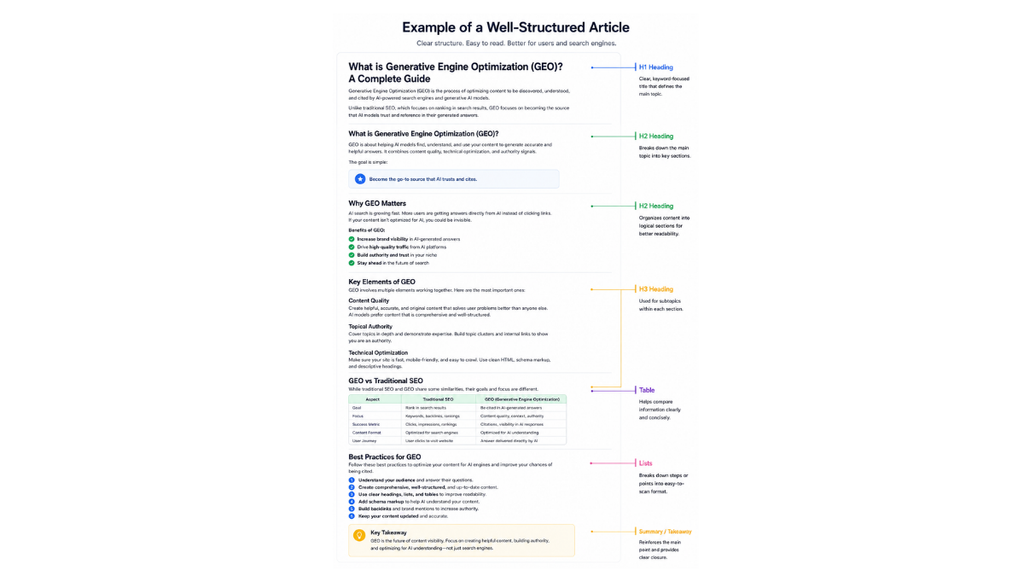
4. Make Your Content Easy to Extract and Understand
AI systems need to process information from web pages.
Clear structure can help.
Use:
- descriptive headings
- short paragraphs
- meaningful lists
- tables where useful
- definitions
- examples
- comparisons
- step-by-step processes
- factual statements
- supporting evidence
Avoid hiding important information inside unnecessarily complicated layouts.
Semantic HTML can also help communicate the structure of a page.
5. Build Strong Topical Coverage
GEO is not only about individual pages.
Your website should demonstrate knowledge around a topic.
For example, a website covering AI search could publish related content about:
- Generative Engine Optimization
- AI Overviews
- AI Mode
- AEO
- traditional SEO
- semantic search
- retrieval systems
- AI visibility
- content optimization
- structured data
- technical SEO
- measuring AI-search performance
Then connect related articles naturally through internal links.
This creates a clearer topical structure for users and search systems.
6. Use Evidence, Facts, and Original Information
One of the more interesting findings from recent GEO research is that being merely cited does not necessarily mean that your content strongly influenced an AI answer.
A 2026 study examining citation selection and citation absorption found that highly influential pages tended to be more structured, semantically aligned, and rich in extractable evidence such as definitions, numerical facts, comparisons, and procedural information.
That suggests an important distinction:
Being selected as a source is not the same as having your information meaningfully used.
Therefore, make important claims easy to verify.
Instead of:
“This method works better.”
write:
“In our test, method A reduced processing time from X to Y.”
Then explain how you measured it and link to the evidence where appropriate.
7. Strengthen Your Website’s Technical Structure
Content quality cannot compensate for a website that search systems cannot properly access.
Check the basics:
- Make important pages crawlable.
- Make sure pages can be indexed.
- Use descriptive URLs.
- Use logical heading structures.
- Fix broken internal links.
- Avoid accidental
noindexdirectives. - Make important content available in the HTML.
- Use canonical URLs correctly.
- Keep your site technically accessible.
- Make navigation understandable.
JavaScript is not automatically a problem, but important content should not depend on unnecessary technical complexity.
Google’s guidance continues to emphasize foundational SEO alongside optimization for generative AI experiences.
8. Optimize Images and Videos Too
GEO isn’t limited to text.
Google’s current AI-search guidance also discusses local, shopping, image, and video content.
For images:
- use descriptive filenames
- write useful alt text
- place images near relevant content
- provide contextual captions where useful
- use high-quality visuals
For videos:
- provide descriptive titles
- explain what the video contains
- include relevant supporting text
- use appropriate structured data when applicable
Visual content can provide additional information that complements the main article.
9. Optimize Local and Ecommerce Content
Local businesses and ecommerce websites have additional opportunities.
For a local business, make important information clear:
- business name
- address
- service area
- opening hours
- products or services
- contact information
- reviews and reputation
- relevant local content
For ecommerce websites, provide accurate:
- product names
- descriptions
- prices
- availability
- specifications
- images
- shipping information
- return information
Google specifically identifies local and shopping experiences as areas where providing useful, appropriate content matters for generative AI search.
10. Use Structured Data Correctly
Structured data can help search engines understand eligible content and products.
But don’t treat schema markup as a GEO ranking hack.
Use structured data when it accurately represents information visible on the page and when it is appropriate for the content.
The goal should be:
accurate structured information + useful visible content
11. Don’t Waste Time on llms.txt as a Ranking Hack
llms.txt has received significant attention in GEO discussions.
But Google’s current documentation is clear: llms.txt is not required for Google Search and does not currently provide a positive or negative visibility or ranking effect in Google Search. Google says maintaining one is fine for other services or systems that may use it.
So don’t spend weeks creating an elaborate llms.txt strategy while ignoring:
- content quality
- technical SEO
- internal linking
- crawlability
- original information
- search intent
- authority
- user experience
Those fundamentals are much more important.not adding every possible schema type simply because you think it might improve AI visibility.
12. Don’t Manufacture AI Citations or Mentions
One of the worst GEO strategies is trying to manipulate AI systems into mentioning your brand.
For example:
- publishing hundreds of low-value pages
- inserting unnatural brand mentions
- creating fake references
- generating repetitive content
- manipulating third-party websites
- producing pages solely to influence AI answers
These tactics can reduce content quality and may create spam problems.
Google’s spam policies specifically prohibit scaled content abuse when large amounts of unoriginal content are produced primarily to manipulate Search rankings. The policies also apply to attempts to manipulate generative AI responses.
Build evidence for your brand instead of manufacturing mentions.
13. Build Authority Across the Web
AI systems can use information from multiple sources.
That makes your overall web presence important.
Useful signals can include:
- reputable backlinks
- expert mentions
- original research
- industry publications
- trustworthy reviews
- relevant communities
- professional profiles
- partnerships
- useful resources
But don’t pursue mentions purely because you want an AI system to repeat your brand name.
The better strategy is to become a genuinely useful source that other websites naturally reference.
14. Create Content That AI Systems Can Verify
A strong GEO page should make important information easy to check.
Instead of:
GEO is becoming extremely important for every business.
Use:
Google now provides generative AI experiences such as AI Overviews and AI Mode, and its guidance says foundational SEO remains relevant for these experiences.
The second statement is stronger because the reader can verify it.
This is especially important as AI-generated responses become more citation-oriented.
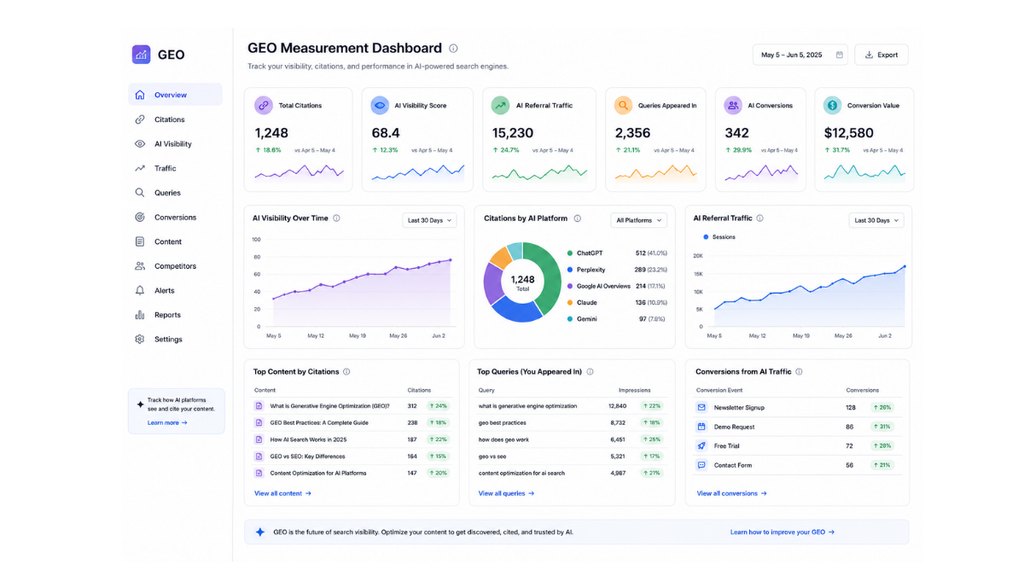
15. Measure GEO Performance
You cannot improve what you don’t measure.
Track:
- AI visibility
- citations
- pages appearing in AI answers
- branded mentions
- referral traffic
- organic traffic
- conversions
- query coverage
- changes in visibility over time
Google has also expanded Search Console reporting around AI features. Its documentation notes that AI Overviews are counted in the Search Console Performance report, while AI Mode is included in Search Console totals.
When analyzing GEO, don’t focus only on:
“Was my website cited?”
Ask better questions:
- Which pages were cited?
- For which queries?
- How often?
- Which competitors appeared?
- What information from my page was actually used?
- Did AI visibility generate website visits?
- Did those visitors convert?
Recent research argues for measuring GEO beyond simple citation counts because citation selection and actual influence on the generated answer are different outcomes.
GEO vs Traditional SEO
GEO and SEO should not be treated as competing strategies.
| Traditional SEO | Generative Engine Optimization |
|---|---|
| Targets search-result visibility | Targets visibility in AI-generated responses |
| Focuses heavily on rankings | Focuses on discovery, selection, citation and influence |
| Optimizes pages for search intent | Optimizes information for retrieval and synthesis |
| Uses technical SEO | Still requires technical SEO |
| Uses internal and external links | Benefits from strong contextual authority |
| Measures rankings and traffic | Can additionally measure AI visibility and citations |
Don’t replace SEO with GEO. Strengthen your SEO and make your content more useful for generative search.
GEO vs AEO: What’s the Difference?
AEO stands for Answer Engine Optimization.
The terms overlap, and there is no universally accepted boundary between AEO and GEO.
AEO is often used for optimizing content so answer engines can provide direct answers from it.
GEO is generally broader and focuses on visibility within generative AI responses.
For a website owner, the distinction is less important than the underlying principles:
Create clear, authoritative, useful content that can satisfy users and be understood by search and AI systems.
Common GEO Mistakes to Avoid
Keyword stuffing
Repeating “generative engine optimization” dozens of times will not make your content more authoritative.
Use natural language and cover the topic comprehensively.
Publishing AI-generated content without adding value
AI can help with research, outlining, editing, and drafting.
But mass-producing generic articles simply to increase the number of indexed pages is a bad strategy. Google’s spam policies specifically address scaled content abuse.
Chasing every GEO hack
The GEO industry is still developing.
A 2026 critical survey of GEO research found that evidence remains heterogeneous and that no reviewed technique demonstrated a stable, longitudinal, cross-platform causal effect on organic discoverability or downstream behavior.
So be skeptical of claims such as:
“Do these five things and ChatGPT will rank you.”
There is no universal formula.
Ignoring traditional SEO
If your website isn’t crawlable, indexable, useful, and technically sound, advanced GEO tactics won’t fix the foundation.
Creating content only for AI
Your ultimate audience is still people.
If a page is difficult for humans to read, it probably isn’t the type of content you want representing your brand in AI responses either.
A Practical GEO Strategy for 2026
If you’re starting from scratch, don’t try to implement everything simultaneously.
Follow this order:
1. Fix technical SEO
Make sure your important pages can be crawled and indexed.
2. Understand your audience
Identify the questions, problems, comparisons, and decisions your audience actually cares about.
3. Create unique content
Add original data, examples, experience, analysis, or useful explanations.
4. Build topical coverage
Create supporting content around your main subject and connect it with internal links.
5. Improve information structure
Use descriptive headings, concise answers, lists, tables, examples, and evidence.
6. Strengthen authority
Earn relevant links, mentions, references, and recognition.
7. Optimize relevant business information
Pay extra attention to local, ecommerce, product, image, and video information when applicable.
8. Monitor AI visibility
Track citations, AI mentions, traffic, conversions, and query coverage.
9. Update your strategy
Generative search is evolving quickly. What works on one platform may not work identically on another.
Does GEO Replace SEO?
No.
GEO should be viewed as an extension of modern search optimization rather than a complete replacement for SEO.
Google’s official position is particularly clear: its generative AI search features are built on core Search ranking and quality systems, so foundational SEO remains relevant.
The future is therefore less about SEO vs GEO and more about creating websites that are:
technically accessible + useful to humans + authoritative + easy to understand + rich in original information.
What Does the Future of GEO Look Like?
Generative search is still developing.
AI systems are becoming better at:
- understanding complex questions
- breaking questions into multiple searches
- comparing sources
- synthesizing information
- providing citations
- interacting with websites
- completing multi-step tasks
Google is also experimenting with more agentic experiences, while other AI search platforms continue to evolve.
This means GEO will likely move beyond simply asking:
“How do I get cited?”
and toward:
“How can my information become a reliable and useful part of an AI-generated answer?”
That is a much more sustainable way to think about optimization.
Frequently Asked Questions About Generative Engine Optimization
What is Generative Engine Optimization?
Generative Engine Optimization (GEO) is the practice of improving a website’s content and structure so generative AI search systems can discover, understand, select, cite, and use its information in AI-generated responses.
Is GEO the same as SEO?
No, but they overlap heavily. GEO focuses more specifically on visibility and influence within generative AI responses, while SEO covers broader search visibility. Google says foundational SEO remains relevant to its generative AI search experiences.
Does GEO replace traditional SEO?
No. Technical SEO, crawlability, indexing, helpful content, site structure, and other foundational practices remain important for generative search.
How can I optimize my website for AI Overviews?
Start with strong SEO fundamentals, create unique and useful content, answer user questions clearly, provide evidence, maintain a crawlable website, and build authority around your topic. There is no guaranteed technique for appearing in an AI Overview.
Does llms.txt improve GEO?
Not for Google Search. Google’s current documentation says llms.txt is not required for Google Search and does not currently affect Google Search visibility or rankings.
Does structured data improve AI visibility?
Structured data can help search engines understand eligible content when implemented correctly, but it should not be treated as a guaranteed GEO ranking technique. The markup should accurately represent information on the page.
How do I measure GEO success?
Measure AI visibility, citations, branded mentions, pages appearing in AI responses, referral traffic, conversions, and query coverage. Citation count alone does not tell you how influential your content was in the final answer.
Can AI-generated content be used for GEO?
AI can assist with research, drafting, editing, and content workflows. However, publishing large amounts of unoriginal AI-generated content primarily to manipulate search visibility can fall under Google’s scaled content abuse policies.
What is the most important GEO strategy?
There is no single guaranteed GEO tactic. The strongest foundation is to combine technical SEO with genuinely useful, original, well-structured, evidence-based content that satisfies real user needs.
Final Takeaway
The biggest mistake with GEO is treating it as a collection of hacks.
Generative search is not simply another ranking system where you can discover one perfect keyword density, schema type, prompt, or llms.txt configuration and guarantee visibility.
The more sustainable approach is to make your website a useful and reliable source of information.
Focus on:
- strong technical SEO
- clear information architecture
- unique and valuable content
- topical coverage
- original research and evidence
- helpful answers
- relevant links and authority
- accurate business and product information
- useful images and videos
- measurement and continuous improvement
The original GEO research demonstrated that optimization can influence visibility in generative-engine responses under experimental conditions. But newer research also shows why GEO should be approached carefully: being cited, being influential in an answer, generating traffic, and producing business value are different outcomes.
In 2026, the best GEO strategy isn’t to write for AI instead of people. It’s to create information that is so clear, useful, original, and trustworthy that both people and AI systems have a reason to use it.