Modern DevOps teams need more than a tool that simply builds code. They need a way to connect CI/CD, deployment, security, testing, cloud cost management, and governance across the software delivery lifecycle. That is where Harness fits in.
What is Harness in DevOps? Harness is a software delivery platform that helps engineering teams automate building, testing, deploying, verifying, and managing software. Its platform brings capabilities such as Continuous Integration, Continuous Delivery, GitOps, security, feature flags, and cloud cost management into one ecosystem.
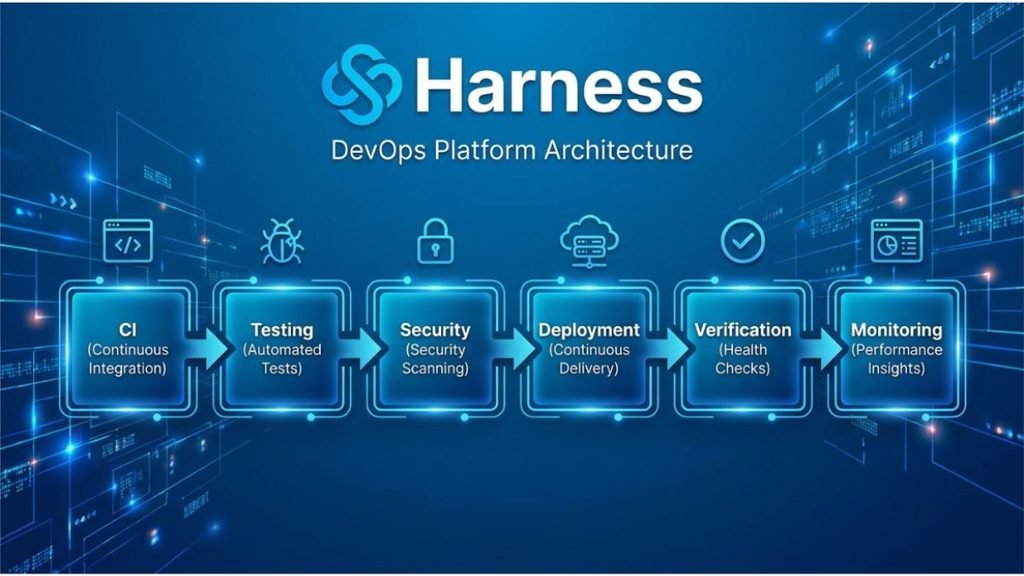
What Is Harness in DevOps?
Harness in DevOps is a platform designed to automate and govern software delivery from code commit through production deployment. Instead of maintaining separate tools and scripts for every stage, teams can connect development, testing, deployment, and operational workflows through a centralized DevOps platform.
The main idea is straightforward: engineers define how software should move through environments, while Harness automates repetitive work and applies policies along the way. Its platform supports deployment automation, rollback, verification, security checks, and visibility across the full delivery lifecycle. Gartner describes Harness as a platform covering CI, CD, feature flags, cloud cost management, and chaos engineering.
Why Harness Is Important for Modern DevOps
Software delivery becomes difficult when teams rely on disconnected scripts, Jenkins jobs, cloud services, and manual approvals. Harness provides a centralized delivery platform where engineering teams can automate these workflows while maintaining governance and visibility.
This matters especially for organizations deploying frequently across Kubernetes and cloud environments. Automated rollbacks, progressive delivery, continuous verification, and policy controls can reduce manual intervention and make releases more predictable.
Core Components of Harness
Harness is broader than a traditional CI/CD tool. Its platform is divided into several capabilities that address different parts of modern software delivery.
| Harness component | Primary purpose |
|---|---|
| Continuous Integration | Build and test software |
| Continuous Delivery | Automate application deployments |
| GitOps | Manage Kubernetes and declarative deployments |
| Security | Integrate security testing into delivery |
| Internal Developer Portal | Provide developer self-service |
| Cloud Cost Management | Analyze and optimize cloud spending |
| Feature Flags | Control feature releases |
| Service Reliability | Improve verification and operational confidence |
These capabilities allow teams to create a more connected software delivery platform instead of assembling every function independently. Harness also continues expanding its CD, GitOps, AI, and verification capabilities.
Key Features of Harness
Harness stands out through automation and governance across multiple stages. Its pipeline studio provides a visual way to create delivery workflows, while integrations connect repositories, cloud providers, Kubernetes clusters, testing systems, and other services.
Another important capability is continuous verification. Instead of assuming a deployment succeeded because it completed technically, teams can evaluate application behavior and decide whether to continue, pause, or roll back a release.
Harness also supports security testing inside pipelines. Its Security Testing Orchestration module can run security scans and consolidate findings for developers and security teams.
How Harness Works
A typical Harness pipeline begins with a code change from a repository such as GitHub. The pipeline can then build the application, run tests, scan for security issues, deploy the artifact, verify application health, and promote the release to another environment.
The workflow can include automated governance and approval points. For example, a production deployment might require a successful security scan and verification step before traffic is shifted to the new version.
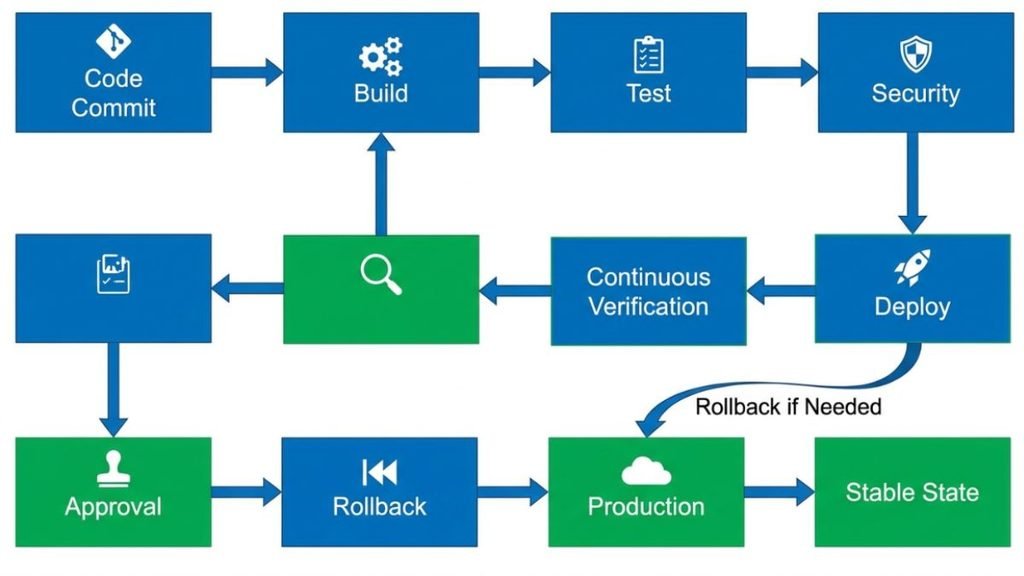
This approach gives DevOps teams a repeatable delivery process without requiring every step to be manually coordinated.
Harness Continuous Integration (CI)
Harness CI automates the build and test portion of the development lifecycle. Teams can connect source repositories, define build stages, run tests, create artifacts, and pass those artifacts into later delivery stages.
This makes Harness useful when organizations want CI connected directly to their deployment process. Instead of treating build and deployment as separate systems, teams can create a CI/CD pipeline that carries an application from source code toward production.
Harness Continuous Delivery (CD)
Harness deployment automation is one of its core capabilities. Teams can define deployment strategies for applications and infrastructure across development, staging, and production environments.
Harness supports progressive delivery patterns such as canary and blue-green deployments, allowing teams to reduce release risk by gradually introducing changes. Its 2026 product updates also highlight progressive Kubernetes canary rollouts, verification controls, and GitOps rollback capabilities.
For example, a company could send 5% of production traffic to a new version, monitor performance, and then increase traffic if the release remains healthy.
Harness GitOps and Infrastructure Automation
Harness GitOps helps teams manage Kubernetes applications using Git as a source of truth. It integrates with technologies including Argo CD and Flux while adding Harness management and governance capabilities.
This is particularly useful for teams managing many Kubernetes environments. Instead of manually changing cluster configurations, engineers can update the desired state in Git and allow automation to reconcile the environment.
Harness vs Jenkins: Key Differences
Harness and Jenkins can both automate software delivery, but their approaches are different. Jenkins is an extensible automation engine built around plugins and Pipeline. Its official documentation describes Pipeline as a suite of plugins for implementing continuous delivery pipelines.
| Area | Harness | Jenkins |
|---|---|---|
| Approach | Integrated DevOps platform | Automation server |
| CI/CD | Native platform capabilities | Pipeline and plugins |
| Deployment | Built-in deployment workflows | Usually configured through plugins/scripts |
| GitOps | Integrated capability | Requires additional tooling |
| Governance | Platform-level controls | Often assembled through configuration |
| UI | Visual pipeline experience | Plugin-dependent experience |
| Extensibility | Integrations and platform modules | Large plugin ecosystem |
| Best fit | Teams wanting an integrated delivery platform | Teams wanting highly customizable automation |
Jenkins remains powerful for teams that already have mature Jenkinsfiles and plugin-based workflows. Harness can be more attractive when an organization wants broader software delivery automation without stitching together as many separate components.
Gartner and TrustRadius both list Jenkins among the solutions commonly compared with Harness.
Benefits of Using Harness in DevOps
Harness can reduce repetitive deployment work while giving teams greater visibility into software delivery. Automated pipelines make releases more consistent, while verification and rollback capabilities help teams respond faster when deployments fail.
It can also simplify governance. Security checks, approvals, permissions, and deployment policies can become part of the delivery workflow instead of separate manual processes. This is valuable for organizations that need governance automated across multiple teams and environments.
Common Use Cases of Harness
Teams commonly use Harness for automated CI/CD, Kubernetes deployment, GitOps, security testing, feature releases, and cloud cost optimization. It can also support large organizations managing complex multi-environment delivery workflows.
For example, a SaaS company might use Harness CI to build an application, Harness testing to validate it, CD to deploy it to Kubernetes, GitOps to maintain cluster state, and continuous verification to monitor the release.
Its Cloud Cost Management capability can also provide deeper visibility into Kubernetes and cloud spending, including clusters, namespaces, workloads, and other cost contributors.
Challenges and Limitations of Harness
Harness is powerful, but it is not automatically the best choice for every organization. Teams with simple deployment requirements may find a large DevOps platform unnecessary.
There can also be a learning curve when organizations adopt multiple Harness modules. Teams must understand pipeline configuration, permissions, connectors, environments, services, and governance policies. Cost and platform complexity are also worth evaluating before committing to a broad rollout.
This is why comparing Harness competitors matters. Gartner lists GitHub, AWS, GitLab, CircleCI, Atlassian, CloudBees, and others among alternatives considered by Harness buyers. TrustRadius also lists Jenkins, GitLab, LaunchDarkly, and several other platforms among commonly compared solutions.
Gartner’s Harness alternatives comparison
Best Practices for Implementing Harness
Start with one high-value delivery workflow rather than migrating every pipeline at once. A strong starting point might be a frequently deployed application where automated testing, deployment, and rollback can deliver measurable improvements.
Standardize pipeline templates, permissions, naming conventions, environments, and approval policies as adoption grows. Teams should also monitor deployment frequency, failure rates, lead time, rollback frequency, and other software delivery metrics to prove whether the platform is improving engineering performance.
Is Harness the Right DevOps Tool for Your Organization?
Harness is worth considering if your organization needs a broad CI/CD tool with deployment automation, GitOps, security, verification, and cloud management capabilities in one ecosystem.
It may be less compelling for a small team that only needs basic CI or a straightforward CD tool. In that situation, Jenkins, GitHub Actions, GitLab, or another focused tool may provide a simpler starting point. The right choice depends on your existing infrastructure, engineering skills, governance requirements, Kubernetes usage, and delivery complexity.
The broader Harness competitors landscape includes platforms such as GitHub, GitLab, AWS, CircleCI, CloudBees, and others, so comparing capabilities against your actual workflow is more useful than choosing based on feature count alone.
Conclusion: The Future of Harness in DevOps
So, what is Harness in DevOps really about? It is about turning fragmented software delivery tasks into a more automated, governed, and measurable workflow. Instead of relying on disconnected scripts and manual handoffs, teams can connect CI, CD, GitOps, security, testing, verification, and cloud cost management.
As DevOps continues moving toward platform engineering and AI-assisted development, tools that connect the full delivery lifecycle will become increasingly important. Harness is positioning itself in that broader category, but the best solution will always depend on your team’s architecture, budget, complexity, and operational goals.
In short, Harness is not simply another CI/CD tool. It is a broader software delivery platform designed to help modern engineering teams build, test, deploy, verify, and manage software with greater automation and control.
What is Jenkins and Harness?
Jenkins is an open-source automation server for building and deploying software, while Harness is a modern DevOps platform that automates CI/CD, GitOps, and cloud deployments.
Is Harness a CI/CD tool?
Yes, Harness is a CI/CD platform that helps teams automate software building, testing, deployment, and delivery processes.
What are the 7 phases of DevOps?
The seven phases of DevOps are Planning, Development, Building, Testing, Release, Deployment, and Operations/Monitoring.
What is a Harness used for?
Harness is used to automate software delivery, manage deployments, implement GitOps workflows, and improve release reliability.
Is Harness a replacement for Jenkins?
Yes, many organizations use Harness as a Jenkins alternative because it offers built-in CI/CD capabilities, easier management, and advanced deployment automation.