API Gateway vs Load Balancer: Differences, Architecture, and When to Use Each
As applications grow, sending every request directly to backend servers quickly becomes difficult to manage. You need reliable traffic management, secure request handling, and a way to keep services available when demand suddenly increases. That is where an API gateway and a load balancer become important.
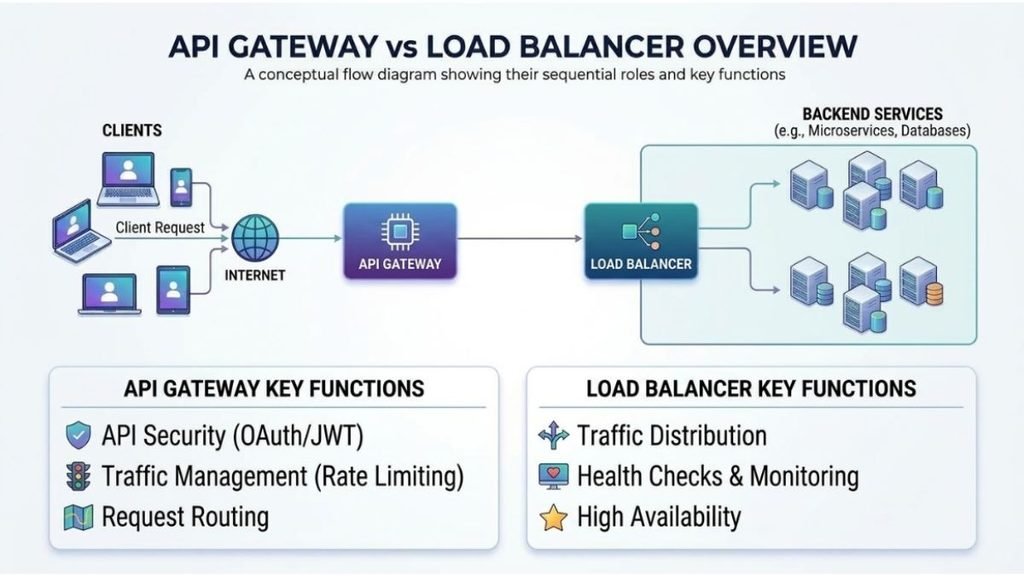
At first glance, an API gateway and load balancer can seem interchangeable because both sit between clients and backend systems. However, they solve different problems. An API gateway manages and controls API traffic, while a load balancer primarily distributes traffic across available servers or service instances.
Understanding the difference between an API gateway vs load balancer helps you choose the right architecture instead of adding infrastructure you do not actually need.
What Is an API Gateway?
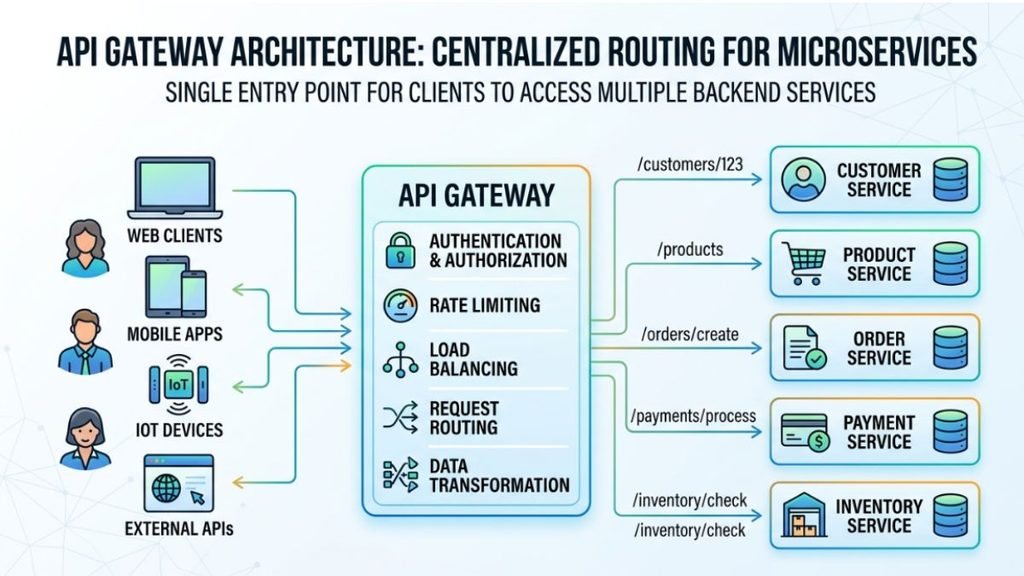
An API gateway is a centralized entry point that receives API requests from applications, users, partners, or other systems and determines how those requests should be handled. It provides API routing, security controls, and policy enforcement before forwarding traffic to backend services.
Think of it as a smart front door for your application. A request such as /api/orders/123 can be inspected, authenticated, rate-limited, and routed to an order service without exposing that service directly to the client.
In a microservices architecture, this pattern is especially useful because a single application may contain dozens of independent services. Instead of making clients understand where every service lives, the gateway provides a consistent API endpoint and handles the routing behind the scenes.
For example, an e-commerce platform could have separate customer, product, order, inventory, and payment services. The API gateway can route /customers to the customer service, /products to the product service, and /orders to the order service.
Modern gateways can also provide API authentication, authorization, API keys, JWT validation, OAuth 2.0 integration, rate limiting, request transformation, response transformation, API versioning, analytics, and monitoring. The exact feature set depends on the gateway product and deployment model.
What Is a Load Balancer?
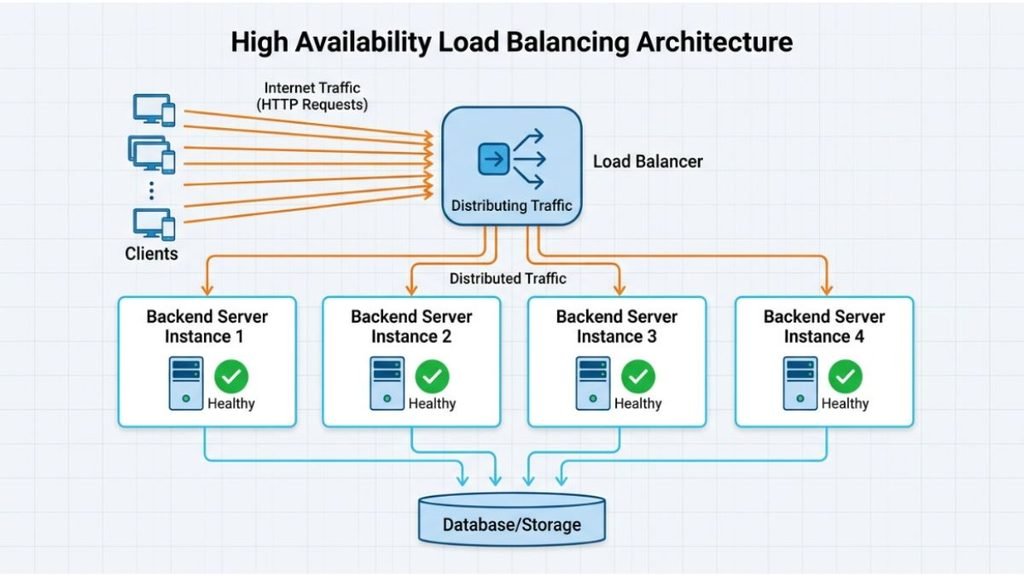
A load balancer distributes incoming network traffic across multiple backend servers or service instances. Its main goal is to prevent one server from becoming overloaded while other available servers sit idle.
Suppose an application has four identical backend servers. Instead of sending every request to Server 1, the load balancer distributes requests among all four servers. If one server becomes unhealthy, health checks can detect the problem and stop sending new traffic to that instance.
This creates a foundation for high availability, fault tolerance, and horizontal scaling. As demand increases, additional backend instances can be added to the pool without requiring clients to know where those instances are located.
Load balancers can use different load balancing algorithms, including round robin, least connections, weighted routing, and IP hash. The appropriate algorithm depends on application behavior and whether backend servers have similar capacity.
Load balancers also come in different forms. A Layer 4 load balancer operates at the transport layer and commonly makes decisions using IP addresses and ports. A Layer 7 load balancer operates at the application layer and can understand protocols such as HTTP and HTTPS.
How Do API Gateways and Load Balancers Work?
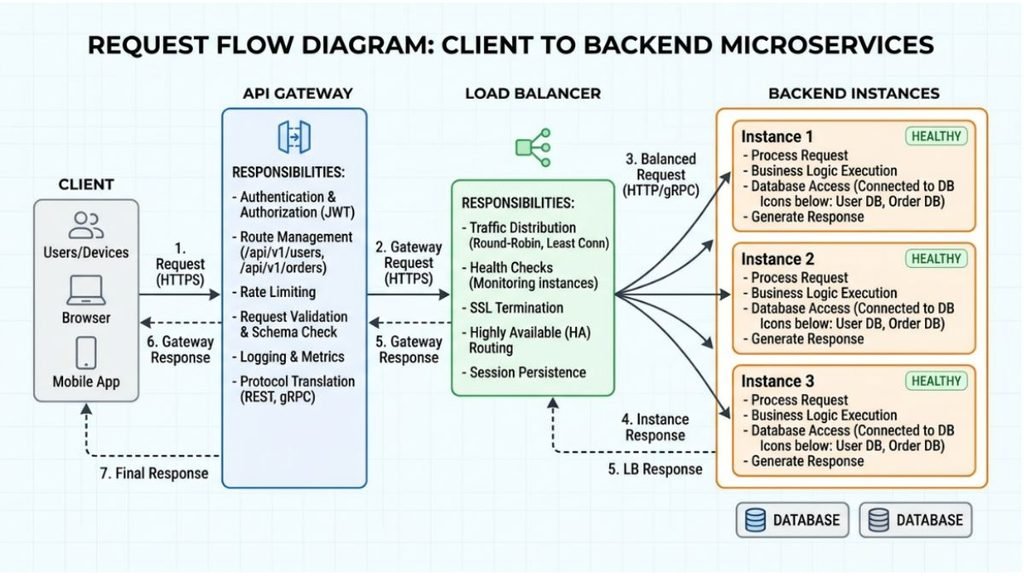
The easiest way to understand an API gateway and load balancer is to follow a request from the client to the backend.
Imagine a customer sends:
GET /api/orders/123
The API gateway can first authenticate the request, apply a rate limit, inspect the URL, and determine that the request belongs to the order service. The request can then reach a load balancer responsible for that service.
The load balancer checks available backend instances and selects one based on its routing algorithm and health information. The final request may therefore follow this path:
Client → API Gateway → Load Balancer → Order Service → Backend Instance
This division of responsibility is important. The gateway makes application-aware routing and policy decisions, while the load balancer focuses on traffic distribution and backend availability.
The two technologies can also operate independently. A simple web application may only need a load balancer in front of several identical servers. Conversely, a managed API platform may use an API gateway that routes directly to services that already provide their own distribution.
The distinction also becomes clearer through the OSI model. API gateways generally operate at Layer 7 because they need to understand application requests. Load balancers may operate at Layer 4 or Layer 7 depending on the product and use case.
API Gateway vs Load Balancer: Key Differences
The main difference between API gateway and load balancer is their primary responsibility. A gateway manages APIs and application-level requests, while a load balancer distributes traffic among backend targets.
| Area | API Gateway | Load Balancer |
|---|---|---|
| Primary purpose | API management and request routing | Traffic distribution |
| Typical OSI layer | Layer 7 | Layer 4 or Layer 7 |
| Routing | Application-aware | Algorithm and health-based |
| Authentication | Common feature | Usually handled elsewhere |
| Authorization | Common feature | Not a primary function |
| Rate limiting | Common feature | Limited API-specific controls |
| API versioning | Supported | Not a primary purpose |
| Request transformation | Common | Limited |
| Health checks | Often available | Core capability |
| TLS/SSL termination | Common | Common |
| API analytics | Common | Primarily traffic metrics |
| Best fit | APIs and microservices | Scalable backend services |
So, is API gateway a load balancer? Not exactly.
An API gateway may perform certain traffic-distribution functions, but its role is broader. It can authenticate users, enforce policies, transform requests, manage versions, and apply consumer-specific controls.
Likewise, an advanced Layer 7 load balancer can perform path-based or host-based routing. That does not automatically make it a full API management platform.
IBM describes the distinction similarly: an API gateway acts as an entry point for managing and directing API requests, while a load balancer distributes requests across backend servers or instances.
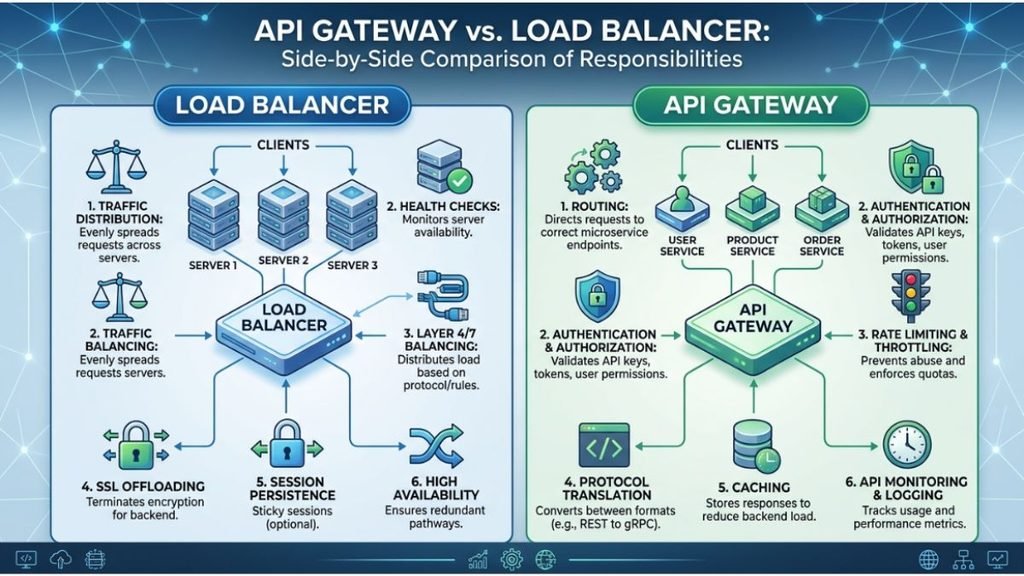
API Gateway vs Load Balancer: Routing, Security, and Performance
Routing is one of the biggest areas of overlap between these technologies. A load balancer can distribute traffic using round robin, least connections, weighted routing, or IP hash. Layer 7 load balancers can also support path-based or host-based routing.
An API gateway goes deeper into the meaning of the request. For example, it might route /api/v1/orders to one backend and /api/v2/orders to another. It can also use headers, authentication information, API versions, or other application-level rules when making routing decisions.
Security is another major difference. API gateways commonly centralize authentication, authorization, API keys, JWT validation, OAuth 2.0 policies, throttling, and access control. This allows teams to enforce consistent API policies without implementing the same logic independently in every backend service.
Load balancers can provide important security capabilities too, including TLS termination, SSL offloading, access controls, and WAF integration in some Layer 7 products. However, they generally do not replace a complete API security and governance layer.
Performance depends on what the component needs to inspect and process. A Layer 4 load balancer can introduce relatively little application-level processing because it does not need to understand HTTP request content. An API gateway performs more work, but that processing can eliminate duplicated security and policy logic across backend services.
For high-volume systems, teams should measure latency, processing overhead, throughput, and connection behavior rather than assuming one technology will always be faster.
Can an API Gateway and Load Balancer Work Together?
Yes. In many production environments, an API gateway and load balancer work together rather than competing with each other.
One common architecture places a load balancer in front of multiple API gateway instances:
Internet → Load Balancer → API Gateway Instances → Backend Services
Here, the load balancer distributes incoming connections across gateway instances. The gateway then performs authentication, routing, rate limiting, transformations, and other API policies.
Another architecture places the gateway in front of a load balancer responsible for a particular backend service:
Internet → API Gateway → Load Balancer → Backend Instances
This arrangement lets the gateway determine which service should receive the request while the load balancer selects a healthy instance within that service.
The right design depends on where your organization wants centralized security, scaling, health checks, and routing responsibilities to live. The important point is to avoid unnecessarily duplicating the same policies at multiple layers.
IBM’s current comparison also describes architectures where gateways and load balancers operate together, independently, or in different positions depending on application requirements.
API Gateway vs Load Balancer in Kubernetes
Kubernetes makes this comparison more interesting because several networking components can perform overlapping functions.
A Kubernetes Service provides a stable way to reach a group of Pods. A Service of type LoadBalancer can provision or integrate with an external load balancer on supported cloud platforms. Traffic from that external load balancer is then directed toward backend Pods.
Kubernetes Ingress provides HTTP and HTTPS routing based on concepts such as hosts and paths. It can also support load balancing and TLS termination through its controller. However, the Kubernetes project states that the Ingress API is frozen and recommends Gateway instead for new development.
The newer Kubernetes Gateway API provides a more expressive model for traffic routing. It supports resources such as Gateway, HTTPRoute, and GRPCRoute and can represent infrastructure such as a cloud load balancer or an in-cluster proxy.
For example, a Kubernetes architecture might look like:
External Load Balancer → Gateway API → Kubernetes Service → Pods
The Gateway API can define application-level routing while the Service provides stable access to the underlying workloads.
When Should You Use an API Gateway vs a Load Balancer?
Choose an API gateway when your main challenge involves managing APIs rather than simply distributing connections.
For example, a financial application may expose APIs to mobile apps, web clients, and external partners. The gateway can centralize API security, authentication, authorization, rate limiting, API versioning, and request routing while keeping internal services private.
A load balancer is usually the better fit when the primary requirement is distributing traffic across healthy backend instances. An e-commerce website with several identical application servers may need a load balancer for horizontal scaling, health checks, and high availability without requiring a complete API management layer.
Some requirements naturally point toward both technologies.
| Requirement | Better fit |
|---|---|
| Distribute traffic across identical servers | Load balancer |
| Health-based backend selection | Load balancer |
| Horizontal scaling | Load balancer |
| API authentication | API gateway |
| JWT or OAuth 2.0 enforcement | API gateway |
| Consumer rate limiting | API gateway |
| API version management | API gateway |
| Request/response transformation | API gateway |
| Path-based routing | Layer 7 load balancer or API gateway |
| Host-based routing | Layer 7 load balancer or API gateway |
| Microservices API front door | API gateway |
| High availability for gateway instances | Load balancer + API gateway |
The decision should therefore start with the problem you are trying to solve. If the problem is backend traffic distribution, start with a load balancer. If it is API security, governance, routing, or consumer management, an API gateway is usually more appropriate.
API Gateway vs Load Balancer: Which One Should You Choose?
There is no universal winner in the API gateway vs load balancer debate because the two components have different jobs.
Choose a load balancer when you need reliable load balancing, health-based traffic distribution, horizontal scaling, and high availability for backend services.
Choose an API gateway when you need centralized API management, authentication, authorization, rate limiting, application-aware routing, transformations, versioning, and API governance.
In larger systems, using both is often the most practical architecture. A load balancer can distribute traffic across gateway instances, while the gateway manages API requests and directs them toward the correct backend services.
The simplest way to make the decision is to follow the request path and ask one question: Who should decide where the request goes, and who should decide which healthy server handles it?
The API gateway answers the first question at the application level. The load balancer answers the second through traffic distribution and backend health.
That distinction makes the load balancer vs API gateway comparison much easier: the gateway manages the meaning and policy of API requests, while the load balancer manages where traffic is delivered.
FAQs
What comes first, API gateway or load balancer?
Usually, the load balancer comes first, routing traffic to multiple API gateway instances. However, the order can vary by architecture.
Can an API gateway also be a load balancer?
Yes, some API gateways can perform load balancing, but their primary role is API management, security, and request routing.
What are the key differences between a load balancer and an application gateway?
A load balancer mainly distributes traffic across servers, while an application gateway provides Layer 7 routing, security, authentication, and API-level controls.
Can an API gateway be used with an ALB?
Yes. An API Gateway and Application Load Balancer (ALB) can work together to provide API management plus backend traffic distribution.
Is NGINX a load balancer or API gateway?
NGINX can be both. It is commonly used as a load balancer, reverse proxy, and, with the right configuration, an API gateway.