What Is Agentic AI Process Automation?
Agentic AI process automation combines artificial intelligence with workflow automation to allow AI agents to understand goals, reason about tasks, plan actions, use external tools, and execute multi-step processes with limited human intervention.
An AI agent can dynamically determine what needs to happen next instead of simply executing the same sequence every time.
Agentic AI therefore represents a shift from automation based primarily on predefined workflows toward goal-driven and adaptive automation.
How Agentic AI Process Automation Works
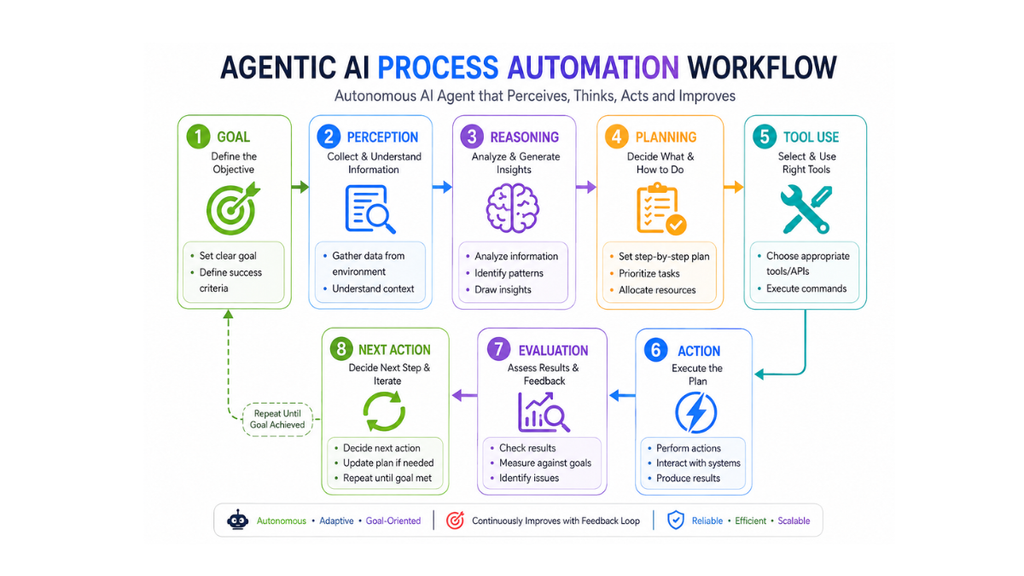
An agentic AI system is not simply an LLM connected to a workflow. It is a collection of components that work together to understand objectives, make decisions, interact with systems, and evaluate outcomes.
1. Goal and Task Understanding
The process starts with a goal.
The agent needs to understand what the user or business process is trying to accomplish, identify relevant information, and determine the boundaries of the task.
This stage can involve agentic AI application analysis, where the system determines whether the requested task is suitable for autonomous execution.
The system should also identify:
- required inputs
- expected outputs
- available tools
- required permissions
- constraints
- success criteria
- human approval requirements
A clearly defined goal is particularly important because autonomous systems need measurable outcomes to determine whether a workflow has succeeded.
2. Planning and Reasoning
Once the objective is understood, the agent creates a plan.
The plan may contain multiple dependent actions. If the result of one action changes the available information, the agent can revise subsequent actions.
This is different from conventional workflow automation, where the execution path is usually defined before the workflow starts.
Reasoning is therefore one of the fundamental capabilities behind agentic AI automation.
3. Tool Use
An AI model by itself cannot directly interact with every external system.
Agents require tools that provide access to capabilities such as:
- APIs
- databases
- search engines
- browsers
- enterprise applications
- file systems
- code execution
- internal services
Tools transform an AI system from something that primarily generates responses into a system capable of performing actions.
This is why an agentic AI tech stack normally contains much more than a foundation model.
4. Action and Execution
After planning, the agent executes the required actions through its available tools.
The agent may perform several tool calls before reaching the desired outcome.
The execution process should remain controlled through authentication, authorization, permissions, and validation.
5. Evaluation and Iteration
The agent evaluates the result after performing an action.
If the result is incomplete or incorrect, it can modify the plan and continue.This feedback mechanism is one of the most important differences between agentic process automation and simple rule-based automation.
Agentic AI Process Automation Architecture
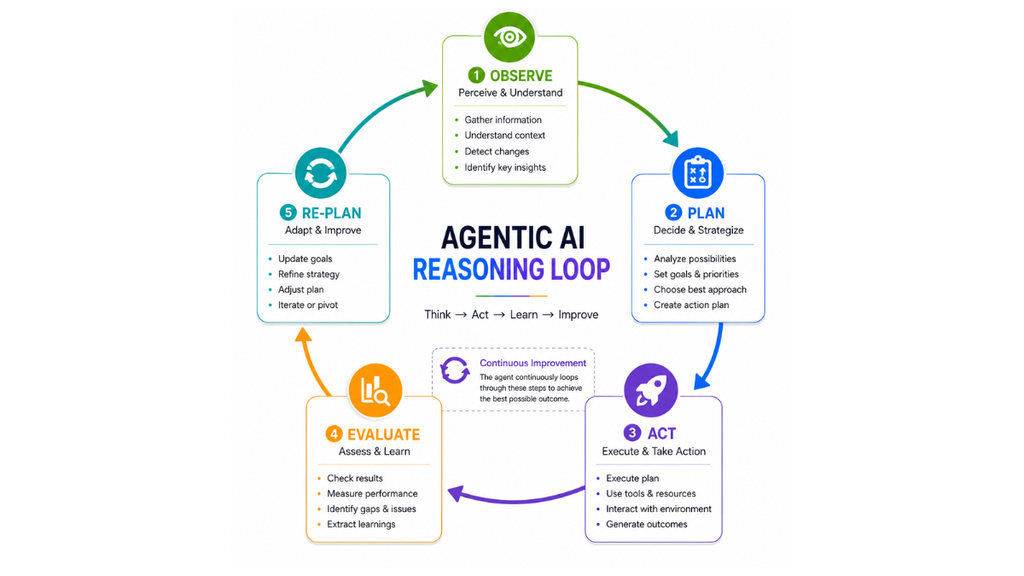
A practical agentic AI architecture can be organized into several interconnected layers.
User and Process Layer
This layer defines the objective and business context.
It contains:
- user requests
- business rules
- workflow requirements
- success metrics
- permissions
- approval requirements
Agent Layer
The agent is responsible for coordinating the workflow.
It can interpret the objective, reason about the task, create plans, select tools, maintain state, and determine the next action.
Model Layer
Large language models provide capabilities such as language understanding, reasoning, classification, extraction, and decision support.
However, the model is only one component of the complete system.
Tool and Integration Layer
This layer connects the agent to external capabilities.
APIs, databases, browsers, SaaS platforms, internal applications, and other services can become tools available to the agent.
Memory and Context Layer
Memory allows agents to retain relevant information during and across tasks.
This can include short-term context, long-term memory, user preferences, previous interactions, or task state.
Data and Knowledge Layer
Agents may require access to structured databases, documents, knowledge bases, vector databases, and other information sources.
For retrieval-based workflows, RAG can provide relevant information to the agent before it makes decisions or performs actions.
Orchestration Layer
Agentic AI orchestration coordinates agents, tools, workflows, memory, and state.
For more complex systems, orchestration may also coordinate multiple specialized agents.
Security and Governance Layer
Production systems need authentication, authorization, access controls, logging, validation, security policies, and governance.
Monitoring and Evaluation Layer
This layer tracks agent behavior, tool calls, workflow outcomes, errors, costs, latency, and human interventions.
Agentic AI Tech Stack
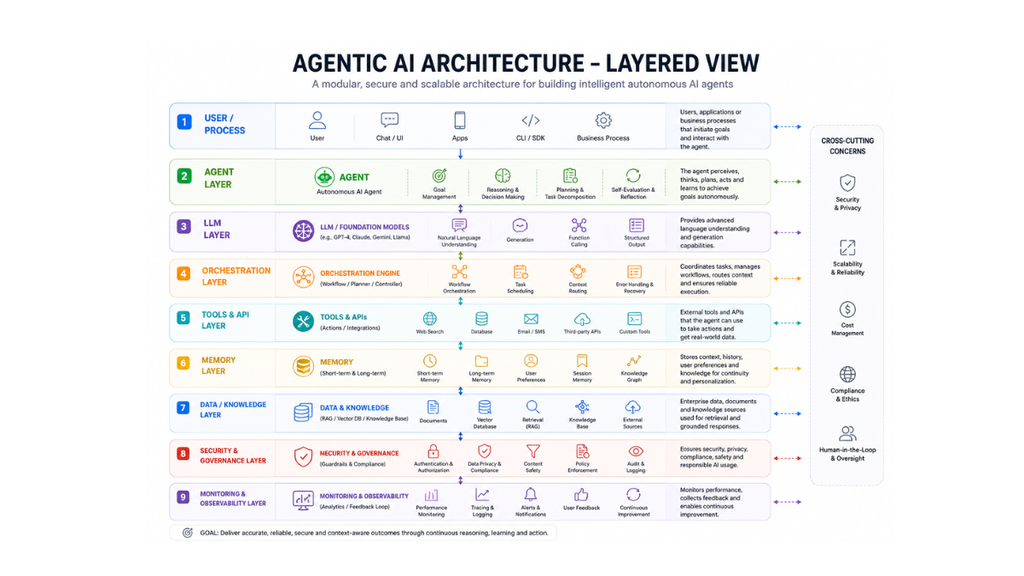
An agentic AI tech stack normally combines multiple technologies.
Foundation Models
LLMs provide reasoning and language capabilities.
Different models may be selected according to factors such as reasoning performance, latency, cost, context requirements, and deployment constraints.
Agent Frameworks
Agent frameworks provide mechanisms for managing tools, state, memory, reasoning, and workflow execution.
They reduce the amount of infrastructure that developers need to implement manually.
Orchestration
Orchestration manages how different components communicate and how tasks move through the system.
In multi-agent environments, orchestration becomes even more important because multiple agents may have different responsibilities.
Tools and APIs
Tools give agents access to external capabilities.
Proper API management and permissions are critical because an agent may otherwise have more access than required.
Memory
Memory maintains relevant information across workflow steps and interactions.
It can improve continuity while reducing the need to repeatedly provide the same context.
Data and RAG
Agents may retrieve information from databases, documents, vector databases, knowledge bases, and RAG pipelines.
Infrastructure
Agentic AI infrastructure includes the computing, storage, networking, deployment, observability, and security systems required to run agents reliably.
Production infrastructure must also account for scaling, failures, model updates, and external service availability.
Monitoring and Evaluation
Agentic AI monitoring provides visibility into agent decisions and execution.
Important metrics include:
- task completion rate
- tool failures
- execution time
- model usage
- cost
- human intervention
- failed workflows
- unexpected actions
- security events
Agentic AI vs Traditional Process Automation
Traditional automation is primarily deterministic.
A predefined condition triggers a predefined action.
Agentic automation is more adaptive because the agent can reason about a goal and dynamically determine its next action.
| Traditional Automation | Agentic AI Automation |
|---|---|
| Fixed rules | Goal-driven behavior |
| Predetermined workflow | Dynamic planning |
| Rule-based decisions | AI-based reasoning |
| Fixed execution path | Adaptive execution |
| Limited context | Context-aware decisions |
| Manual exception handling | Potential autonomous recovery |
| Static integrations | Dynamic tool use |
This does not mean that agentic AI should replace traditional automation everywhere.
In many architectures, both approaches work together.
Deterministic automation can handle predictable operations, while AI agents handle tasks requiring reasoning, adaptation, and decision-making.
Which Tasks Are Most Appropriate for Agentic AI?
One important question is:
For which type of task is agentic AI most appropriate?
Agentic AI is generally better suited to processes that:
- contain multiple dependent steps
- require contextual decisions
- interact with multiple systems
- involve changing information
- require tool usage
- have clearly defined objectives
- benefit from adaptive planning
- contain exceptions that cannot easily be encoded as rules
- can operate within controlled permissions
The complexity of a process alone does not justify using an AI agent.
A complex but completely deterministic workflow may still be better handled with conventional automation.
Agentic AI becomes valuable when reasoning, planning, autonomy, tool use, and adaptation are important parts of the process.
Agentic AI Process Automation Use Cases
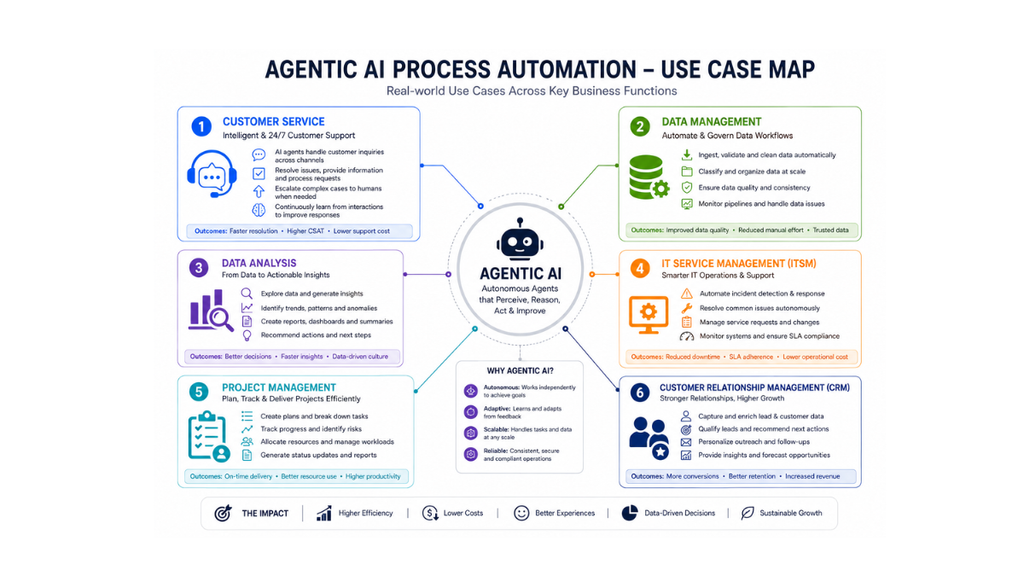
Agentic AI can be applied to different business and technical processes.
Customer Service
Agents can understand requests, retrieve relevant information, interact with business systems, and coordinate several workflow steps.
Agentic RAG can be particularly useful when the process requires information retrieval before an action.
Agentic AI Data Management
Agentic AI data management can support information discovery, classification, validation, transformation, and coordination across data systems.
The agent can use different tools depending on the task and evaluate whether the resulting operation satisfies the required condition.
Agentic AI Data Analysis
Agentic AI data analysis combines data retrieval, analytical tools, reasoning, and evaluation.
Instead of simply returning a generated response, the agent can coordinate multiple analytical operations before producing the final result.
This is closely related to agentic analytics, where AI agents participate in analytical workflows and decision-support processes.
IT Service Management
Agentic AI for ITSM can support ticket analysis, information retrieval, troubleshooting workflows, escalation, and resolution.
Agentic AI in IT service management can also connect agents with internal knowledge bases and enterprise tools.
Project Management
Agentic AI for project management can coordinate information across project-management systems, monitor workflow states, and assist with task-level decisions.
CRM
Agentic AI CRM workflows can connect customer information with actions across sales, support, and relationship-management systems.
Autonomy in Agentic AI
Autonomy in agentic AI should be carefully controlled.
More autonomy does not automatically mean better automation.
The level of autonomy should depend on:
- risk
- reversibility
- business impact
- data sensitivity
- required accuracy
- available safeguards
Low-risk operations may be fully automated, while high-impact actions may require human approval.
A production agent should have clearly defined boundaries covering:
- accessible data
- available tools
- permitted actions
- approval requirements
- execution limits
- escalation conditions
This creates controlled autonomy rather than unrestricted autonomous behavior.
Agentic AI Monitoring and Stress Testing
Agentic systems require continuous observation because their behavior can depend on model responses, context, tools, external systems, and changing data.
Agentic AI monitoring should track the complete execution path rather than only the final response.
Important areas include:
- agent decisions
- tool calls
- failed actions
- latency
- token/model costs
- task completion
- human interventions
- unexpected behavior
- security events
Agentic AI stress testing can be used before production deployment to evaluate behavior under unusual inputs, tool failures, incomplete information, high workloads, and unexpected workflow conditions.
Monitoring should continue after deployment because model updates, changing data, new tools, and external API changes can affect system behavior.
When Should You Not Use Agentic AI?
Agentic AI is not appropriate for every process.
A simple deterministic workflow may be:
- cheaper
- faster
- easier to test
- easier to audit
- easier to maintain
using conventional automation.
Agentic systems introduce additional concerns around:
- model reliability
- security
- permissions
- observability
- cost
- governance
- evaluation
- failure recovery
The objective should therefore be appropriate autonomy, not maximum autonomy.
Agentic AI Governance and Security
Security should be considered part of the architecture rather than something added after deployment.
Agents may have access to sensitive information and external systems, making permissions particularly important.
Agents should receive only the access required for their tasks.
Governance should also define who is responsible for reviewing agent behavior, handling failures, changing permissions, and evaluating system performance.
The Future of Agentic AI Process Automation
The rise of agentic AI is moving automation beyond fixed workflows toward systems capable of interpreting goals, planning actions, interacting with software, and adapting during execution.
The future of agentic AI process automation will likely involve deeper integration between:
- AI agents
- enterprise applications
- data platforms
- agent frameworks
- orchestration systems
- APIs
- RAG
- memory
- monitoring
- security infrastructure
However, successful implementation depends on much more than adding an LLM to an existing workflow.
Frequently Asked Questions
What is agentic AI process automation?
Agentic AI process automation uses AI agents to understand goals, reason about tasks, create plans, use tools, execute multiple workflow steps, and evaluate results with limited human intervention.
How does agentic AI differ from traditional automation?
Traditional automation follows predefined rules and execution paths. Agentic AI can reason about goals, dynamically plan actions, use tools, evaluate results, and adapt its workflow.
What is an agentic AI tech stack?
An agentic AI tech stack can include foundation models, agent frameworks, orchestration, APIs, tools, memory, databases, RAG systems, security, infrastructure, monitoring, and evaluation.
What type of task is agentic AI most appropriate for?
Agentic AI is most appropriate for goal-driven, multi-step processes that require reasoning, tool use, contextual decisions, changing information, and adaptive execution.
What is agentic AI monitoring?
Agentic AI monitoring tracks agent decisions, tool calls, errors, latency, costs, workflow outcomes, human interventions, and unexpected behavior.
Can agentic AI replace traditional automation?
Not always. Traditional automation remains useful for predictable and deterministic processes. Agentic AI is more valuable when a workflow requires reasoning, planning, adaptation, and autonomous tool use.
What is autonomy in agentic AI?
Autonomy refers to how independently an AI agent can make decisions and perform actions. Production systems should define appropriate autonomy based on risk, permissions, business impact, and human-approval requirements.