Modern AI agents can search the web, call APIs, work with files, use external tools, remember information, and complete tasks across multiple steps. But giving an agent more capabilities does not automatically make it more reliable. An agent can use a powerful LLM and still fail because it receives irrelevant information, outdated memory, excessive tool results, or poorly structured instructions.
This is where context engineering becomes important. Instead of treating the prompt as the entire interface between an application and an LLM, developers need to manage the broader information available to the model during execution, including system prompts, message history, memory, retrieved data, tools, tool results, and runtime state.
1. What Is Context Engineering for AI Agents?
Context Engineering Definition
Context engineering for AI agents is the practice of designing, selecting, organizing, and maintaining the information supplied to an LLM so it has the relevant context required for its current task.
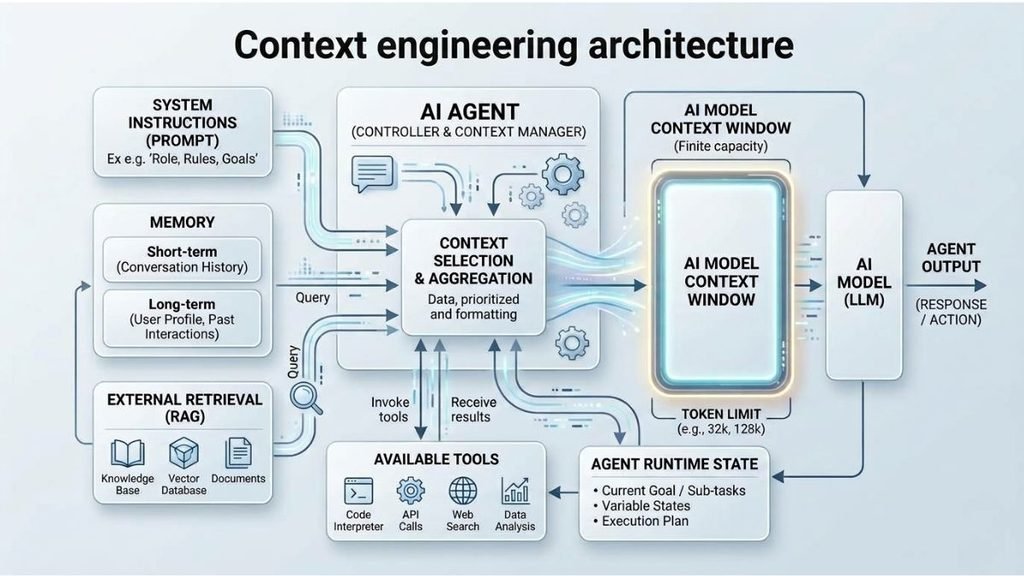
That information can include system instructions, user requests, message history, AI agent memory, retrieved documents, tool calls, tool results, external data, examples, and application state.
The objective is not to place every available piece of information inside the context window. Instead, an effective context system should provide the information that is most useful for the agent’s next decision.
What Context Includes in an AI Agent
An agent’s context is usually composed of several different components.
System prompts establish the agent’s role and constraints. Message history provides conversational state. Memory preserves information that may remain useful later. Retrieval systems provide external knowledge, while tools allow the agent to interact with its environment. Tool results, intermediate findings, and runtime state can then provide additional information for later decisions.
This makes context a continuously changing system rather than a single block of text.
Why Context Engineering Matters
An agent operating for several steps can generate a large amount of information. Search results, API responses, tool calls, retrieved documents, and intermediate findings can all accumulate.
The challenge is deciding which information should remain available, which information should be retrieved again, and which information should be compressed or moved outside the active context.
2. Context Engineering vs Prompt Engineering: What Is the Difference?
What Prompt Engineering Controls
Prompt engineering focuses primarily on writing and organizing instructions that guide an LLM toward a desired behavior.
A system prompt can define an agent’s role, task, constraints, output requirements, and behavioral expectations. Clear instructions remain important, particularly when an agent needs to follow specific policies or interact with tools.
What Context Engineering Controls
Context engineering covers a much broader information environment.
It determines which instructions, memories, documents, tools, examples, previous interactions, and runtime information should be available to the model at a particular point in execution.
As agents operate over longer time horizons, managing the entire context becomes increasingly important because every new interaction can introduce information that may affect the next decision.
Why Agents Need More Than Better Prompts
A better prompt cannot solve every context problem.
An AI research agent might have an excellent system prompt but still fail if it receives outdated documents, irrelevant search results, duplicated information, or incomplete findings from earlier steps.
Prompt engineering helps guide behavior. Context engineering determines whether the model has the information required to apply those instructions effectively.
3. Why the Context Window Is a Finite Resource
Context Windows as Working Memory
The context window acts as the model’s working memory during inference. It contains the information the model can reference when generating its next response or deciding what action to take.
A larger context window provides more capacity, but that does not mean every available piece of information should be included.
The Attention Budget Problem
An LLM has a limited attention budget when processing large volumes of context. As the amount of information increases, the model can become less effective at locating and using specific information within that larger context.
This creates an important principle for context engineering: more context is not automatically better context.
The goal is to provide the smallest practical set of high-signal tokens that supports the desired outcome.
Context Rot and Context Pollution
Context rot describes the degradation that can occur as the amount of information in a context increases and important information becomes harder for the model to use reliably.
Context pollution occurs when unnecessary, outdated, duplicated, or misleading information accumulates in the active context.
Several related failure modes can appear. Context poisoning occurs when incorrect information enters the context and later influences decisions. Context distraction occurs when excessive information competes with important signals. Context confusion occurs when irrelevant information affects the model’s interpretation, while context clash occurs when different pieces of context contradict one another.
4. What Goes Into an AI Agent’s Context?
System Instructions and Agent Goals
System instructions establish the agent’s purpose, constraints, policies, and expected behavior.
Effective system prompts should be clear enough to guide behavior without encoding unnecessarily brittle logic. The goal is to provide the minimum information necessary to establish the agent’s role, constraints, and expected behavior.
Conversation History and Memory
Message history provides immediate conversational information, while memory can preserve useful information beyond the current interaction.
For example, an agent may need to remember user preferences, previous decisions, project requirements, or unfinished tasks. A memory system can store this information outside the active context and retrieve it when relevant.
This connects directly with our guide on how AI agents use memory.
Retrieved Knowledge and External Data
Agents often need information that does not exist in their initial context. Databases, documents, APIs, search systems, and RAG pipelines can provide that information.
RAG is therefore one mechanism used by context engineering, but it is not the entire discipline. Retrieval determines which external information can be supplied, while context engineering also determines how that information interacts with instructions, memory, tools, history, and runtime state.
Our guide on how to build a RAG system covers the retrieval architecture in greater detail.
Tools, Tool Results, and Runtime State
Tools give agents access to external capabilities such as databases, search engines, APIs, code execution environments, and business applications.
The tool definitions themselves influence model behavior, while returned tool results become new information that the agent may use during subsequent steps.
This means tool design is also part of context design.
5. How AI Agent Context Is Built and Selected at Runtime
Static vs Dynamic Context
Not all context changes at the same rate.
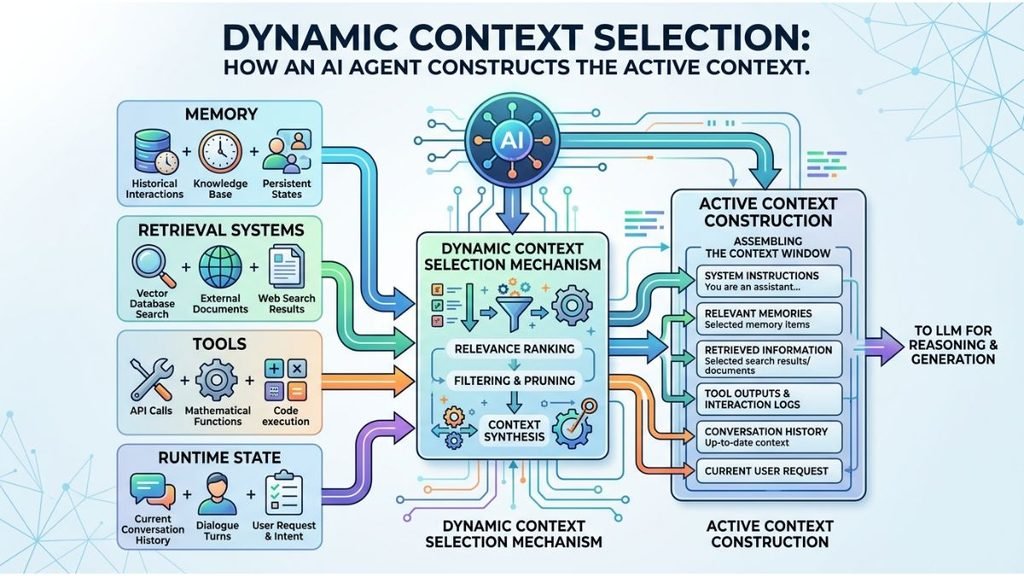
Static context can include system instructions, policies, naming conventions, and relatively stable tool definitions. Dynamic context includes user requests, retrieved documents, tool outputs, current state, and intermediate findings that change throughout execution.
Separating these categories helps developers determine what can be cached and what needs to be retrieved or refreshed.
Context Retrieval and Just-in-Time Information
Traditional systems may retrieve relevant information before an LLM call. Agents can also retrieve information dynamically while performing a task.
Just-in-time context allows agents to maintain lightweight references to information and retrieve the underlying data only when it becomes necessary.
This approach is especially useful for agents working with large codebases, document collections, and external systems.
Selecting High-Signal Information
Context selection should consider more than simple relevance.
A useful selection strategy can account for relevant information, freshness, source reliability, duplication, task importance, and the available token budget.
The practical question is not:
What information can we give the model?
It is:
What information does the model need for this particular decision?
That shift is central to effective context engineering.
6. How to Manage Memory, History, and Context Freshness
Short-Term and Long-Term Agent Memory
Short-term memory generally contains information needed during the current task, while long-term memory stores information that may remain useful across future sessions.
Keeping all historical information inside the context window is inefficient. Instead, agents can store durable information externally and retrieve only the relevant parts when needed.
This creates a useful distinction between working memory and persistent memory.
Keeping Context Fresh and Relevant
Context can become less useful when information becomes outdated.
A previous database record may have changed. A user’s preferences may have been updated. A tool result may no longer represent the current state.
A robust context system can therefore use timestamps, source metadata, version information, and freshness rules to determine whether previously stored information should still influence the agent.
Preventing Repetition and Stale Context
Repeated information consumes tokens without necessarily adding new value.
When multiple tool calls return similar results, or when old instructions are repeated across many turns, the system can summarize, trim, or replace redundant information.
The objective is to maintain high-signal context while preserving the details that affect the current task.
7. How to Manage Tools, MCP, and External Context
Designing Efficient Tool Descriptions
Tool definitions are part of the model’s available context. Poorly named or overlapping tools can make tool selection harder.
Good tool design should give agents clear capabilities while keeping tool descriptions, parameters, and responses efficient.
This means tool routing should be treated as part of context engineering rather than as an isolated implementation detail.
Tool Results as Context
Tool results can introduce large amounts of information into the active context.
Consider a database tool that returns thousands of records when the agent only needs three fields from five matching records. The tool technically worked, but its output created unnecessary context pollution.
Returning structured and task-relevant results can therefore improve both efficiency and reliability.
MCP and External Capabilities
The Model Context Protocol (MCP) gives AI applications a standardized way to connect models with external tools and data sources.
However, every additional capability can introduce more tool descriptions, parameters, responses, and decisions into the agent’s information environment.
Our Model Context Protocol guide explains how MCP connects AI systems with external capabilities.
Avoiding Tool Overload
An agent does not necessarily become more capable when dozens of tools are exposed simultaneously.
A smaller set of relevant capabilities can make tool selection clearer and reduce unnecessary decisions. In larger systems, tools can also be discovered dynamically so the model sees capabilities that are relevant to the current task.
8. Context Compression, Compaction, and Isolation for Long-Horizon Agents
Context Compression and Summarization
Long-running agents accumulate messages, tool calls, search results, observations, and intermediate decisions.
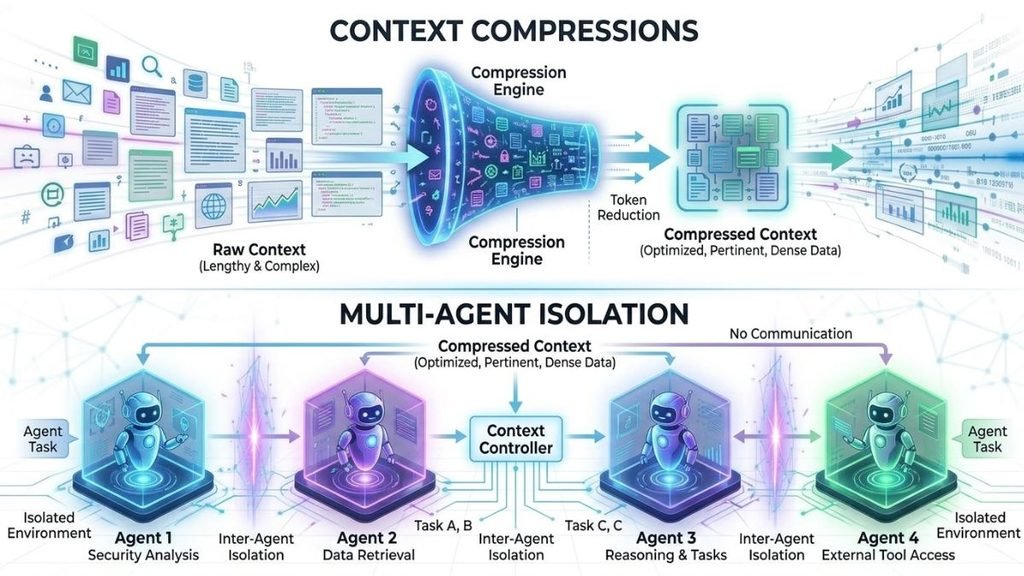
Context compression reduces this information while preserving the details needed for continued execution.
Summarization is one approach, but compression can also involve trimming redundant messages, removing unnecessary tool results, or moving information into external state.
Compaction for Long Tasks
When an agent approaches its context limit, compaction can summarize the accumulated trajectory and create a smaller representation containing important state.
The difficult part is deciding what to preserve. An overly aggressive summary may remove information that appears unimportant now but becomes critical several steps later.
Offloading Context to External Storage
Not everything needs to remain inside the active LLM context window.
Files, databases, scratchpads, application state, and other external stores can hold information that the agent can retrieve when required.
This approach allows an agent to maintain a smaller active context while still having access to large volumes of information.
Context Isolation and Multi-Agent Systems
Context isolation becomes particularly valuable in multi-agent architectures.
A research agent may need search results and source notes, while a coding agent may need source files and implementation state. Giving both agents the entire information history can increase unnecessary context.
Instead, each agent can maintain a focused context and return only the information required by another agent.
9. Common Context Engineering Failure Modes and How to Fix Them
Context Poisoning
Context poisoning happens when incorrect information becomes part of the information available to the agent.
The source might be a hallucinated intermediate result, an outdated memory, an unreliable document, or an incorrect tool response.
Important information should therefore be validated when possible, and the system should preserve enough source information to distinguish verified facts from temporary assumptions.
Context Distraction and Confusion
An agent may struggle when irrelevant information competes with important instructions or evidence.
Reducing unnecessary history, improving retrieval, filtering tool outputs, and exposing only relevant capabilities can reduce context distraction and context confusion.
Context Clash
Context clash occurs when different pieces of context provide contradictory information.
For example, an old memory may specify one requirement while the current user instruction changes it.
A production system should therefore establish precedence rules and preserve information about freshness and source so the model can distinguish current instructions from historical context.
Context Overload
A larger context window does not eliminate the need for context management.
Increasing context size does not automatically solve relevance and recall problems. Effective agents therefore need strategies for selecting, compressing, and isolating information even when the underlying model supports a large context window.
10. How to Build an Effective Context Engineering System in Production
A Practical Context Engineering Template
A useful context engineering template should answer several questions before an agent is deployed.
What information does the agent need for the task? Where does that information live? Which information belongs in instructions, memory, retrieval, tools, or external state? When should information enter the context? When should it be removed, summarized, or refreshed?
Starting with the desired outcome makes these decisions easier because context can be evaluated according to whether it actually helps the agent achieve the task.
Context Quality and Token Budgeting
A production system should measure context quality rather than simply tracking the number of tokens used.
Useful signals include retrieval relevance, context size, duplication, freshness, tool usage, latency, cost, and whether additional context actually improves agent performance.
Caching, Latency, and Cost
Context management also affects infrastructure.
Repeatedly retrieving or sending large amounts of information can increase inference cost and latency. Stable information may therefore benefit from caching, while frequently changing information should be retrieved when necessary.
The best strategy depends on an application’s requirements for freshness, speed, reliability, and cost.
Evaluating Context Quality
Context engineering should be evaluated as part of the overall agent system.
Developers can compare different context selection strategies, examine failure cases, test long-running interactions, and measure whether compression or retrieval changes agent behavior.
This connects context management with AI agent testing and observability. Our AI agent monitoring guide covers observing agent behavior in production.
Conclusion
Context engineering for AI agents is the discipline of managing the information environment in which an LLM operates.
Prompt engineering remains important, but capable agents also need systems for managing memory, message history, retrieval, tools, MCP, runtime state, context compression, and external information. The goal is not to maximize the amount of information inside the context window. It is to maintain the information that is most relevant to the agent’s current task.
As agents operate across longer time horizons and become more autonomous, context management becomes increasingly important. Whether the system relies on RAG, memory, MCP, tool retrieval, compaction, or multi-agent architectures, reliable performance depends on how effectively the application curates the information available to the model at each stage of its work.
The core principle is simple: provide the model with the right information, at the right time, in a form it can use effectively.
FAQs
Who are the big 4 AI agents?
There is no universally recognized “big 4” of AI agents; the term can vary depending on the context and companies being discussed.
What are the 5 components of an AI agent?
The five common components are perception, reasoning, memory, planning, and action, which work together to complete tasks.
How does Claude Code implement context engineering?
Claude Code manages context through tool use, file retrieval, memory, compaction, and selective context loading so relevant information remains available during long tasks.
What are the five layers of context engineering?
A practical five-layer model is instructions, memory, knowledge, tools, and runtime state, which together provide the context an agent needs.
What are the four pillars of context engineering?
A common framework describes four pillars as write, select, compress, and isolate—strategies for creating, retrieving, reducing, and separating context.